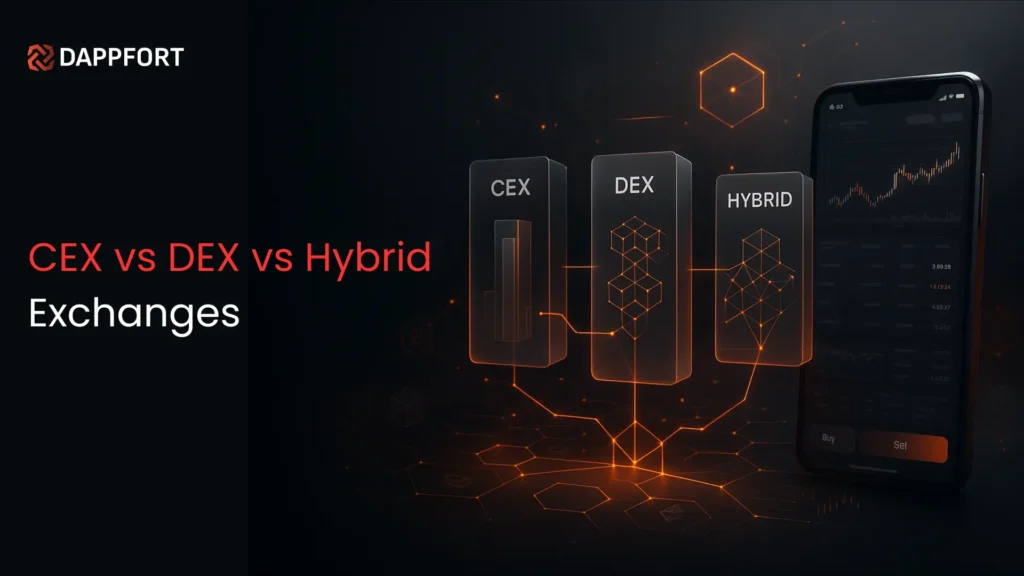
If you want to build a cryptocurrency exchange in 2026 as startup, the decision isn’t as simple as picking between centralized and decentralized anymore.
By 2026, the ecosystem has matured: new regulatory norms, advances in blockchain interoperability, hybrid architecture models and adaptive liquidity methods redefine what an “exchange” can be. For startup founders and blockchain entrepreneurs, choosing the right type of exchange—CEX, DEX, or Hybrid—is critical.
The decision influences everything: development complexity, security & compliance obligations, user adoption, liquidity, operational costs, and long-term scalability.
In this article, we dissect all three models: their architecture, strengths, weaknesses, and suitability. We also offer a lens through which startups can decide what to build, and explain how a modular, hybrid-first approach can give both flexibility and robustness.
CEX Architecture
What Is a CEX?
A Centralized Exchange (CEX) is a platform operated by a company that manages user accounts, custody, order books, trade matching, wallets, and liquidity. Businesses seeking centralized crypto exchange development company often choose this model to provide high-speed trading, deep liquidity, and seamless fiat integration for mainstream users.
Core Architectural Components of a CEX
- Order Matching Engine & Central Order Book — The heart of a CEX. Incoming buy/sell orders are queued, matched, and executed in milliseconds, ensuring high throughput and low latency.
- Custodial Wallet Infrastructure (Hot & Cold Storage) — User funds sit in wallets managed by the exchange. Active funds are kept in “hot” wallets for liquidity and withdrawals; the majority are secured in “cold” wallets for safety.
- User Account & Balance Management — Tracks user balances, deposits/withdrawals, transaction history, KYC/AML status, and permissions.
- Liquidity Management & Market Maker / Liquidity Partner Integration — To support deep liquidity and minimize slippage, exchanges often work with market makers or liquidity providers.
- Fiat On/Off‑Ramp & Payment Gateway Integration — Enables users to deposit or withdraw fiat currency (bank transfers, cards, payment rails) in addition to crypto — critical for mass adoption.
- Frontend / Backend Stack & APIs — Trading UI, charts, wallets, API access for algorithmic or institutional traders, admin dashboards, monitoring, risk‑management tools.
- Compliance & KYC/AML Infrastructure — Identity verification, sanction screening, transaction monitoring—necessary if handling fiat or operating in regulated jurisdictions.
Advantages of CEX Architecture
- Deep Liquidity & Large User Base — Because of high trading volumes and pooled order books, CEXs deliver tight spreads and rapid execution even under load.
- Fiat & Banking Integration — On‑ramps/off‑ramps for fiat make crypto accessible to mainstream users.
- Advanced Trading Features — Margin, derivatives, futures, lending, staking — possible only with centralized custody & fast order matching.
- Familiar UX & Customer Support — Easier for non‑crypto native users; companies can provide support, compliance, and recovery services.
Limitations & Challenges of CEX Architecture
- Custodial Risk & Single Point of Failure — Since funds are held centrally, hacks, internal fraud or mismanagement can compromise all user assets.
- Regulatory & Compliance Overheads — KYC/AML, licensing, audits, banking relationships — all increase cost and complexity.
- Trust Requirement from Users — Users must trust the exchange’s integrity, security, and transparency — less in line with decentralization ethos of crypto.
Bottom line: A CEX is best when you target high-volume trading, institutional clients, fiat integration, and advanced trading features. It demands strong security, compliance, and operational infrastructure — but offers maximum user reach and monetization potential.
DEX Architecture
What Is a DEX?
A Decentralized Exchange (DEX) is built on blockchain smart contracts, requiring no centralized custody. Users trade directly from their wallets; assets remain under user control until executed via on‑chain transactions. DEXs embrace the core principles of decentralization, privacy, permissionlessness and transparency.
Core Architectural Components of a DEX
- Smart-Contract‑based Trading Engine — Implements an Automated Market Maker (AMM) or on‑chain order book logic. Swap, liquidity provision, pool management all run via code.
- Liquidity Pools & LP Contracts — Users lock funds in liquidity pools and receive LP tokens, earning a share of trading fees. Enables permissionless liquidity without a centralized reserve.
- User Wallet Integration / Non‑Custodial Access — Users connect their wallet (e.g. MetaMask, hardware wallet) to trade — funds remain in their control, not on the exchange.
- On‑Chain Settlement & Transparency — Transactions are publicly recorded on blockchain, increasing auditability and trustlessness.
- Optional Cross‑Chain & Bridge/Router Infrastructure — For advanced DEXs offering multi-chain swaps, cross-chain liquidity routing, and interoperability.
- Governance / Community Modules — Many DEXs support DAO‑based governance, token-based fee distribution, and community-led decisions — aligning incentives transparently.
Advantages of DEX Architecture
- Non-Custodial, Self-Sovereign Asset Ownership — Users always control their private keys; no custody risk from a third-party exchange.
- Permissionless, Global & Privacy-friendly — Anyone with a supported wallet and internet can trade; often no KYC needed.
- Access to Emerging Tokens & DeFi Innovation Early — New tokens often get liquidity on DEXs before being listed on CEXs.
- Lower Operational Overhead for Builders — Without fiat rails, custody, or central infrastructure, overhead is lower — enabling leaner teams and faster deployment.
Limitations & Challenges of DEX Architecture
- Liquidity Constraints & Slippage — Without deep pooled liquidity or market‑maker support, trades (especially large ones) can suffer high slippage or poor execution.
- Limited Advanced Trading Features — Margin trading, derivatives, advanced order types — difficult to implement or risky under trustless custody.
- User Experience & Complexity — Requires users to manage wallets, gas fees, on‑chain transactions — which can be intimidating for non‑tech users.
- Smart-Contract Risk & Code Vulnerabilities — A bug or exploit can compromise user funds. Users also bear private‑key risk themselves.
Developing a decentralized exchange requires expertise in smart contracts, liquidity pool architecture, wallet integration, cross-chain interoperability, and security auditing. Businesses seeking professional decentralized exchange development company can accelerate their time-to-market while ensuring a secure, scalable, and feature-rich trading ecosystem.
Bottom line: DEX architecture is ideal for projects targeting DeFi‑native users, decentralized ownership, privacy, and global accessibility — but demands trade‑offs in liquidity depth, advanced trading features, and UX polish.
Hybrid Architecture — Combining CEX & DEX Strengths
What Is a Hybrid Exchange?
A Hybrid Exchange blends features of centralized and decentralized exchanges. As demand grows for platforms that combine performance with user-controlled asset security, hybrid cryptocurrency exchange development has become an increasingly popular approach among startups and established crypto businesses.
Core Architectural Components of Hybrid Architecture Works
- Central Matching Engine + Order Book — Ensures fast, high-throughput execution, like a CEX.
- On‑Chain Settlement or Smart‑Contract‑Backed Custody — After trade matching, settlement or custody is handled via blockchain smart contracts or non‑custodial wallets, preserving decentralization.
- Liquidity Aggregation from CEX‑style market makers and DEX‑style liquidity pools — Supports deep liquidity while minimizing slippage.
- Optional Compliance & Fiat On/Off‑Ramps — The exchange can support fiat operations in regulated jurisdictions while preserving crypto‑only, non-custodial trades for crypto-native users.
- Cross‑Chain & Bridge Integrations — Hybrid models often support multi-chain assets, on/off ramps, and cross-chain liquidity routing.
- Modular Infrastructure with Flexibility — Allows toggling between centralized and decentralized features based on region, user type, or regulatory environment.
Key Advantages of Hybrid Exchanges
- Balance of Performance & Security — Fast execution and deep liquidity from centralized order matching, combined with non-custodial or on-chain settlement security.
- Flexibility & Global Reach — Supports fiat users, crypto-native users, institutional clients — across geographies.
- Reduced Custody & Central Risk — Since custody is optional or decentralized, the risk of massive hacks or insolvency reduces significantly.
- Compliance + Decentralization — Possible — Can meet regulatory requirements where needed, and offer privacy-friendly or permissionless trading elsewhere.
- Adaptability to Market Evolution — As DeFi, regulation, or user demands evolve, hybrid platforms can pivot: centralized for derivatives, decentralized for DeFi pools, etc.
Challenges & Considerations of Hybrid Exchange:
- Complex Architecture — Building both central matching logic and on‑chain settlement/custody increases complexity, cost, and testing surface.
- Dual Risk Surface — Must secure both traditional infrastructure (servers, databases, wallets) and smart contracts — requiring audits, security ops, and maintenance.
- Regulatory Duality — Must navigate compliance for fiat/fiat‑crypto users while preserving permissionless crypto‑only parts — regulatory clarity may vary by jurisdiction.
- User Experience Complexity — Need to manage UI for different user types (fiat vs crypto, custodial vs non‑custodial).
Bottom line: Hybrid exchanges present a compelling, balanced architecture for 2026 — combining liquidity, speed, security, compliance, and flexibility. They are ideal for startups seeking to serve both institutional/retail fiat users and crypto-native DeFi communities.
Security & Compliance Comparison
Choosing which crypto exchange type to build isn’t just about features or architecture — security and regulatory compliance often decide viability and longevity.
Custody & Security Risk Comparison
- CEX: Centralized custody — funds stored in exchange wallets. Risk: hacks, internal fraud, mismanagement, single point of failure. Even with strong infrastructure, CEXs remain high-value targets.
- DEX: No custody — users hold their own keys; exchange never holds funds. Risk: smart‑contract vulnerabilities, user-key loss, rug-pulls, governance risks.
- Hybrid: Custody optional or via non‑custodial wallets/smart‑contracts. Risk surface spans both traditional infrastructure and smart‑contract security; mitigation depends on architecture, audits, and operations.
Compliance & Regulatory Exposure Comparison
- CEX: High regulatory burden: KYC/AML compliance, licensing, banking partnerships, user data storage, reporting. Essential if supporting fiat, institutional users.
- DEX: Often permissionless and pseudonymous. Regulatory exposure lower in many jurisdictions — but increasing regulatory scrutiny globally.
- Hybrid: Flexible compliance: enables KYC‑compliant fiat sections, while keeping crypto‑only sections permissionless. Offers balance between compliance and decentralization.
Liquidity & Market Risk Comparison
- CEX: High liquidity with deep order books and market‑maker support. Slippage low; good for large trades.
- DEX: Liquidity depends on pooled assets; slippage or price impact can be significant for large orders. New or niche tokens may lack liquidity.
- Hybrid: Liquidity best of both worlds — centralized matching for volume, plus access to DeFi liquidity pools — improving depth and flexibility.
Operational/Technical Risk Comparison
- CEX: Requires robust infrastructure, custody security, compliance operations, customer support — operational overhead is high.
- DEX: Smart-contract audit, gas‑fee volatility, blockchain congestion, limited fiat support — trade‑offs are primarily technical or user-experience-related.
- Hybrid: Both infrastructure maintenance and blockchain-based settlement — complexity is higher, but so is flexibility.
Which Should a Startup Build in 2026?
Decision Factors for Founders
Your choice should be guided by:
- Target Audience: Are you aiming at retail crypto users, institutional clients, or DeFi-native traders?
- Revenue Model & Monetization Strategy: Do you need fiat on‑ramps, institutional liquidity, derivatives? Or are you targeting token trading, DeFi liquidity, and protocol fees?
- Regulatory Environment & Compliance Appetite: Do you want to support fiat currencies, or stay crypto-only? Do you have capacity for KYC/AML, banking integrations?
- Security & Custody Philosophy: Do you want to custody funds centrally, or empower users with self-custody?
- Liquidity & Market Depth Requirements: Do you expect high-volume trades or long-tail token swaps?
- Speed to Launch & Operational Overhead: Do you need a lean, fast-to-launch protocol, or are you prepared for heavy infrastructure?
When to Build a CEX
- You target retail and institutional users who require fiat on/off ramps, high volume trading, deep liquidity, derivatives, margin/futures.
- You prioritize user experience, speed, and advanced trading features.
- You have the resources and appetite for backend, custody security, compliance, and operational overhead.
When to Build a DEX
- You aim for DeFi-native users, global crypto-only traders, or early-stage token projects.
- You value decentralization, self-custody, permissionless access, minimal compliance overhead.
- You want a lean, fast-to-launch platform with lower operational costs.
When to Build a Hybrid Exchange
- You want the best of both worlds: liquidity and performance of CEX + decentralization, self-custody, and DeFi liquidity.
- You anticipate multi-geography operations, fiat + crypto users, or need flexible compliance modules.
- You want a future-proof, modular platform capable of evolving as user preferences or regulations change.
How Dappfort Build the Right Crypto Exchange?
As a Dappfort cryptocurrency exchange development company, we believe the future of crypto infrastructure lies in flexible, modular, hybrid-first architectures while maintaining a clear understanding of the technical, operational, and regulatory trade-offs associated with each exchange model.
Modular & Configurable Exchange Architecture
We design exchange platforms with modular components: matching engine, custody module, settlement engine, compliance layer, cross‑chain bridge integration, and liquidity aggregator. This allows you to choose — or switch — between CEX, DEX, or Hybrid mode as your business grows or regulatory requirements change.
Robust Security & Compliance Stack
Whether you go CEX, DEX, or Hybrid — security and compliance are non-negotiable. We implement MPC wallets, cold-hot wallet segregation, smart-contract audits, AML/KYC engines (if needed), and infrastructure hardened for institutional-grade security.
Cross-Chain & Multi-Chain Support
2026 is a multi-chain world. Our architecture supports Ethereum, EVM chains, Layer‑2s, and integrates cross-chain bridges — enabling token variety, cross-chain swaps, and global liquidity.
Scalable & Maintainable Infrastructure
We build using microservices, containerization, and modular deployment — ensuring your platform scales horizontally as users grow, and adapts to new features (derivatives, lending, staking, etc.) without full rebuilds.
Advisory & Product Strategy Support
Beyond code — we help draft compliance policies, tokenomics strategies, liquidity sourcing plans, and roadmap. Our goal: help you pick the right exchange model before you launch to maximize success and minimize risk.
Conclusion
There isn’t a universally best exchange model. CEX, DEX, and Hybrid each thrive in 2026 because they serve different goals. The right choice depends on who you’re building for, where you’re operating, how you plan to handle liquidity, and how aggressively you want to scale under regulatory pressure.
- CEX: Best for fiat users, high-liquidity, institutional volume, and advanced features.
- DEX: Best for decentralized, permissionless access, crypto-native user base, and minimal overhead.
- Hybrid: Best for founders wanting flexibility — combining the strengths of both models while mitigating their weaknesses.
At Dappfort, we build modular, secure, scalable exchange platforms — giving startups and enterprises the flexibility to adopt any model now or switch later based on market response.
If you are considering building a crypto exchange — whether centralized, decentralized, or hybrid — we can help you with architecture design, compliance advisory, security hardening, liquidity strategy, and long-term scalability.
Build smart. Build secure. Build for the future.
Frequently Asked Questions (FAQ)
Which exchange model is safest — CEX or DEX?
It depends on what you value. A DEX avoids custodial risk because users hold their own keys — but introduces smart contract and user-key risk. A CEX centralizes custody and hence has a single point of failure, but with proper infrastructure, audits, and security controls, it can be hardened. Hybrid models attempt to combine best practices to mitigate both risks.
Can a hybrid exchange satisfy compliance and still offer decentralization?
Yes. Hybrid exchanges can implement optional KYC/AML for fiat users and still allow crypto‑to‑crypto trades via non-custodial wallets or on‑chain settlement. This dual-mode gives regulatory coverage where needed while preserving decentralization for crypto-native users.
Are DEXs viable for high-volume or institutional trading?
Not yet — DEXs typically lack deep liquidity and advanced order types (margin, derivatives). Slippage, gas fees, price impact and smart‑contract risk make them less suitable for large-volume or professional trading. CEX or Hybrid architectures remain better suited for that user segment.
What’s the major trade-off of running a CEX?
You get speed, liquidity, and fiat integration — but at the cost of custodial risk, compliance burden, and operational overhead (security, KYC/AML, banking relationships, audits, customer support).
For a startup with limited resources, which model should I start with?
If you target crypto-native users and want fast deployment with minimal compliance overhead — start with a DEX. If you expect fiat users or want long-term institutional growth, consider a hybrid-first design so you can scale toward a CEX model as you grow.
CEX, DEX, or Hybrid — Don’t Guess. Architect It Right
The right exchange model depends on your users, compliance needs, and launch timeline — not on what’s trending. Dappfort’s modular architecture lets you start with one model and evolve into another without rebuilding from scratch.
Related Readings:
- How Hybrid Cryptocurrency Exchanges Work?
- Benefits of Hybrid Crypto Exchange Development for Startups
- Hybrid Crypto Exchange Development Cost Breakdown in 2026
- Crypto Exchange Architecture: A Complete Guide for 2026
- Cryptocurrency Exchange Development: Complete Guide for Businesses (2026)