Launching a hybrid crypto exchange in 2026 typically costs between $40,000 and $250,000+, depending on architecture complexity, security layers, compliance scope, and liquidity integrations. Unlike pure CEX or DEX builds, hybrid platforms require parallel off-chain and on-chain systems, which directly impacts development effort and budget.
This guide breaks down what you’re actually paying for when working with a hybrid crypto exchange development company — from core infrastructure and trading engines to wallets, compliance workflows, and regional deployment costs across the US, UAE, and India—without inflated promises or vague estimates.
Understanding Hybrid Crypto Exchange
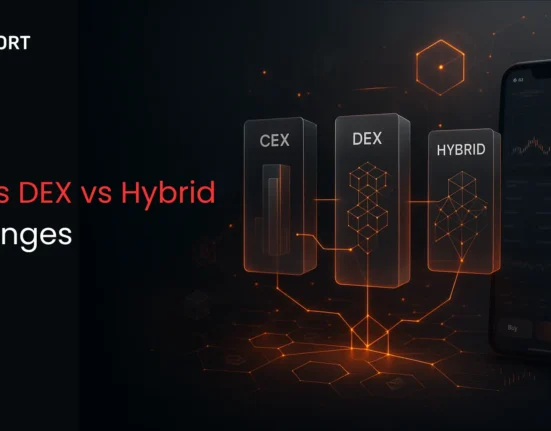
A hybrid crypto exchange combines the speed and liquidity of centralized exchanges (CEX) with the transparency and fund control of decentralized exchanges (DEX) in a single platform.
Core Characteristics of HEX:
- Centralized order matching engine (speed & liquidity)
- Decentralized or semi-custodial wallet architecture
- User control over funds
- On-chain settlement with off-chain performance
- Enterprise-grade security & compliance
Hybrid exchanges are designed to solve the biggest pain points of traditional exchanges: custody risks, hacks, regulatory pressure, and lack of transparency. These hybrid exchange advantages are a major reason why businesses are increasingly exploring hybrid trading architectures.
Realistic Cost Range to Build a Hybrid Crypto Exchange
Let’s start with a realistic cost range, based on current market benchmarks and development complexity.
💰 Hybrid Crypto Exchange Development Cost Overview
| Exchange Type | Estimated Cost Range | Best For |
| MVP Hybrid Exchange | $40,000 – $70,000 | Early-stage startups |
| Startup-Grade Platform | $80,000 – $150,000 | Funded startups |
| Enterprise-Grade Exchange | $180,000 – $350,000+ | Institutions, enterprises |
⚠️ These costs vary significantly based on features, security depth, region, and compliance requirements.
These costing figures already assume:
- Production-ready code (not demos)
- Security testing
- Real liquidity handling
- Admin & monitoring tools
Anything significantly cheaper usually omits wallet security, compliance readiness, or scalability, which becomes expensive later.
Factors That Influence Hybrid Crypto Exchange Development Cost
1. Trading Engine & Order Matching System
Unlike DEXs, hybrid exchanges depend on high-performance matching engines capable of handling thousands of orders per second. This is one of the highest-investment components because mistakes here affect market fairness and uptime.
Cost Impact: High
Why: Requires low-latency architecture, scalability, and fault tolerance.
Cost increases when:
- High Speed Order Matching Engine
- Latency requirements are strict
- Multiple trading pairs are required
- Futures or margin trading is planned
2. Wallet Architecture & Asset Custody (Custodial + Non-Custodial)
Hybrid exchanges typically use:
- Hot wallets for active liquidity
- Cold wallets for reserves
- MPC or multisig logic for withdrawals
Cost Impact: High
This layer demands cryptographic expertise, auditability, and operational safeguards.
Wallet systems alone can account for 20–30% of total development cost, depending on chain support.
3. Liquidity Integration
Liquidity does not magically appear.A hybrid exchange without liquidity fails regardless of UI quality.
Liquidity can be:
- Internal (user-driven)
- External (market makers, exchanges)
- Aggregated (multiple sources)
Costs rise when:
- External liquidity providers are integrated
- Market-making APIs are required
- Depth synchronization is needed across pairs
Cost Impact: Medium–High
Poor liquidity equals to platform failure. So be conscious.
4. Security Infrastructure
Security is not a module—it’s a process. It is engineering.
True hybrid exchanges invest in:
- Behavioral fraud detection
- Withdrawal anomaly systems
- Infrastructure hardening
- Penetration testing cycles
Skipping this stage lowers initial cost but multiplies long-term risk.
Includes:
- DDoS protection
- Rate limiting
- Anti-phishing
- Withdrawal monitoring
- AI-based fraud detection
Cost Impact: Very High
Security shortcuts lead to long-term losses.
5. Compliance & KYC/AML
Mandatory for regulated markets (US, UAE, EU). Especially relevant for US and UAE launches, compliance includes:
Includes:
- KYC workflows
- AML transaction screening
- Audit-ready logging
- Reporting exports
Cost Impact: Medium–High (region-dependent)
Compliance complexity directly correlates with geography.
Feature-Level Cost Breakdown
Hybrid Crypto Exchange Feature Cost Table
| Feature Module | Estimated Cost |
| UI/UX Design (Web + Admin) | $6,000 – $12,000 |
| Trading Engine & APIs | $18,000 – $40,000 |
| Wallet Integration (Multi-chain) | $12,000 – $30,000 |
| Liquidity Aggregation | $8,000 – $20,000 |
| Security Layer | $15,000 – $35,000 |
| KYC / AML Integration | $6,000 – $15,000 |
| Admin Dashboard | $5,000 – $10,000 |
| Testing & QA | $5,000 – $12,000 |
| Deployment & DevOps | $4,000 – $10,000 |
These numbers reflect production-grade platforms, not MVP demos. Businesses evaluating professional hybrid exchange development services should ensure that security, liquidity, and compliance requirements are included within the quoted scope.
White-Label vs Custom Hybrid Exchange: Cost Comparison
Development Model Comparison
| Aspect | White-Label | Custom Development |
| Cost | Lower upfront | Higher upfront |
| Time to Launch | 30–45 days | 3–6 months |
| Customization | Limited | Unlimited |
| Scalability | Moderate | High |
| Ownership | Partial | Full IP ownership |
Cost Difference:
- White-label hybrid exchange: $40,000 – $90,000
- Custom hybrid exchange: $120,000 – $350,000+
Most successful platforms start white-label, then evolve into custom builds after validation.
Best practice for new ventures: Start with white-label, migrate to custom after traction.
GEO-Specific Cost Breakdown (USA, UAE, India)
Cost to Build a Hybrid Crypto Exchange in the USA
| Factor | Cost Impact |
| Developer rates | Very high |
| Compliance | Strict |
| Hosting & audits | Expensive |
Estimated Cost:
$180,000 – $350,000+
Best for:
- Institutional exchanges
- Regulated markets
- Venture-backed startups
Cost to Build a Hybrid Crypto Exchange in UAE
| Factor | Cost Impact |
| Developer cost | Medium |
| Regulation | Pro-crypto |
| Market maturity | High |
Estimated Cost:
👉 $120,000 – $220,000
Ideal for:
- MENA region launches
- Crypto-friendly jurisdictions
- Global exchanges
Cost to Build a Hybrid Crypto Exchange in India
| Factor | Cost Impact |
| Developer cost | Low–Medium |
| Technical talent | High |
| Compliance | Moderate |
Estimated Cost:
$60,000 – $140,000
Best for:
- Startups
- MVPs
- Global-first platforms
Hidden Costs Most Founders Ignore
Many exchanges fail not because of development—but because of ignored operational costs.
Common Hidden Expenses:
- Cloud hosting (AWS, GCP)
- Ongoing security audits
- Compliance renewals
- 24/7 monitoring & support
- Legal & licensing fees
- Feature upgrades post-launch
📌 Rule of thumb:
Reserve 20–30% of your initial budget for post-launch operations.
How Long Does It Take to Build a Hybrid Crypto Exchange?
| Phase | Duration |
| Planning & Architecture | 2–3 weeks |
| UI/UX Design | 2–4 weeks |
| Core Development | 8–12 weeks |
| Security & Compliance | 3–4 weeks |
| Testing & Launch | 2–3 weeks |
Total Time:
👉 3–5 months, depending on scope.
Shorter timelines usually mean:
- White-label builds
- Reduced customization
- Limited trading features
How to Reduce Hybrid Crypto Exchange Development Cost (Smartly)
You should reduce cost without reducing quality.
Reducing Costs Without Compromising Quality
- Start with MVP features only
- Use modular architecture
- Choose multi-chain wallets instead of custom per chain
- Outsource development to crypto-experienced teams
- Avoid unnecessary UI animations early
Cutting cost is about strategic scope control, not shortcuts.
Why Choose Dappfort for Hybrid Crypto Exchange Development?
As a specialized cryptocurrency exchange development company, Dappfort provides enterprise-grade exchange solutions with expertise in:
- Hybrid trading architecture
- Secure wallet frameworks
- Liquidity integration
- Global compliance readiness
- GEO-specific deployment strategies
Whether you’re launching in the US, UAE, or India, our solutions are designed to scale securely and compliantly.
👉 Get a personalized cost estimate based on your region & features.
Final Thoughts
Building a hybrid crypto exchange is not about launching fast—it’s about launching correctly. The real cost lies not in development, but in future-proofing decisions made early.
If your goal is to build a serious trading platform, understanding cost at this depth is not optional—it’s your competitive advantage.
Reach us today for launching hybrid crypto exchange
FAQs – Cost to Build a Hybrid Crypto Exchange
How much does it cost to build a hybrid crypto exchange?
Costs range from $40,000 to $350,000+, depending on features and region.
Is white-label hybrid exchange cheaper?
Yes, but with limited flexibility and scalability.
Which country is best to build a hybrid exchange?
India offers the best cost-efficiency, while UAE provides regulatory flexibility.
Can I launch a hybrid exchange in under 90 days?
Yes, with a white-label or MVP-first approach.