Table of Contents
Crypto exchanges have matured, but the problems haven’t disappeared. Centralized exchanges offer speed and liquidity, yet expose users to custody risks. Decentralized exchanges promise transparency and control but struggle with performance and user adoption.
Hybrid cryptocurrency exchanges emerged to solve this exact problem.
This article explains how hybrid cryptocurrency exchanges work, breaks down their architecture step by step, and shows why this model is becoming the preferred choice for businesses, institutions, and serious traders. The explanation is technical enough for decision-makers, yet simple enough for everyday users.
What Is a Hybrid Cryptocurrency Exchange and Why Does It Exist?
Hybrid cryptocurrency exchanges exist because neither centralized nor decentralized models alone fully meet modern trading expectations. Users want speed, liquidity, and convenience—but they also want control, transparency, and reduced counterparty risk.
A hybrid cryptocurrency exchange combines centralized systems for performance with decentralized infrastructure for settlement and custody. Orders are handled off-chain for efficiency, while assets remain protected through on-chain smart contracts and user-controlled wallets.
In practical terms, hybrid exchanges aim to remove the weakest points of traditional exchanges without compromising usability.
Why Are Hybrid Cryptocurrency Exchanges Gaining Global Adoption?
Hybrid exchanges are gaining traction because they directly address the most painful issues in crypto trading—trust failures, regulatory pressure, and scalability limitations. As the market matures, users and institutions are no longer willing to compromise security for convenience.
These evolving expectations are also reflected in modern centralized vs decentralized exchange comparisons, where hybrid models are increasingly seen as the middle ground.
Unlike experimental models, hybrid exchanges are built with real-world trading behavior, compliance needs, and risk management in mind. This makes them particularly attractive to enterprises planning long-term operations.
Key reasons driving hybrid exchange adoption
- Reduced custodial risk
Hybrid exchanges let users control their own private keys instead of storing funds centrally. This greatly lowers the chances of large-scale losses from hacks, internal misuse, or exchange failures. - Institutional-grade performance
Off-chain order matching allows hybrid exchanges to process high trading volumes with low latency. This supports advanced order types and fast execution expected by professional and institutional traders. - Improved regulatory flexibility
By separating compliance from fund custody, hybrid exchanges can implement KYC and AML requirements without centralizing assets, making it easier to adapt to regional regulations. - Higher user trust
On-chain settlement and non-custodial wallets create transparency. Users trade with confidence, knowing the platform cannot freeze, mismanage, or access their funds.
Centralized vs Decentralized vs Hybrid Cryptocurrency Exchanges Explained
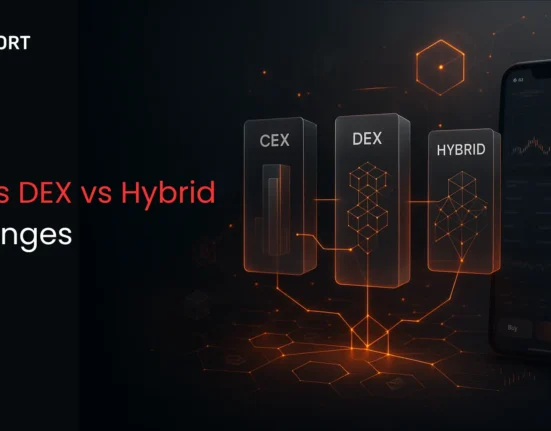
When comparing CEX vs DEX vs Hybrid, the real decision comes down to how much control, performance, and risk you’re willing to balance. Each exchange model solves a different problem.
Centralized exchanges deliver high speed and liquidity but rely on user trust. Decentralized exchanges remove intermediaries and improve transparency, yet often sacrifice efficiency. Hybrid exchanges combine both approaches, offering strong performance without giving up user control.
How Hybrid Cryptocurrency Exchanges Work ? (Architecture Explained)
Understanding how a hybrid crypto exchange works becomes simple when you follow the lifecycle of a trade—from registration to settlement. Each step is designed to separate performance-critical operations from security-critical ones.
User Authentication & KYC Layer
Hybrid exchanges typically start with a centralized onboarding process. Users create accounts, complete KYC and AML verification, and receive permissions based on jurisdiction and compliance rules.
This layer ensures the platform can operate legally while preventing illicit activity. Importantly, identity verification does not require the exchange to take custody of user funds, preserving decentralization where it matters most.
Order Placement Through Off-Chain Systems
When a trader places a buy or sell order, it is submitted to an off-chain trading engine rather than directly to the blockchain. This approach allows high-speed trading without blockchain congestion, high gas fees, and slow confirmation times that plague fully on-chain systems.
Orders are cryptographically signed by users, ensuring authenticity. Funds remain untouched until a matching order is found, protecting users from unnecessary exposure.
Order Matching Engine and Liquidity Management
The order matching engine is the performance core of a hybrid exchange. It manages order books, executes trades, and determines fair market pricing in real time.
Because this engine operates off-chain, it can support high-frequency trading, market-making strategies, advanced order types and institutional liquidity—something most decentralized exchanges cannot efficiently achieve.
On-Chain Trade Settlement Using Smart Contracts
Once a trade is matched, settlement occurs on-chain through audited smart contracts. Funds move directly between user wallets without passing through centralized custody.
This ensures transparency, immutability, and verifiable execution while significantly reducing counterparty risk. Settlement logic is visible on the blockchain, strengthening trust in the system.
Hybrid Cryptocurrency Exchange Architecture Explained for Businesses
Hybrid exchange architecture is intentionally modular. Each layer serves a specific purpose, allowing businesses to scale, secure, and customize the platform based on operational needs. Many enterprises now explore hybrid crypto exchange development to implement this architecture efficiently.
Core Architectural Components of a Hybrid Exchange
- Frontend user interface : The frontend provides real-time trading views, price charts, order forms, and account dashboards for web and mobile. It is designed to feel as intuitive as a centralized exchange while masking the underlying complexity of decentralized settlement.
- Backend trading and risk engine : This layer handles off-chain order matching and validation, trade execution logic, liquidity aggregation, and risk controls. Its centralized nature ensures performance, while strict permissioning prevents abuse or manipulation. These systems are often implemented using Dappfort crypto trading platform solutions that focus on scalability, security, and modular exchange design.
- Blockchain and smart contract layer : Smart contracts verifies trade settlement, wallet interaction, and asset transfers. This layer enforces trustless execution, ensuring that trades are completed exactly as programmed without reliance on intermediaries.
- Wallet and custody infrastructure : Hybrid exchanges often integrate non-custodial or semi-custodial wallets. Multi-signature protection, withdrawal limits, and cold storage mechanisms add additional layers of security without compromising usability.
Custodial vs Non-Custodial Wallet Architecture in Hybrid Exchanges
Hybrid exchanges may offer flexible custody models.
- Fully non-custodial wallets maximize security and user control, while semi-custodial setups can improve onboarding speed and recovery options.
- This adaptability allows businesses to balance compliance requirements with user expectations, especially when targeting institutional or enterprise clients.
Security Architecture and Risk Mitigation
- Security in hybrid exchanges is multi-layered. Smart contracts undergo rigorous audits, backend systems are protected against DDoS attacks, and private keys are secured using encrypted key management systems.
- Role-based access control and continuous monitoring further reduce internal and external threats, making hybrid platforms significantly safer than traditional centralized exchanges.
Benefits of Hybrid Cryptocurrency Exchanges for Users and Operators
The benefits of hybrid crypto exchange development come from fixing the core weaknesses of both centralized and decentralized platforms. Hybrid exchanges improve speed, security, and user control without forcing trade-offs.
For users, this means faster execution with full custody of assets. For operators, it means better liquidity, regulatory flexibility, and scalable performance. These advantages are why hybrid exchanges are widely viewed as the next evolution of crypto trading platforms.
Challenges and Limitations of Hybrid Cryptocurrency Exchanges
Despite their advantages, hybrid exchanges introduce architectural and operational complexity. A successful hybrid exchange requires strong technical planning and experienced development partners.
Complex development architecture
Building a hybrid exchange requires expertise in both centralized systems and decentralized blockchain development, increasing planning and execution demands.
Higher initial development costs
Security audits, compliance integration, and scalable infrastructure require upfront investment, though they often reduce long-term operational risk.
Smart contract vulnerabilities if poorly audited
Poorly designed or unaudited smart contracts can expose vulnerabilities. Continuous audits and updates are essential for maintaining platform integrity.
Regulatory differences across jurisdictions
Operating across multiple jurisdictions requires constant legal adaptation, particularly as crypto regulations continue to evolve globally.
Real-World Use Cases of Hybrid Cryptocurrency Exchanges
Hybrid exchanges are especially effective in scenarios requiring both trust and performance.
- They are widely used for institutional trading platforms, enterprise-grade token exchanges, security token marketplaces, and cross-border settlement systems. These use cases demand compliance, transparency, and scalability—areas where hybrid exchanges excel.
How to Build a Hybrid Cryptocurrency Exchange Platform?
Building a hybrid exchange is a strategic initiative, not just a technical project. It requires careful architectural planning, regulatory foresight, and security-first development.
Key steps in hybrid exchange development
- Selecting suitable blockchain networks based on scalability and fees (Ethereum, Layer 2s or Alternatives)
- Designing modular exchange architecture
- Developing a high-performance order matching engine
- Implementing secure wallet and custody solutions
- Deploy and Audit smart contracts and infrastructure
- Integrating compliance, security layers and monitoring.
Many businesses partner with a hybrid cryptocurrency exchange development company to accelerate deployment and reduce technical risk.
Final Thoughts: Why Hybrid Exchanges Represent the Future?
Hybrid cryptocurrency exchanges are not a compromise—they are an evolution. By combining speed, liquidity, compliance, and security into a single architecture, they solve the fundamental weaknesses of earlier exchange models.
For businesses aiming to build trusted, scalable, and future-ready crypto platforms, hybrid exchanges offer a clear competitive advantage.
Frequently Asked Questions About Hybrid Cryptocurrency Exchanges
How does a hybrid cryptocurrency exchange differ from a decentralized exchange?
Hybrid exchanges use off-chain order matching for speed and on-chain settlement for security, while DEXs perform all operations on-chain, often limiting scalability.
Are hybrid exchanges truly non-custodial?
Most hybrid exchanges offer non-custodial or semi-custodial models, allowing users to control assets while benefiting from centralized performance.
Is hybrid exchange development more expensive than building a DEX?
Initial costs are higher, but hybrid exchanges often save money long-term by reducing security incidents and improving operational stability.
Which blockchain networks are best for hybrid exchanges?
Ethereum, Layer 2 networks, and high-throughput chains are commonly used, depending on performance and fee requirements.
Can hybrid exchanges support margin or derivatives trading?
Yes. With proper risk engines, compliance controls, and liquidity management, hybrid exchanges can support advanced financial instruments.