Starting a crypto exchange today isn’t easy.
Startups often have to choose between speed and safety.
Centralized exchanges are fast and easy to use, but users must trust the platform with their money. When an exchange gets hacked or pauses withdrawals, that trust is lost. Decentralized exchanges give users more control, but they can feel slow, confusing, and hard to use.
Hybrid crypto exchanges bring the best of both.
They allow trades to happen quickly, like on centralized platforms, while letting users keep control of their assets, like on decentralized ones. For example, a trader can place an order instantly without handing over full control of their funds.
For startups, this approach makes it easier to build trust, grow users, and prepare for future regulations. Here are the benefits to understand before choosing the hybrid crypto exchange as your business plan for upcoming years.
Understand about Hybrid Crypto Exchange Development
A hybrid crypto exchange is a trading platform that combines:
- Centralized order matching and liquidity management
- Decentralized asset custody and on-chain settlement
In simple terms, users trade with the speed and convenience of a centralized exchange while retaining greater control over their assets, similar to a decentralized exchange.
How Hybrid Cryptocurrency Exchanges Development Work?
- Users connect wallets or create accounts
- Orders are matched off-chain using high-performance engines
- Trades are settled on-chain through smart contracts
- Funds remain under user control or limited escrow
This architecture reduces risk without sacrificing usability.
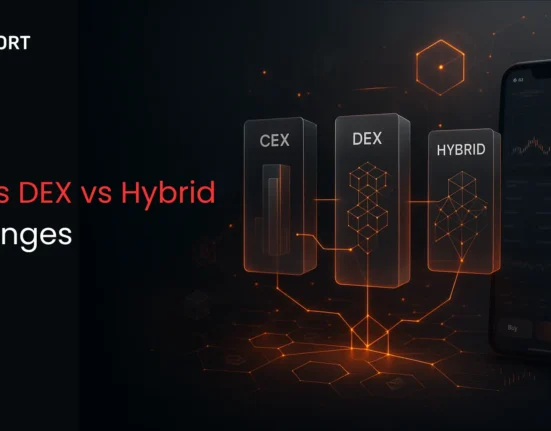
Hybrid Crypto Exchange Development vs Centralized vs Decentralized
| Aspect | Centralized Exchange | Decentralized Exchange | Hybrid Crypto Exchange |
| Trade Speed | High | Low–Medium | High |
| Asset Custody | Platform | User | User-controlled |
| Liquidity | High | Low | High |
| Transparency | Limited | High | High |
| Regulatory Flexibility | High | Low | Medium–High |
| User Experience | Excellent | Complex | Excellent |
This balance explains why hybrid exchange development is gaining strong momentum, as more businesses adopt the hybrid exchange model to combine the advantages of centralized and decentralized trading environments.
Major Benefits of Hybrid Crypto Exchange Development
The primary benefits of hybrid exchange development include fast trade execution, non-custodial asset security, improved liquidity, regulatory flexibility, and a superior user experience. Hybrid exchanges combine the strengths of centralized and decentralized platforms, making them ideal for scalable and future-ready crypto trading.
- Centralized Speed with Decentralized Security
- Security Without Compromising User Experience
- Greater User Trust and Transparency
- Higher Liquidity Than Pure DEX Platforms
- Follows Regulatory Compliance While Preserving User Control
- Superior User Experience for All Skill Levels
- Pull-Based Infrastructure and Resource Management
- Operational and Custodial Risk for Businesses
Combines Centralized Speed with Decentralized Security
Hybrid exchange development delivers the performance users expect from centralized platforms while reducing custodial risks through decentralized asset management.
Trades are executed instantly using centralized matching engines, but assets are settled on-chain or held in non-custodial wallets.
For example, a trader places an order that executes in milliseconds, while the final settlement occurs securely via smart contracts.
This architecture offers speed without sacrificing security, making it ideal for high-volume trading environments.
Enhances Security Without Compromising User Experience
One of the strongest benefits of hybrid exchange development is its ability to reduce large-scale security risks. Since the platform does not fully custody user assets, the impact of potential breaches is significantly minimized.
For example, even if a system component is compromised, user funds remain protected in decentralized wallets.
This security model increases user confidence while preserving the smooth, intuitive experience of centralized platforms.
Builds Greater User Trust and Transparency
Hybrid exchanges record trade settlements on the blockchain, making transactions verifiable and tamper-proof. This transparency is a major trust-building factor for modern crypto users.
For example, users can independently verify settlements on-chain while still using professional dashboards and trading tools.
This combination of transparency and usability encourages long-term engagement and platform loyalty.
Provides Higher Liquidity Than Pure DEX Platforms
Liquidity remains a challenge for many decentralized exchanges. Hybrid exchange development addresses this by aggregating liquidity through centralized order books and professional market makers.
For example, liquidity providers can operate efficiently within a hybrid model, ensuring tighter spreads and reduced slippage.
Improved liquidity leads to better price discovery, higher trading volumes, and increased platform revenue.
Supports Regulatory Compliance While Preserving User Control
Hybrid exchanges offer flexibility in regulatory implementation. Platforms can integrate KYC and AML where required without fully centralizing custody.
For example, identity verification can be applied at the account level, while assets remain user-controlled.
This adaptability makes hybrid exchange development suitable for businesses operating across multiple jurisdictions.
Delivers a Superior User Experience for All Skill Levels
Hybrid exchanges offer beginner-friendly interfaces alongside advanced trading tools for professionals.
For example, new users can place simple spot trades, while experienced traders access advanced order types, analytics, and APIs.
This inclusivity broadens the user base and improves adoption across market segments.
Facilitates Pull-Based Infrastructure and Resource Management
Hybrid exchange development supports a pull-based operational model, where resources scale based on real demand rather than forecasts.
For example, blockchain settlement capacity, server infrastructure, and liquidity provisioning increase only when trading volume grows.
This demand-driven approach reduces waste, optimizes costs, and ensures sustainable scalability.
Reduces Operational and Custodial Risk for Businesses
By avoiding full custody of user funds, hybrid exchanges significantly lower legal and operational exposure.
For example, compliance and insurance requirements are simplified compared to fully centralized exchanges.
This reduced risk profile makes hybrid exchange development attractive for long-term, enterprise-grade businesses.
Benefits of Developing Hybrid Crypto Exchange for Startups
Faster Time-to-Market for Startups
Hybrid crypto exchange development allows startups to launch competitively without committing entirely to centralized or decentralized models.
For example, a startup may initially deploy centralized trading with decentralized settlement and expand features incrementally. This phased approach accelerates launch timelines while maintaining architectural flexibility.
Multiple and Sustainable Revenue Streams
Hybrid exchanges can monetize through: Trading fees, Liquidity services, Premium tools, Institutional APIs, Token listings. This diversified revenue model reduces reliance on a single income source.
Global Market Reach and Scalability
Hybrid exchanges support cross-border trading, Web3 wallets, and multi-currency access. For businesses, this enables rapid international expansion without proportional increases in operational costs.
Role of AI and LLMs in Hybrid Exchange Development
AI and Large Language Models (LLMs) further strengthen hybrid exchange platforms.
AI-Driven Risk Monitoring
- Behavioral analysis
- Anomaly detection
- Real-time alerts
Automated Compliance and Reporting
- AI-assisted KYC reviews
- Transaction monitoring
- Regulatory reporting
LLM-Powered Customer Support
- 24/7 multilingual assistance
- Faster issue resolution
- Reduced support overhead
These technologies improve efficiency while enhancing user trust.
Technology Stack to Develop Hybrid Crypto Exchange:
Front End : React.js / Next.js
Back End: Node.js / Python / Go, REST & GraphQL APIs
Blockchain Layer: Ethereum, BNB Chain, Polygon
Database Layer: PostgreSQL / MySQL, MongoDB, Redis (caching)
Security Layer: SSL/TLS, DDoS protection
Compliance Layer: KYC & AML integration
Infrastructure & DevOps: AWS / Google Cloud / Azure, Docker & Kubernetes, CI/CD pipelines
This modular design supports long-term innovation and reflects the architecture commonly used in professional Dappfort crypto exchange development services for building secure and scalable trading platforms.
Future of Hybrid Crypto Exchange Development Service Goes Beyond
The future points toward:
- AI-native hybrid exchanges
- DeFi integrations within compliant frameworks
- DAO-assisted governance models
- Tokenized real-world assets
Hybrid exchanges are positioned to become the standard trading infrastructure in the next phase of crypto adoption.
Hire Skilled Hybrid Crypto Exchange Development Company for your startup success:
If your goal is to build a hybrid crypto exchange that can scale globally, adapt to regulation, and earn long-term user trust, hybrid exchange development is no longer optional—it is strategic. Choose Dappfort hybrid crypto exchange development company with proven expertise in security, performance, and compliance, so your platform is built for longevity rather than shortcuts.
Conclusion: Why Hybrid Exchange Development Is a Strategic Imperative?
The benefits of hybrid exchange development reflect a clear industry shift toward balance—speed without custody risk, transparency without complexity, and compliance without over-centralization.
For founders, enterprises, and investors seeking a future-ready crypto trading platform, hybrid exchanges offer the most resilient and scalable path forward.
Reach us for your hybrid crypto exchange business idea
FAQ
What are the benefits of hybrid crypto exchange development?
Hybrid crypto exchanges offer speed, security, liquidity, transparency, and regulatory flexibility.
Are hybrid crypto exchanges safer than centralized exchanges?
Yes. Reduced custodial exposure significantly lowers security risks.
Can startups build hybrid crypto exchanges profitably?
Yes. Hybrid models balance scalability, cost efficiency, and multiple revenue streams.
Do hybrid crypto exchanges require KYC?
It depends on jurisdiction and business strategy.