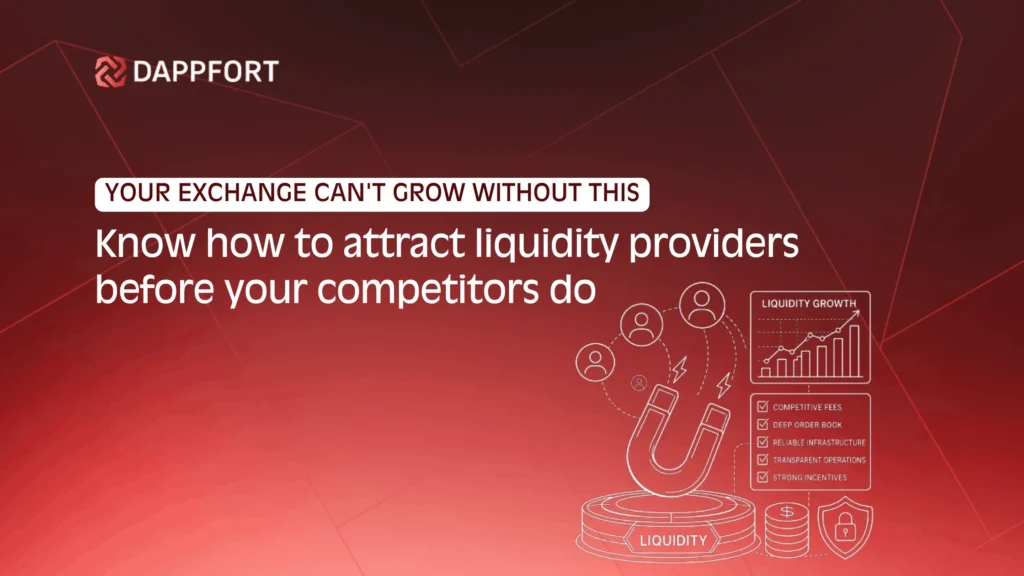
Launching an Exchange Is Easy. Launching One With Liquidity Is Not.
We launched last month, but nobody is trading. This is one of the most common problems founders run into after building a cryptocurrency exchange.
The platform might look polished. The wallets work fine. Trading pairs are all listed. Users can sign up and deposit funds without any trouble. But the moment traders open the order book, they find wide spreads, thin depth, and slow execution. Many leave within minutes.
The problem isn’t usually the interface. It’s liquidity. A crypto exchange without liquidity is like a marketplace without buyers and sellers. Even strong marketing campaigns struggle when traders cannot execute orders at competitive prices.
The good news is that liquidity is not random. Successful exchanges plan for it before launch through market makers, liquidity providers, API infrastructure, incentives, and trading operations.
In this guide, we’ll explain how new exchanges attract liquidity providers, what professional trading firms look for, and how founders can launch with a healthier order book from day one.
Why Does Liquidity Matters More Than Most Founders Expect?
A feature-rich exchange won’t succeed if traders can’t execute orders smoothly. Liquidity is what keeps trading fast, efficient, and trustworthy.
Founders often focus on features:
- Mobile app
- Referral system
- Staking
- Launchpad
- Futures
- Copy trading
Professional traders focus on something simpler:
Can I enter and exit positions efficiently?
Liquidity directly affects:
| Metric | Impact |
| Bid-ask spread | Tighter spreads attract traders |
| Order execution | Faster fills improve experience |
| Slippage | Lower slippage increases trust |
| Market depth | Larger orders become possible |
| Institutional interest | Professional desks require liquidity |
A technically sound exchange can still fail if traders consistently see poor execution.
Who Are Liquidity Providers?
Liquidity providers are firms or traders that continuously place buy and sell orders on the order book.
Common categories include:
- Professional market makers – specialized firms quoting hundreds of pairs
- High-frequency trading firms – algorithmic traders providing tight spreads
- OTC desks – institutional trading operations
- Liquidity networks – aggregated pools connected through APIs
- Internal market-making operations – exchange-managed liquidity during early growth
These participants are not doing founders a favor. They are running businesses. To attract them, your exchange must offer infrastructure, incentives, and operational reliability.
What Liquidity Providers Evaluate Before Connecting?
Liquidity providers don’t just look at your trading volume—they assess whether your exchange is technically reliable, secure, and ready for long-term market making.
Before a market maker quotes your order book, they typically evaluate:
Matching engine performance : Latency and throughput under load
API reliability : Stable WebSocket and REST connectivity
Uptime history : Consistent infrastructure and monitoring
Withdrawal operations : Fast, predictable fund movement
Compliance controls : KYC/AML processes and risk monitoring
Fee structure : Maker rebates and competitive trading costs
Liquidity strategy : Whether other liquidity sources already exist
A common mistake is contacting market makers before the exchange infrastructure is production-ready. Serious liquidity providers quickly detect unstable APIs and operational weaknesses.
Strategy 1: Launch With Liquidity Aggregation
The fastest way to avoid an empty order book is to aggregate external liquidity before launch.
Instead of waiting for organic trading activity, the exchange connects to:
- Centralized exchange liquidity pools
- Market maker APIs
- Institutional liquidity networks
- Cross-exchange routing systems
This allows traders to see tighter spreads and deeper books from the first day. Founder Insight.
Exchanges that launch with visible depth generally convert users better than exchanges that launch with empty books and hope liquidity arrives later.
At Dappfort, liquidity planning is typically discussed during architecture, not after deployment, because API design and order-routing decisions affect how easily liquidity providers can integrate.
Strategy 2: Offer Maker Incentives
Liquidity providers earn money from spreads and incentives. New exchanges often need to make participation attractive during the early stages.
Common Incentives
| Incentive | Purpose |
| Maker fee rebates | Encourage order book quoting |
| Volume-based discounts | Reward active trading firms |
| Liquidity mining | Bootstrap market depth |
| Listing partnerships | Coordinate liquidity for new assets |
| VIP tiers | Retain professional traders |
The key is striking a balance between incentives and long-term economics. Too many rewards can create artificial volume that just disappears the moment the incentives stop.
Strategy 3: Build APIs That Trading Firms Actually Want
Retail users interact with the UI. Liquidity providers interact with APIs.
A professional trading firm may never use your web interface. They connect through automated systems and evaluate your exchange based on API quality.
Minimum Requirements
- Low-latency WebSocket feeds
- Reliable REST endpoints
- Order management APIs
- Private account streams
- Rate-limit documentation
- Sandbox environment
- Clear error handling
- FIX support for institutional connectivity
Founders are often surprised by how much API quality influences liquidity acquisition. A market maker can tolerate a simple interface; they rarely tolerate unreliable market data.
Strategy 4: Reduce Operational Friction
Fast trading alone isn’t enough to attract liquidity providers. Smooth deposits, withdrawals, and reliable operations are just as important for creating a seamless trading experience.
They evaluate:
- Deposit confirmation times
- Withdrawal processing
- Wallet availability
- Account verification speed
- Support responsiveness
An exchange with fast matching but slow withdrawals still loses professional traders. This is why operational workflows should be designed alongside trading infrastructure. Liquidity providers care about the entire trading lifecycle, not only order execution.
Strategy 5: Start With Fewer, Stronger Trading Pairs
Launching with too many trading pairs can dilute liquidity and create inactive markets. Focusing on a smaller set of high-demand pairs helps build deeper order books and a better trading experience.
A better approach is:
Focus on 5–15 high-demand pairs
Example:
- BTC/USDT
- ETH/USDT
- SOL/USDT
- BNB/USDT
- A limited number of strategic listings
Concentrated liquidity creates tighter spreads and a better user experience than fragmented liquidity across dozens of inactive markets.
Not Sure Which Liquidity Strategy Fits Your Exchange?
Every exchange’s liquidity mix looks different depending on trading volume, target pairs, and regulatory footprint. Talk to Dappfort’s team to map out which combination of aggregation, incentives, and internal market making makes sense for your launch.
Strategy 6: Use Internal Market Making Carefully
In the early stages of an exchange, internal market making can help create a smoother trading experience. When managed responsibly, it improves market quality while supporting healthy liquidity growth.
This can help:
- Maintain visible depth
- Reduce extreme spreads
- Support newly listed assets
- Create a healthier initial market
However, internal market making should be transparent, risk-controlled, and compliant with applicable regulations. The goal is to support market quality not create misleading trading activity.
What Professional Market Makers Ask First?
Before committing liquidity to your exchange, market makers want proof that your platform is technically stable, operationally reliable, and built for real trading activity.
When approaching liquidity firms, expect questions such as:
- What is your matching engine latency?
- How many orders per second can the engine handle?
- Which API protocols do you support?
- How do you handle withdrawals?
- What are your maker and taker fees?
- What compliance controls do you have in place?
- Which trading pairs get priority?
- What launch volume are you expecting?
Founders who have solid answers to these questions have a much easier time landing liquidity partnerships.
Common Mistakes That Drive Liquidity Providers Away
Even a well-designed exchange can struggle to attract liquidity if it lacks stability and operational readiness. These common mistakes often discourage professional liquidity partners.
| Mistake | Result |
| Launching with empty order books | Poor first impression |
| Unstable WebSocket feeds | Market makers disconnect |
| Slow withdrawals | Capital moves elsewhere |
| Excessive listing fees | Fewer quality projects |
| No sandbox environment | Harder API testing |
| Weak monitoring | Latency spikes during volatility |
| Overpromising volume | Damaged credibility |
Liquidity providers value predictability more than marketing claims.
A Practical Launch Sequence
A successful exchange launch isn’t just about going live—it’s about building each layer in the right order. Following a structured rollout helps ensure stability, liquidity, and a better trading experience from day one.
For founders building a new exchange, a practical sequence looks like this:
Architecture & Matching Engine
Define throughput, latency, and scalability targets.
Wallet & Security Layer
Implement custody, permissions, and monitoring.
Liquidity Integration
Connect market makers and external liquidity sources before launch.
API Testing
Provide sandbox access and validate trading connectivity.
Soft Launch
Monitor latency, spreads, and operational workflows.
Public Launch
Scale marketing after liquidity and infrastructure are stable. This sequence reduces the risk of attracting users before the trading experience is ready.
How Dappfort Approaches Liquidity-Ready Exchange Development?
Building a crypto exchange requires more than feature development. At Dappfort, every exchange is designed with the infrastructure, performance, and liquidity foundations needed to support real-world trading from day one.
Exchange projects are typically planned around:
- High-throughput matching engines
- Liquidity aggregation
- Market-maker connectivity
- Institutional APIs
- KYC/AML workflows
- Scalable infrastructure
- Performance monitoring
The goal isn’t simply launching an exchange. It’s launching one that traders can actually use under real market conditions.
Frequently Asked Questions
How much liquidity does a new exchange need?
There is no single number. Most exchanges focus on providing sufficient depth in a small set of high-demand pairs before expanding listings.
Can a new exchange attract market makers?
Yes, if it offers reliable infrastructure, APIs, competitive fees, and a clear liquidity strategy.
Should liquidity be planned before development?
Ideally, yes. Matching engine design, API architecture, and order-routing decisions affect how easily liquidity providers can integrate later.
Is liquidity mining enough?
Liquidity mining can help bootstrap activity, but long-term liquidity usually depends on professional market makers and real trading demand.
Final Thoughts
Most new crypto exchanges don’t fail because they lack features. They fail because traders don’t find enough liquidity to stay.
Attracting liquidity providers takes more than outreach alone. It requires fast infrastructure, reliable APIs, operational readiness, incentives, and a clear launch strategy.
Founders who plan liquidity ahead of launch are far more likely to achieve tighter spreads, deeper order books, and a trading experience that retains users as the platform grows.
If you’re planning a new exchange, the best time to design your liquidity strategy is before development begins—not after traders start leaving.
Liquidity is not something that can be added after launch. It begins with the right architecture, scalable infrastructure, and trading engine. Founders planning a long-term platform should evaluate crypto exchange development services that are designed to support liquidity aggregation, institutional APIs, secure wallet integration, and high-performance trading from day one.
Build an Exchange Liquidity Providers Actually Want to Quote
Matching engine performance, API reliability, and order-routing design determine whether market makers connect on day one or stay away. Book a free 30-minute session with Dappfort’s blockchain architects to review your exchange model and identify liquidity risks before launch.
Related Reading
- Crypto Matching Engine Development: Solving Liquidity, Slippage & Market Manipulation for Modern Exchanges
- Cryptocurrency Exchange Development: Complete Guide for Businesses (2026)
- Crypto Exchange Architecture: A Complete Guide for 2026
- How Crypto Exchange Development Makes Money: Business Strategies for Entrepreneurs