Cryptocurrency exchange development in the United States is becoming more competitive than ever. As regulations tighten and institutional adoption accelerates, building a high-performance, compliant, and scalable crypto exchange is no longer optional—it’s essential for survival in the US market.
However, many crypto startups and businesses struggle with one critical challenge: choosing the right exchange architecture. Poor system design leads to slow trading speeds, security vulnerabilities, compliance risks, and costly downtime—issues that have already caused major exchange failures in recent years.
The solution lies in understanding modern cryptocurrency exchange architecture and aligning it with US market requirements, including compliance, scalability, and user expectations.
In this guide, you’ll learn:
- What cryptocurrency exchange architecture is and why it matters in the US
- Core components like matching engines, wallets, and liquidity systems
- Different architecture models (monolithic, microservices, composable, and headless)
- The best architecture for CEX, DEX, hybrid, and AI-powered exchanges
- Frontend and backend features required for high-performance trading platforms
- Future trends shaping crypto exchange systems in 2026 and beyond
By the end of this article, you’ll have a clear roadmap to build or scale a crypto exchange that is secure, compliant, and ready to compete in the US market. Businesses evaluating implementation options often work with a Dappfort cryptocurrency exchange development company to accelerate development while maintaining security and compliance requirements.
What Is Cryptocurrency Exchange Architecture?
Cryptocurrency exchange architecture refers to the system-level design that allows a trading platform to operate reliably under heavy load while maintaining security, accuracy, and regulatory compliance. It defines how core components communicate, scale, and recover from failures.
Unlike traditional web applications, crypto exchanges must handle continuous real-time activity while maintaining strict financial accuracy. Every trade, balance update, deposit, and withdrawal must be processed correctly, recorded clearly, and protected at all times.
A modern cryptocurrency exchange architecture typically includes:
- User interface and trading frontend
- Order matching and trade execution engine
- Wallet and custody management system
- Liquidity aggregation and routing layer
- Risk management and monitoring modules
- Compliance workflows for KYC and AML
- APIs for third-party and mobile integrations
- Databases, messaging queues, and event streams
- Security, auditing, and logging layers
These components are built as independent but connected services. This modular approach allows exchanges to scale efficiently, apply updates smoothly, and strengthen security without disrupting the entire platform.
Core Components of Cryptocurrency Exchange Architecture
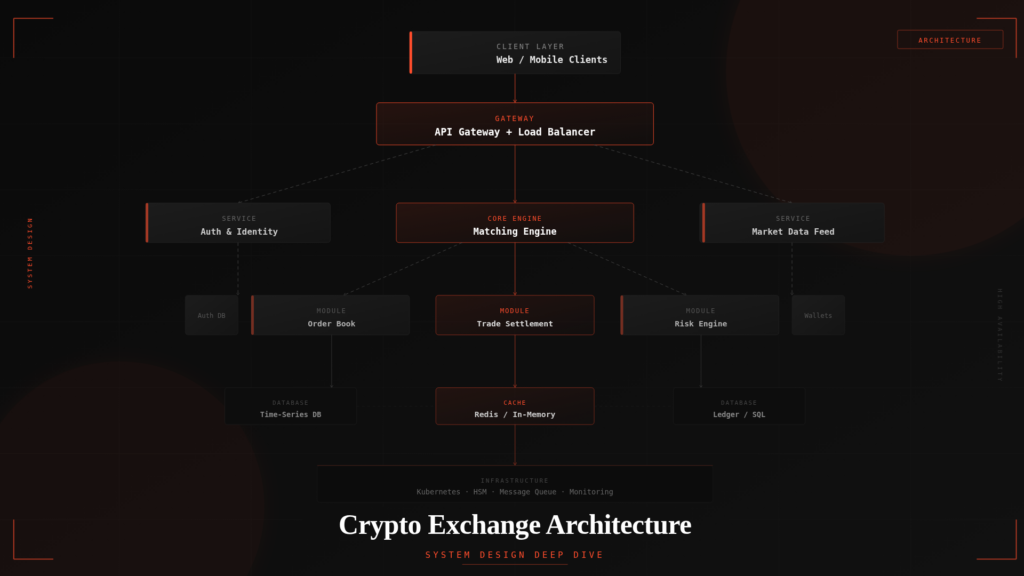
A cryptocurrency exchange is only as strong as the architecture behind it. Every layer—from the user interface to liquidity systems and custody infrastructure—must work together seamlessly to deliver a secure, scalable, and high-performance trading experience.
Below are the core components of modern crypto exchange architecture in 2026:
1. User Interface
The front end is the user-facing layer of the exchange, directly influencing trading speed and user behavior.
Key features include:
- Real-time trading interface with live price updates
- Depth charts and order book visualization
- WebSocket-based live data streaming
- Multi-currency and multi-language support
- Responsive design for web and mobile
A high-performance UI minimizes delay between user action and order submission, which is critical in volatile markets.
2. Core Backend System
The backend handles all core exchange operations and coordinates between services.
Core modules include:
- Order management system (OMS)
- Wallet and custody services
- Payment processing systems
- KYC/AML verification
- Admin and reporting dashboards
A well-architected backend ensures low-latency processing, secure data handling, and horizontal scalability using microservices.
3. Order Matching Engine
The crypto exchange matching engine is responsible for executing trades with minimal latency.
Key capabilities:
- Maintains an in-memory order book for fast access
- Executes trades based on price-time priority
- Supports thousands of transactions per second
- Ensures atomic and deterministic trade execution
High-performance engines are often built using low-level languages like C++ or Rust to achieve microsecond-level execution speeds.
4. Liquidity Management System
Liquidity determines how efficiently orders are filled. Many startup exchanges also rely on external crypto liquidity solutions to improve market depth and reduce slippage during the early growth stages of the platform.
A robust system includes:
- Internal liquidity pools
- External market maker integrations
- Smart order routing across multiple sources
- AI-driven liquidity optimization
Together, these components form the foundation of effective liquidity management strategies in crypto exchanges, enabling tighter spreads and consistent execution.
5. Wallet & Custody Infrastructure
This layer manages user assets and is critical for platform security.
Components include:
- MPC (Multi-Party Computation) wallets
- Multi-signature cold storage
- Hot wallet risk controls and limits
- Automated withdrawal validation
- Multi-chain blockchain node integration
Secure custody systems reduce the risk of unauthorized access and asset loss.
6. KYC/AML Compliance System
Compliance systems ensure regulatory adherence and risk control.
Core features:
- Real-time identity verification (KYC)
- Blockchain transaction monitoring (KYT)
- Risk scoring and fraud detection
- Sanctions screening
- Suspicious activity reporting (SARs)
These systems are increasingly powered by AI to detect abnormal behavior patterns.
7. Security Architecture
Security is embedded across all layers of the exchange.
Key components include:
- Multi-factor authentication (MFA)
- Role-based access control (RBAC)
- End-to-end encryption
- DDoS protection and rate limiting
- Continuous monitoring and intrusion detection
A strong security architecture protects both infrastructure and user funds.
8. Payment Processing & Fiat Integration
This layer enables fiat-to-crypto and crypto-to-fiat transactions.
Core features:
- Multi-currency payment support
- Integration with payment gateways and banking APIs
- Deposit and withdrawal management
- Fee calculation and processing
Efficient payment systems improve onboarding and transaction reliability.
9. Data Layer
The data layer handles storage, retrieval, and processing of platform data.
Includes:
- Trade history and transaction logs
- User data and account records
- Order book snapshots
- Analytics and reporting data
Advanced exchanges use database replication, sharding, and caching (e.g., Redis) to ensure high availability and performance.
10. Regulatory Compliance Infrastructure
Compliance is critical, especially for US-based exchanges.
A robust system includes:
- KYC procedures
- AML policies
- Transaction monitoring
- Reporting and audit trails
These requirements fall under broader crypto exchange regulations and compliance frameworks that define how exchanges operate legally.
11. Infrastructure Layer
This layer ensures system reliability and scalability.
- Cloud infrastructure (AWS, GCP, Azure)
- Load balancing and traffic distribution
- Containerization (Docker, Kubernetes)
- Auto-scaling and failover systems
A resilient infrastructure ensures uptime even during peak trading activity.
Frontend and Backend Features of Cryptocurrency Exchange Architecture (2026)
A modern cryptocurrency exchange is built on two tightly connected layers: the frontend and the backend. The frontend defines how users interact with the platform, while the backend handles trading logic, security, compliance, and system performance.
In 2026, successful exchanges focus on speed, reliability, security, and user trust. Both frontend and backend systems must work together seamlessly to deliver a stable trading experience under heavy market conditions.
Below is a clear breakdown of the core frontend and backend features used in modern crypto exchange architecture.
Frontend Features of a Crypto Exchange Architecture
The frontend is what users see and interact with.
Key features include:
- User dashboard with balances, portfolio overview, and activity history
- Advanced trading interface with real-time charts, order book, and multiple order types
- Multi-currency wallet management for deposits, withdrawals, and transaction tracking
- Support for spot, margin, futures, and staking features
- Responsive design for web and mobile devices
- Security controls such as 2FA, withdrawal whitelisting, and session management
- Built-in support, notifications, and market updates
The goal of the frontend is to deliver a fast, clear, and secure trading experience.
Backend Features of a Crypto Exchange Architecture
The backend is the core engine of the exchange.
Key components include:
- High-performance order matching engine for real-time trade execution
- Secure wallet and custody system using hot and cold storage
- KYC and AML compliance system for identity verification and transaction monitoring
- Order management system for validation, risk checks, and margin control
- API and WebSocket services for real-time data and integrations
- Liquidity management and market-making support
- Scalable databases and caching layers
- Multi-layer security including encryption, DDoS protection, and audits
- Admin panel for platform monitoring, compliance, and operations
The backend ensures speed, accuracy, security, and regulatory compliance. Achieving these goals also depends on selecting the right crypto exchange technology stack, including programming languages, databases, messaging systems, and cloud infrastructure.
Key Challenges in Exchange Architecture
Building a crypto exchange is not just about assembling components.
Major challenges include:
- Handling high-frequency trading loads
- Ensuring low latency execution
- Maintaining liquidity across markets
- Meeting regulatory requirements
- Securing user funds
Solving these requires both strong architecture and continuous optimization.
Future Trends in Crypto Exchange Architecture (2026–2030)
Here’s what will dominate next-generation architecture:
- Modular multi-chain nodes
- AI-based liquidity routing
- MPC + ZK-security wallets
- Cross-chain settlement systems
- AI-driven trade execution optimization
- On-chain KYC (Zero-Knowledge Identity)
- Quantum-resistant encryption
Conclusion :
In 2026, cryptocurrency exchange architecture continues to evolve to meet higher market expectations. Exchanges are now built with faster trading engines, stronger security frameworks, and smoother user experiences. These improvements make platforms more reliable, scalable, and easier to use, even during periods of high market activity.
Modern architecture helps exchanges handle growing user demand, support multiple blockchains, meet regulatory requirements, and protect user assets. As competition increases, having a well-designed and future-ready architecture is essential for long-term success.
For businesses planning to launch or upgrade a crypto exchange platform, working with an experienced development partner is critical. Dappfort provides crypto exchange development services that help businesses design and build secure, scalable, and compliance-ready platforms using modern technologies.
Dappfort provides end-to-end solutions tailored to your business needs, from architecture design and development to deployment and ongoing support. With the right technical foundation and expert guidance, you can build a crypto exchange that is prepared for the challenges of 2026 and beyond.
Let’s build your crypto exchange the right way—secure, scalable, and ready for the future.
FAQ
What is the best architecture for a crypto exchange in 2026?
A hybrid microservices architecture with AI-driven monitoring and multi-chain support is ideal.
How do crypto exchanges ensure high security?
Through multi-sig wallets, MPC custody, cold storage, encryption, and DDoS protection.
Which programming languages are best for exchange architecture?
C++, Rust, Go, and Python.
How do exchanges get liquidity?
Through market makers, liquidity providers, and external exchange APIs.
How long does it take to build an exchange architecture?
Depending on complexity: 3–12 months.
What’s New in Crypto Exchange Architecture for 2026?
Decentralized Systems
AI-Powered Smart Trading
Next-level security
Layer-2 scaling
Cross-chain interoperability
Built-in Compliance
Web3 Architecture
Tokenization
Crypto Exchange Architecture Security Trends 2026?
Authentication and access control
Data Encryption
Smart Contract Audits.
DDoS Protection
Turn Your Exchange Idea Into a Market-Ready Platform
Get a free architecture consultation and discover how to launch a fast, secure, and compliant crypto exchange in 2026.
Related Reading
- Cryptocurrency Exchange Development: Complete Guide for Businesses (2026)
- How Much Does Crypto Exchange Development Cost in 2026?
- Crypto Exchange Development Trends in the USA for 2026
- AI-Powered Crypto Exchange Development for 2026