Most Crypto Startups Make This Mistake Before Building Their Exchange
The biggest mistake crypto founders make does not happen during development. It happens before the first line of code is written. They choose their exchange architecture based on what is popular.
Binance is successful, so we should build a CEX. Uniswap is growing, so we should build a DEX. But successful crypto exchanges are not built by copying existing platforms.
They are built by choosing the right architecture based on:
- Target users
- Liquidity strategy
- Revenue model
- Compliance requirements
- Security expectations
- Long-Term Scalability
Should your startup build a Centralized Exchange (CEX), a Decentralized Exchange (DEX), or a Hybrid model?
That’s the real question founders need to wrestle with before writing a single line of code. This guide breaks down how CEX and DEX platforms differ in development cost, business model, technical architecture, and overall fit so you can figure out which approach actually matches what you’re trying to build.
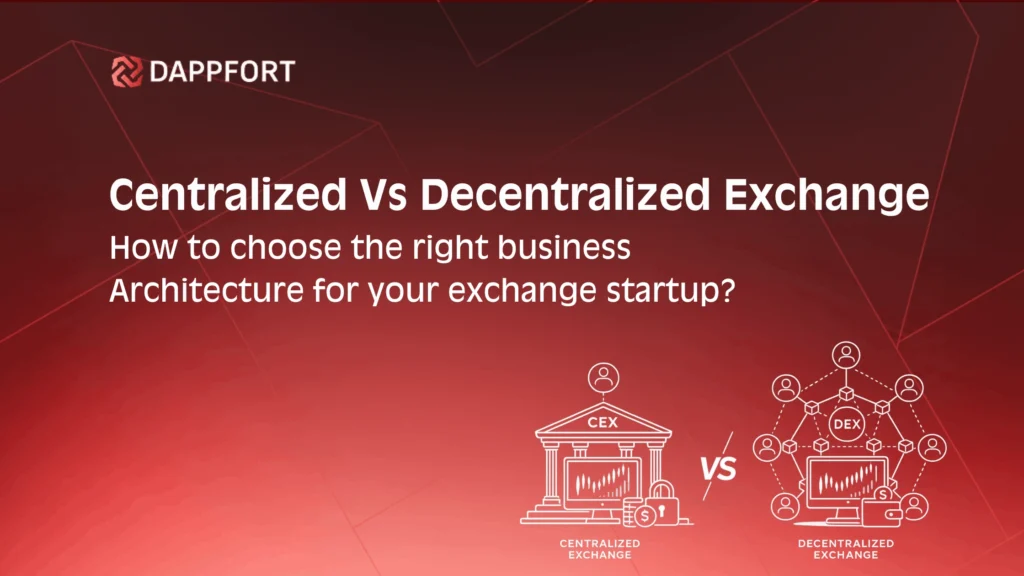
Centralized vs Decentralized Exchange: The Core Difference
At the heart of it, the difference between a CEX and a DEX is about who’s holding the reins.
A Centralized Exchange (CEX) is run by a company. That company handles everything, user accounts, trade execution, order matching, custody of funds, and the infrastructure that keeps the platform running.
Examples include:
- Coinbase
- Binance
- Kraken
A Decentralized Exchange (DEX) uses blockchain technology and smart contracts to enable users to trade directly without depending on a central authority.
Examples include:
- Uniswap
- PancakeSwap
- Curve
The difference is simple:
CEX = Platform-controlled trading experience
DEX = Blockchain-powered user-controlled trading
CEX vs DEX Comparison: Which Exchange Model Fits Your Business?
| Factor | Centralized Exchange (CEX) | Decentralized Exchange (DEX) |
| Control | Managed by company | Managed by smart contracts |
| User Funds | Usually custodial | Non-custodial |
| Trading Model | Order book | AMM / Liquidity pools |
| Transaction Speed | Faster | Depends on blockchain |
| User Experience | Similar to traditional finance apps | Web3-focused |
| Liquidity | Easier institutional management | Community-driven |
| Compliance | Easier integration | More complex |
| Development Focus | Backend infrastructure | Blockchain infrastructure |
Not Sure Which Exchange Model Fits Your Startup?
Every business has different liquidity, compliance, and user needs. Talk to our team to find out whether CEX, DEX, or hybrid is the right starting point for you.
What Is a Centralized Crypto Exchange (CEX)?
A centralized crypto exchange works similar to traditional financial trading platforms. The company manages the complete trading environment. Users create accounts, deposit assets, place orders, and trade through the platform.
The exchange handles:
- User accounts
- Trading engine
- Order matching
- Wallet management
- Deposits and withdrawals
- KYC/AML integration
- Admin controls
- Security monitoring
Through professional centralized crypto exchange development services, businesses can create platforms where users can:
- Create accounts
- Deposit crypto assets
- Execute trades
- Manage portfolios
- Access advanced trading features
A CEX gives businesses greater control over:
- User experience
- Liquidity management
- Revenue generation
- Platform operations
A CEX focuses on delivering:
Speed + Liquidity + Better User Experience
Key Features Required for CEX Development
Advanced Trading Engine
The trading engine is the core of a centralized exchange.
It manages:
- Buy and sell orders
- Order matching
- Trading speed
- Market execution
Advanced platforms may support:
- Limit orders
- Market orders
- Stop-loss orders
- Margin trading
- Trading APIs
Secure Wallet Infrastructure
A reliable CEX requires strong wallet architecture.
Important components include:
- Hot wallets
- Cold storage
- Multi-signature wallets
- Deposit and withdrawal systems
Security-first wallet management helps reduce risks associated with digital asset storage.
User Management and Compliance
Modern exchanges require:
- User registration
- KYC integration
- AML monitoring
- Account verification
- Transaction tracking
This makes CEX platforms suitable for businesses targeting regulated markets.
Why Startups Choose CEX Development?
Businesses usually choose CEX development when they need:
1. Better User Experience
Most retail users are familiar with centralized platforms.
They expect:
- Easy registration
- Simple buying and selling
- Portfolio tracking
- Trading charts
- Instant transactions
This makes CEX platforms attractive for businesses targeting mainstream adoption.
2. High-Speed Trading Performance
Centralized exchanges use advanced trading engines to process large volumes of transactions.
This supports:
- Professional traders
- Institutional users
- High-frequency trading
- Advanced order types
Features include:
- Limit orders
- Market orders
- Stop-loss
- Margin trading
- Trading APIs
3. Easier Liquidity Management
Liquidity is one of the biggest challenges in exchange businesses.
CEX platforms can work with:
- Market makers
- Liquidity providers
- Institutional partners
- External liquidity solutions
This creates a smoother trading experience.
What Is a Decentralized Crypto Exchange (DEX)?
A decentralized exchange allows users to trade directly through blockchain networks. Instead of depositing funds into an exchange wallet, users connect their own wallets.
Through DEX development services, businesses can create blockchain-based trading platforms where users maintain control over their assets.
DEX platforms use:
- Smart contracts
- Automated Market Makers (AMM)
- Liquidity pools
- Blockchain networks
- Web3 wallet connections
The exchange does not control user funds. Users maintain ownership of their assets.
Key Features of DEX Development
Smart Contract Development
Smart contracts handle:
- Token swaps
- Trade execution
- Liquidity management
- Automated transactions
Security audits are essential because smart contract vulnerabilities can impact the entire platform.
Wallet-Based Trading
DEX platforms allow users to connect wallets instead of creating traditional accounts.
Benefits include:
- User-controlled funds
- Increased transparency
- Reduced custody risks
Multi-Chain DEX Development
Modern DEX platforms often support multiple blockchain networks.
Multi-chain functionality helps businesses provide:
- More trading options
- Wider user reach
- Better ecosystem integration
Why Startups Choose DEX Development?
1. Non-Custodial Trading
The biggest advantage of DEX platforms: Users control their private keys. This reduces dependency on centralized custody systems.
2. Blockchain Transparency
Every transaction can be verified on-chain.
Users can analyze:
- Smart contract activity
- Liquidity movement
- Trading transactions
3. Web3 Ecosystem Integration
DEX platforms are ideal for businesses building:
- Token ecosystems
- DeFi products
- Blockchain communities
- Protocol-based applications
CEX vs DEX Architecture: Technical Difference
Choosing between CEX and DEX is mainly an architecture decision.
Centralized Exchange Architecture
A scalable CEX usually includes:
Frontend Layer
Responsible for:
- Trading interface
- User dashboard
- Charts
- Portfolio management
Backend Layer
Handles:
- Trading engine
- Order matching
- User management
- Database operations
Wallet Infrastructure
Includes:
- Hot wallets
- Cold storage
- Blockchain integrations
Security Layer
Includes:
- Encryption
- Two-factor authentication
- Fraud monitoring
- Risk management
Decentralized Exchange Architecture
A DEX includes:
Smart Contract Layer
Handles:
- Token swaps
- Trading execution
- Liquidity management
Blockchain Layer
Provides:
- Transaction verification
- Network security
- Decentralized operations
Wallet Integration
Supports:
- MetaMask
- Hardware wallets
- Mobile wallets
Liquidity Layer
Supports:
- Liquidity pools
- Automated trading
- Token availability
CEX vs DEX Development Cost: Which One Requires More Investment?
The cost of building a crypto exchange depends on:
- Features
- Blockchain selection
- Security requirements
- Scalability goals
- Customization level
Centralized Exchange Development Cost Factors
CEX development usually requires investment in:
- Trading engine development
- Wallet infrastructure
- Admin dashboard
- Security systems
- KYC/AML integration
- Liquidity solutions
- Mobile applications
Advanced features increase complexity:
- Margin trading
- Derivatives
- Institutional trading
- Multi-currency support
Decentralized Exchange Development Cost Factors
DEX development focuses on:
- Smart contracts
- Blockchain integration
- Liquidity protocols
- Security audits
- Cross-chain functionality
The biggest cost factors include:
- Smart contract complexity
- Blockchain fees
- Audit requirements
- Protocol customization
Crypto Exchange Revenue Models: How CEX and DEX Make Money
Choosing an exchange model is also a business decision.
CEX Revenue Models
Centralized exchanges generate revenue through:
Trading Fees
A percentage charged on every transaction.
Withdrawal Fees
Charges for moving assets.
Listing Fees
Projects pay to list tokens.
Premium Services
Advanced trading tools and memberships.
API Access
Institutional users pay for advanced trading infrastructure.
DEX Revenue Models
DEX platforms generate revenue through:
Swap Fees
Users pay fees when exchanging tokens.
Protocol Fees
Revenue generated through trading activity.
Staking
Token-based earning mechanisms.
Liquidity Programs
Incentives around ecosystem growth.
Get a Clear Cost Estimate for Your Exchange
Development cost depends on features, blockchain choice, and compliance needs. Share your requirements and get a tailored cost and timeline breakdown from Dappfort’s team.
Security Comparison: CEX vs DEX
Security is one of the most important factors when building an exchange.
CEX Security Challenges
Centralized exchanges protect:
- User accounts
- Wallet systems
- Trading infrastructure
- Databases
Common security solutions:
- Multi-signature wallets
- Cold storage
- Encryption
- Penetration testing
- Monitoring systems
DEX Security Challenges
DEX security mainly depends on smart contract quality.
Important measures:
- Smart contract audits
- Code reviews
- Bug bounty programs
- Blockchain security testing
A single smart contract vulnerability can impact the entire protocol.
Why Do Many Startups Choose Hybrid Crypto Exchange Development?
The future is not always CEX vs DEX. Many businesses are moving toward hybrid cryptocurrency exchange development to combine the advantages of centralized and decentralized trading models.
A hybrid exchange combines:
CEX benefits:
- Fast execution
- Better UX
- Advanced trading
DEX benefits:
- Transparency
- Wallet ownership
- Blockchain integration
Hybrid exchanges are suitable for businesses that want:
- Enterprise scalability
- Flexible custody options
- Web3 functionality
- Better user experience
Why Choose Dappfort for Crypto Exchange Development?
Building a successful exchange requires expertise across blockchain development, security, and scalable architecture.
As a leading crypto exchange development company, Dappfort helps businesses build customized solutions through:
- CEX development services
- DEX development solutions
- Hybrid exchange development
- Blockchain integration
- Smart contract development
- Web3 platform development
Whether you are launching a startup exchange or expanding an existing blockchain product, choosing the right development partner can reduce technical complexity and accelerate market entry.
How To Choose the Right Crypto Exchange Development Solution?
Choose CEX development if your priority is:
- Faster trading
- Better user experience
- Centralized control
- Traditional exchange features
Choose DEX development if your goal is:
- Decentralized trading
- Web3 adoption
- User-controlled assets
- Blockchain transparency
Choose hybrid exchange development if you need:
- Both centralized and decentralized advantages
- Flexible architecture
- Future-ready scalability
Future Trends in Crypto Exchange Architecture
The crypto exchange industry is evolving toward:
AI-Powered Trading Infrastructure
AI is improving:
- Risk detection
- Market analysis
- Trading automation
Cross-Chain Trading
Users expect to move freely across multiple blockchain networks, not get stuck on just one.
Layer 2 Adoption
Transactions that are faster and cheaper.
Decentralized Identity
Stronger compliance without asking users to give up ownership of their data.
Frequently Asked Questions
Is CEX better than DEX?
There’s no clear winner. CEX has the edge when it comes to speed, usability, and centralized control. DEX pulls ahead if decentralization and user ownership are what matter most to you.
How much does it cost to build a crypto exchange?
It depends on the type of exchange, the features you want, the blockchain infrastructure involved, your security requirements, and how much customization goes into it.
Can startups build both CEX and DEX features?
Yes. A lot of companies go with a hybrid exchange architecture, blending centralized performance with the benefits of decentralization.
Which crypto exchange model is more profitable?
That comes down to the business model itself — your users, your liquidity strategy, and your revenue streams.
How long does crypto exchange development take?
Timelines depend on complexity, the features involved, integrations, and security requirements.
Final Thoughts: Build the Right Crypto Exchange Architecture
The success of a crypto exchange starts with choosing the right foundation.
A CEX delivers:
- Speed
- Control
- Better user experience
A DEX delivers:
- Transparency
- Decentralization
- User ownership
A hybrid exchange delivers:
- Flexibility
- Scalability
- Combined advantages
Before investing in development, define your business goals and select an architecture designed for future growth.
Build your next-generation trading platform with the right crypto exchange development partner like Dappfort and create a scalable exchange solution built for the evolving Web3 market.
Build Your Crypto Exchange with a Team That’s Already Solved These Problems
From CEX to DEX to hybrid architecture, Dappfort helps startups design and launch secure, scalable exchange platforms built for real trading conditions not just demos.
Related Readings:
- Crypto Exchange Architecture: A Complete Guide for 2026
- Crypto Matching Engine Development: Solving Liquidity, Slippage & Market Manipulation
- Crypto Liquidity Solutions for Exchange Startups: The Complete Guide (2026)
- Cryptocurrency Exchange Development: Complete Guide for Businesses (2026)
- How Crypto Exchange Development Makes Money: Business Strategies for Entrepreneurs