Building a Multi-Chain Wallet Isn’t About Connecting More Blockchains
One of the biggest misconceptions in crypto wallet development is thinking that supporting multiple blockchains just means bolting on Bitcoin, Ethereum, Solana, TRON, and other networks one after another.
That’s not actually how modern wallet platforms get built.
At Dappfort, one of the first things we talk through with founders is architecture, not which blockchains to hook up.
Most businesses start with a single network, then quickly find out their users want a lot more. These days, people simply expect a wallet to work with Bitcoin, Ethereum, BNB Chain, Solana, Polygon, Base, Arbitrum, Avalanche Instead of building blockchain-specific applications, businesses can create a flexible platform that integrates new networks with minimal changes to the core system.plus whatever chain takes off next.
The hard part isn’t bolting on one more blockchain.
It’s building infrastructure flexible enough that new networks can be added later without tearing the whole platform apart and rebuilding it.
That’s why wallet development is drifting away from single-blockchain lock-in, toward something more chain-agnostic instead.
A well-designed multi-chain wallet provides users with a unified experience while managing the complexity of different blockchain networks behind the scenes.
In this guide, we’ll explain how multi-chain wallet architecture works, why it’s becoming the industry standard, and what founders should consider before building a wallet designed for long-term growth.
What Is a Multi-Chain Wallet?
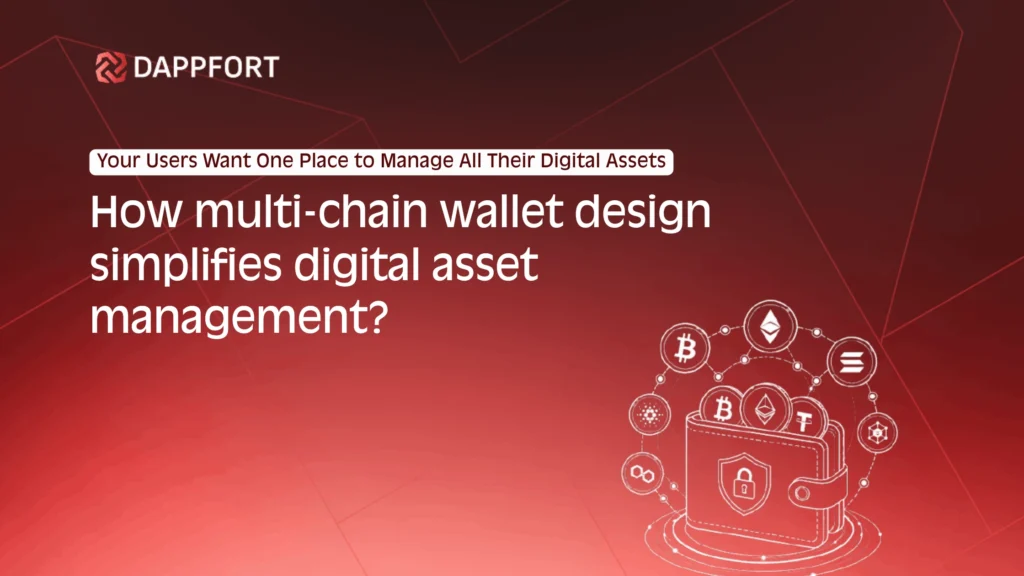
A multi-chain wallet is a crypto wallet that lets people handle assets across several blockchain networks from a single app. Instead of keeping separate wallets for each ecosystem, people can see all their digital assets in one place.
A typical multi-chain wallet might support:
- Bitcoin (BTC)
- Ethereum (ETH)
- Solana (SOL)
- TRON (TRX)
- BNB Chain
- Polygon
- Avalanche
- Base
- Arbitrum
- Thousands of blockchain-based tokens
To the person using it, everything just works.
Underneath, though, it’s a different story. Every blockchain has its own architecture, its own rules for consensus, its own transaction format, and its own method for talking to other systems. That’s exactly why multi-chain wallet design matters so much.
Why Multi-Chain Wallets Have Become the Industry Standard?
The blockchain world isn’t controlled by a small handful of networks anymore. New Layer-1 and Layer-2 ecosystems keep popping up, each bringing something different to the table whether it’s payments, DeFi, NFTs, gaming, or enterprise use cases.
Users no longer want multiple wallet applications. They expect one secure platform that can manage all of their digital assets. For businesses, this creates new expectations.
Modern wallet platforms must deliver:
- A unified user experience
- Support for multiple blockchain ecosystems
- Faster onboarding
- Simplified asset management
- Scalability for future blockchain integrations
Meeting these expectations takes more than bolting on extra blockchain integrations, it takes the right architecture from the ground up.
Single-Chain vs. Multi-Chain Wallet Architecture
Before picking an infrastructure strategy, it helps to understand how these two approaches differ.
Single-Chain Wallets
Single-chain wallets are built around one blockchain ecosystem, think Bitcoin-only or Solana-only wallets.
Since they only need to talk to a single blockchain, development tends to be simpler and infrastructure needs are easier to handle. However, supporting additional blockchain networks later often requires significant architectural changes.
For a startup focused on just one blockchain, this approach can work fine early on. For a business with bigger growth plans, it can become a real bottleneck fast.
Multi-Chain Wallets
Multi-chain wallets are built for flexibility from day one. Rather than locking the application to a single blockchain, they rely on a modular architecture that can connect to multiple blockchain ecosystems through one unified infrastructure.
That gives businesses the ability to:
- Expand into new blockchain networks faster
- Cut down on development effort
- Deliver a consistent user experience across chains
- Support future blockchain ecosystems without rebuilding the platform
This is exactly why most modern wallet providers build multi-chain architecture from the start.
Why Chain-Agnostic Infrastructure Matters?
One of the biggest mistakes we see: designing a wallet around whatever the blockchain ecosystem looks like today.
The industry moves fast, new Layer-1 networks, Layer-2 solutions, token standards, and decentralized apps show up every year. If a wallet’s architecture is tightly locked to one specific blockchain, every expansion turns into a major engineering project.
Chain-agnostic infrastructure fixes this. Instead of building blockchain-specific applications, businesses can create a flexible platform that integrates new networks with minimal changes to the core system.
This approach offers significant long-term advantages:
- Faster blockchain integrations
- Lower maintenance costs
- Easier feature development
- Better scalability
- Reduced technical debt
Ultimately, you’re not building a wallet for one blockchain. You’re building a platform that can keep pace with the blockchain industry as it grows.
How Modern Wallets Connect to Multiple Blockchains?
Every blockchain works differently, but most enterprise-grade wallets follow a similar architecture. Instead of letting every part of the application talk directly to each blockchain, they keep blockchain-specific logic separate from the core wallet.
This modular setup means new blockchain networks can be added without breaking what already works.
A typical multi-chain wallet includes:
- User interface layer
- Blockchain abstraction layer
- Chain adapters
- Wallet orchestration services
- Transaction engine
- Blockchain node connections
- Security and key management
Each component has a dedicated responsibility, making the platform easier to maintain, scale, and extend. As the number of supported blockchain networks grows, this architecture becomes increasingly valuable.
Dappfort Consultant’s Perspective
One question we often ask founders is:
Are you building a wallet for today’s blockchains or for the blockchain ecosystem your users will expect three years from now?
That question usually changes the conversation.
Supporting Bitcoin and Ethereum is relatively straightforward. Building infrastructure that can seamlessly integrate future blockchain networks without repeated redevelopment is a much greater competitive advantage.
At Dappfort, we believe the future belongs to chain-agnostic wallet infrastructure. Businesses that invest in modular architecture today will be better positioned to adapt as blockchain technology continues to evolve.
The Architecture Behind a Multi-Chain Wallet
Supporting multiple blockchain networks isn’t about adding one blockchain after another.
It’s about designing an architecture where every blockchain follows a standardized integration model.
At Dappfort, we view multi-chain wallet development as an infrastructure challenge rather than a blockchain challenge. A well-designed architecture allows businesses to integrate new networks without rebuilding the wallet every time the market evolves.
Let’s look at the core components that make this possible.
1. Blockchain Abstraction Layer
Every blockchain operates differently. Bitcoin follows the UTXO model. Ethereum is account-based. Solana uses a completely different execution model. TRON has its own APIs and transaction structure.
If your application communicates directly with every blockchain, the codebase quickly becomes difficult to maintain.
A Blockchain Abstraction Layer acts as a common interface between your wallet and multiple blockchain networks.
Instead of writing blockchain-specific business logic throughout the application, the wallet communicates with a standardized service that translates requests for each blockchain.
This approach delivers several advantages:
- Simplifies development
- Reduces maintenance
- Accelerates blockchain integrations
- Makes future expansion easier
It’s one of the most important design decisions for any scalable wallet.
2. Chain Adapters
Once an abstraction layer is in place, each blockchain connects through its own Chain Adapter. Think of a chain adapter as a translator. It understands how a specific blockchain works while presenting a consistent interface to the wallet.
A chain adapter typically handles:
- Wallet address validation
- Transaction creation
- Fee estimation
- Balance retrieval
- Transaction broadcasting
- Blockchain synchronization
When a business decides to support another blockchain, developers create a new adapter instead of redesigning the entire wallet. This modular approach dramatically reduces development effort.
3. Wallet Orchestration System
Supporting multiple blockchains means coordinating thousands of blockchain requests every minute. A Wallet Orchestration System manages this complexity.
It decides:
- Which blockchain to connect to
- Which node should process the request
- Which adapter should execute the transaction
- How responses are returned to the application
Rather than every component communicating independently, the orchestration layer ensures requests are routed efficiently across the infrastructure. This improves both performance and maintainability.
4. Unified Transaction Engine
Although blockchain transactions look similar to users, they’re very different behind the scenes. Bitcoin transactions aren’t processed like Ethereum transactions. Solana transactions differ from TRON.
Instead of exposing those differences to users, modern wallets use a Unified Transaction Engine.
It standardizes transaction workflows such as:
- Sending cryptocurrency
- Receiving assets
- Transaction signing
- Broadcasting transactions
- Confirmation tracking
- Error handling
Users enjoy a consistent experience, while blockchain-specific logic remains isolated in the backend.
5. Network Switching
One of the defining characteristics of a multi-chain wallet is its ability to switch between blockchain networks seamlessly. For users, changing from Ethereum to Solana should feel as simple as selecting another network.
Behind the scenes, the wallet must:
- Connect to different blockchain nodes
- Retrieve balances
- Update supported assets
- Apply blockchain-specific transaction rules
- Load the correct network configuration
Efficient network switching creates a seamless user experience while reducing operational complexity.
6. Address Derivation Across Multiple Blockchains
Every blockchain generates wallet addresses differently. Bitcoin, Ethereum, Solana, and TRON all follow different standards.
A multi-chain wallet needs an address management system capable of generating and organizing these addresses securely.
The goal is consistency. Users shouldn’t need to understand how each blockchain derives addresses they should simply access their assets through one intuitive interface.
7. Smart Contract Interactions
Modern wallets do much more than send and receive cryptocurrency.
Users also interact with:
- DeFi applications
- NFT marketplaces
- Staking platforms
- DAO governance
- Token swaps
- Web3 applications
Supporting these experiences requires secure communication with smart contracts across multiple blockchain ecosystems. A scalable wallet architecture manages these interactions while maintaining a consistent experience regardless of the underlying network.
Why Modular Architecture Wins?
One of the biggest differences between enterprise wallet platforms and entry-level products is modularity. Instead of hardcoding blockchain integrations throughout the application, modern wallets separate responsibilities into independent services.
This makes it possible to:
- Add new blockchains faster
- Upgrade existing integrations independently
- Reduce maintenance costs
- Improve testing and security
- Scale without major architectural changes
As blockchain ecosystems continue to expand, modular architecture becomes a long-term competitive advantage.
Consultant’s Perspective
A common mistake is evaluating a wallet by asking:
How many blockchains does it support?
A better question is:
How easily can it support the next blockchain?
Blockchain moves fast, and it’s not slowing down. New Layer-1s, Layer-2 ecosystems, and token standards show up year after year. If your team has to spend months re-engineering your wallet every time a new network takes off, that growth is costing you more than it should.
At Dappfort, we build wallet infrastructure that’s chain-agnostic from the start, so adding new blockchains is just part of doing business, not a fire drill. Get the modular architecture right early, and businesses can move on opportunities as they come up, instead of dragging along a growing pile of technical debt.
Designing a Wallet That Can Scale With the Blockchain Industry
A multi-chain wallet isn’t just about ticking off Bitcoin, Ethereum, and Solana support today. It’s about building something flexible enough to handle whatever blockchain ecosystems show up next.
Ten years from now, the wallets still standing won’t be the ones locked into a fixed list of chains.
Multi-Chain Security Should Be Built Into the Architecture
Supporting multiple blockchains also means managing multiple security models.
A production-ready wallet should include:
- Secure private key management
- End-to-end transaction signing
- Blockchain-specific validation rules
- Role-based access controls for enterprise platforms
- Continuous monitoring and audit logging
Security should be part of the architecture from the beginning not an enhancement added after launch.
Scaling Beyond Today’s Blockchains
The blockchain ecosystem continues to evolve with new Layer-1 networks, Layer-2 solutions, and token standards.
A scalable wallet should make it easy to:
- Integrate new blockchain networks
- Support emerging token standards
- Connect with Web3 applications
- Expand without redesigning the core platform
The objective isn’t to predict the next popular blockchain, it’s to build infrastructure that’s ready for it.
How Dappfort Builds Multi-Chain Wallet Infrastructure?
At Dappfort, we believe businesses shouldn’t have to rebuild their wallet every time the blockchain industry changes. Our approach to multichain crypto wallet development focuses on chain-agnostic architecture, modular blockchain integrations, scalable backend infrastructure, enterprise-grade security, and future-ready technology design.
Our development approach focuses on:
- Chain-agnostic wallet architecture
- Modular blockchain integrations
- Scalable backend infrastructure
- Enterprise-grade security
- Future-ready technology design
Rather than developing wallets around specific cryptocurrencies, we build platforms capable of supporting continuous blockchain expansion.
Build a Wallet That’s Ready for the Next Blockchain
Your wallet shouldn’t need a complete rebuild every time a new blockchain gains traction. Get a scalable, modular architecture designed to support multiple networks today and expand into new ecosystems as your business grows.
Frequently Asked Questions
What is a multi-chain wallet?
A multi-chain wallet lets users manage cryptocurrencies across several blockchain networks from one application.
What’s the difference between a multi-chain wallet and a multi-currency wallet?
A multi-chain wallet is about supporting multiple blockchain networks, while a multi-currency wallet is about managing multiple digital assets. In practice, most modern wallets combine both.
Is multi-chain architecture better than building separate wallets?
For businesses planning long-term growth, yes. A unified architecture simplifies maintenance, improves the user experience, and makes future blockchain integrations significantly easier.
Final Thoughts
The future of Web3 isn’t going to be defined by individual blockchain ecosystems on their own. Users want easy access to their digital assets no matter what network sits underneath.
That’s why multi-chain wallet design has turned into a strategic requirement rather than a nice-to-have.
For founders, the real challenge isn’t picking which blockchains to support right now. It’s building infrastructure that can handle the blockchains your users will expect down the line.
At Dappfort, we help startups and enterprises build chain-agnostic wallet infrastructure that brings together scalability, security, and flexibility. Whether you’re building a crypto wallet, connecting multiple blockchain networks, or planning a large-scale Web3 platform, the architecture you choose will shape how well your product grows in the years ahead.
Dappfort Wallet Consultant’s Insight: Supporting more blockchains doesn’t automatically make a wallet better. The real win is in designing architecture where adding the next blockchain is just a configuration task not a full rebuild. That’s what separates building for today’s market from building for the one coming next.At Dappfort, one of the first things we talk through with founders is architecture, not which blockchains to hook up.
Related Readings:
- Crypto Wallet Architecture Explained
- Blockchain Integration Layer for Crypto Wallet
- MPC Wallet vs Multi-Signature Wallet
- Wallet Signing Process Explained
- Multi-Currency Wallet Infrastructure Explained