The cryptocurrency industry has reached a point where infrastructure quality is becoming a real competitive advantage.
A few years ago, launching a crypto wallet was mostly about letting users store, send, and receive digital assets. That expectation has shifted dramatically. Today, modern wallet platforms are expected to handle multi-chain ecosystems, institutional custody requirements, staking services, DeFi integrations, compliance frameworks, enterprise security controls, and millions of dollars in daily transaction volume.
As the industry matures, the conversation around wallet development is changing too. The most successful digital asset businesses are no longer competing solely on features or how their interface looks. They’re competing on security architecture, operational resilience, transaction reliability, and infrastructure maturity.
This shift has created a new reality for founders, startups, exchanges, and fintech companies entering the market.
The question is no longer:
“Can we build a crypto wallet?”
The real question is:
“Can we build a cryptocurrency wallet architecture that actually protects assets, holds up under growth, keeps user trust intact, and adapts to where our business is heading?”
That’s the gap where successful platforms pull ahead of failed ones.
A lot of organizations learn this the hard way. They pour money into front-end experiences, mobile apps, token integrations, and marketing while treating wallet infrastructure as something they’ll figure out later. What follows is usually a painful cycle of operational complexity, security gaps, scalability ceilings, and expensive rebuilds — all things that better architectural planning upfront would have avoided.
The reality is straightforward. A cryptocurrency wallet isn’t just an application. It’s a digital asset infrastructure system.
Every transaction, every blockchain interaction, every security control, every user balance — all of it depends on the quality of the architecture running behind the interface.
Getting a clear picture of that architecture is the first step toward building a wallet platform that can actually scale with confidence. If you’re also thinking about what it takes financially to get started, our breakdown of the cost to create a crypto wallet gives you a realistic starting point.
In this guide, we’ll break down the core components of cryptocurrency wallet architecture, walk through how modern wallet systems are designed, and look at the infrastructure decisions that separate wallet platforms that thrive from those that struggle to grow.
Is Your Wallet Architecture Ready to Scale?
Most businesses discover infrastructure gaps after launch — when fixing them costs far more. Get clarity before you build.
Why Wallet Architecture Is Becoming a Competitive Advantage?
As digital assets keep pushing into mainstream finance, the bar for wallet infrastructure keeps rising.
Users are trusting wallet applications with assets that might represent personal savings, long-term investments, business treasury funds, or institutional capital. That trust carries a responsibility that goes well beyond software development.
When users choose a wallet platform, they are indirectly evaluating questions such as:
- Is the wallet designed for long-term reliability?
- How secure are my assets?
- What happens if the platform experiences an attack?
- Can the infrastructure handle growing transaction volume?
- How are private keys protected?
- Can this platform support future blockchain ecosystems?
Most users never actually voice these questions. But their confidence in a platform depends entirely on the answers sitting underneath. That’s exactly why wallet architecture has become a genuine business differentiator rather than just a technical checkbox.
The strongest wallet providers know that infrastructure touches everything in the user experience. Faster transactions, tighter security, less downtime, cleaner scalability, stronger operational controls — all of it traces back to architectural decisions made long before a product ever goes live.
Think of wallet architecture the way you’d think of a skyscraper’s foundation. Users never see it. But everything built above depends entirely on how solid it is.
Dappfort Insight on Wallet Architecture: Infrastructure Is Replacing Features as a Competitive Advantage
One of the biggest shifts happening in digital assets right now is how much infrastructure maturity actually matters. Back in the early days of crypto adoption, you could genuinely stand out by adding more coins, introducing staking, or shipping a mobile app. Those things created real advantages then.
Today, they’re just expectations. What separates successful platforms increasingly comes down to infrastructure quality.
Security breaches, delayed transactions, unexpected downtime, custody failures — the market has learned hard lessons from all of it. Features bring users in. Infrastructure is what keeps them around.
Businesses that take cryptocurrency wallet architecture seriously early are building a far stronger foundation for long-term growth than those chasing features without thinking about what sits underneath.
What Is Crypto Wallet Architecture?
Cryptocurrency wallet architecture is the complete system design behind storing, managing, securing, and moving digital assets across blockchain networks.
Most users only ever see a simple interface showing their balances and transaction history. What they don’t see is that a production-grade wallet runs multiple infrastructure layers working together simultaneously, all invisible from the front end.
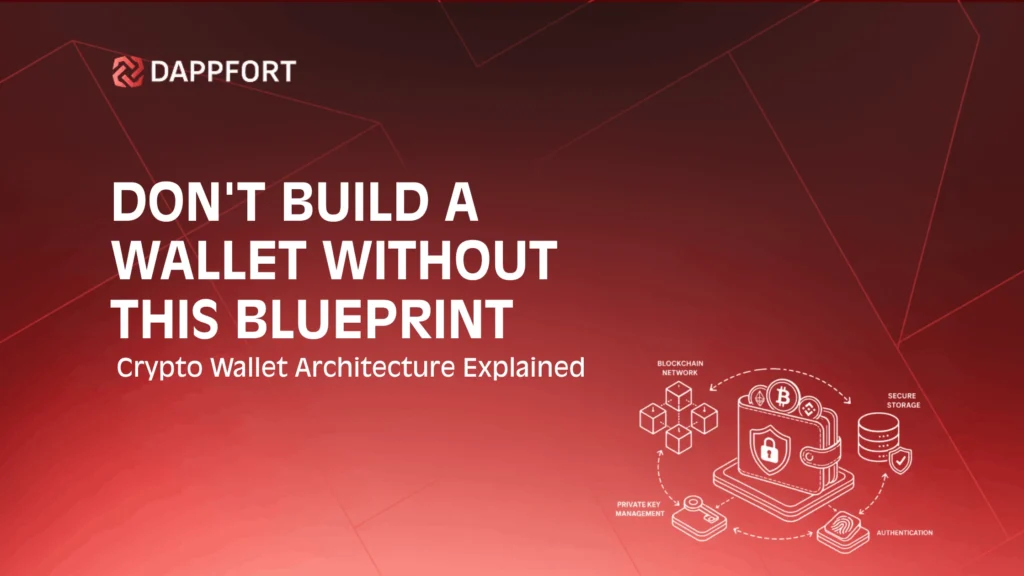
Those layers include wallet management systems, private key security frameworks, transaction signing environments, blockchain communication services, authentication systems, security monitoring infrastructure, compliance and risk management tools, and administrative control systems.
Each layer has a specific role within the broader custody ecosystem. Together, they create the environment where users can interact safely with blockchain networks.
The architecture decides how assets are secured, how transactions get approved, how blockchain data stays current, and how risks get managed day to day.
For any business entering the digital asset market, getting a solid grasp of wallet architecture isn’t optional. Every future capability you want to build sits on top of the foundation you lay in those early stages — whether that’s staking, tokenized assets, NFT ecosystems, institutional custody, or cross-chain functionality.
Why Most Wallet Projects Fail Before They Scale
One of the most persistent misconceptions in wallet development is that success is primarily about features.
Many founders kick off projects talking about which cryptocurrencies they’ll support, what the mobile interface will look like, staking capabilities, DeFi integrations, and future roadmap ambitions. Those things matter. But they’re rarely what determines whether a wallet project actually succeeds or falls apart.
Most long-term problems trace back to architectural weaknesses — poor private key management, inadequate custody systems, shaky transaction authorization workflows, thin monitoring capabilities, scalability limitations that were baked in from day one.
These issues usually stay hidden during early development. They surface once transaction volume picks up and user adoption accelerates. By that point, fixing the underlying architecture costs dramatically more than getting it right from the start would have.
That’s why experienced digital asset businesses plan infrastructure before they plan features. Adding functionality to a solid wallet system architecture is manageable. Redesigning custody architecture after launch is a different problem entirely.
What Successful Wallet Platforms Understand
The strongest wallet businesses approach development from a fundamentally different angle. They don’t treat a wallet as a product. They treat it as financial infrastructure.
That mindset shapes everything. Security architecture gets designed before user interfaces. Custody systems get planned before token integrations. Scalability strategies get worked out before marketing campaigns launch. Transaction authorization frameworks get locked in before public release.
The goal isn’t simply to ship a wallet that works.
The goal is to build wallet infrastructure capable of supporting years of growth while protecting assets under increasingly demanding operational conditions.
This infrastructure-first mindset shows up consistently across successful exchanges, fintech platforms, institutional custody providers, and digital asset businesses of all sizes. It’s what allows them to grow confidently while keeping operational risk under control.
The Core Components of Modern Crypto Wallet Architecture
Wallet implementations vary quite a bit depending on what a business actually needs, but most enterprise-grade wallet systems share the same foundational components.
At the center sits the wallet engine — the component responsible for generating wallet addresses, tracking balances, monitoring blockchain activity, and coordinating interactions with external networks.
Right alongside it is the private key management layer, which controls ownership and authorization of digital assets. Most practitioners consider this the single most critical component in the entire cryptocurrency wallet architecture, because it determines directly how assets are protected.
The transaction signing layer handles authorization for every asset transfer. Every withdrawal, payment, or blockchain interaction passes through this environment before anything reaches the network.
Blockchain integration services provide connectivity between the wallet and supported networks — Bitcoin, Ethereum, Polygon, Solana, TRON, and others.
Authentication systems give users secure access to their accounts. Monitoring and risk management frameworks run continuously in the background, scanning for anything that looks suspicious.
Administrative dashboards give internal teams the visibility they need to manage users, transactions, security events, and compliance requirements.
Together, these components form the working foundation of a secure wallet system architecture. Understanding how they interact is essential for anyone seriously evaluating wallet development or planning a digital asset platform launch.
Wallet Management Engine
The wallet engine is the operational core of the entire platform. Its responsibilities cover wallet creation, address generation, balance tracking, asset management, blockchain synchronization, and transaction coordination. Every user action ultimately passes through it in some form.
As adoption grows, the wallet engine needs to absorb increasing transaction volumes without degrading performance or reliability. That scalability has to be designed in — it doesn’t just appear when you need it.
Private Key Management System: The Most Important Component in Wallet Architecture
If there’s one area that genuinely deserves serious attention during wallet development, it’s private key management.
In cryptocurrency, ownership comes down entirely to control of private keys. That’s it. Not the interface. Not the blockchain. Not the transaction volume. The private key is what authorizes ownership and movement of assets. Whoever holds the private key holds the funds — it’s that direct.
That makes key management one of the most critical responsibilities in any wallet infrastructure, and also one of the most frequently misunderstood.
Many organizations invest heavily in protecting user accounts while paying far less attention to the systems actually protecting the private keys themselves. That imbalance creates a serious vulnerability — because even the most sophisticated authentication system can’t protect assets if the key management layer underneath gets compromised.
Hot Wallet and Cold Wallet Infrastructure
One of the most consequential decisions in cryptocurrency wallet architecture is how digital assets are stored. Most modern wallet platforms use a combination of hot wallets and cold wallets.
Hot wallets stay connected to the internet and handle real-time transactions. They provide the operational liquidity users need to send, receive, and interact with blockchain networks without delays.
Cold wallets operate entirely offline and are designed for long-term asset protection. Being disconnected from public networks dramatically reduces their exposure to external threats.
The balance between hot and cold wallet infrastructure has a direct impact on platform security. Leading digital asset businesses generally keep hot wallet exposure as small as practically possible while maintaining enough liquidity to handle normal operations without friction. This layered custody approach has become the recognized standard for secure wallet infrastructure.
Transaction Signing Layer
Every blockchain transaction needs authorization before it can go anywhere. That authorization happens through transaction signing.
When a user initiates a transaction, the wallet infrastructure creates a transaction request and generates a cryptographic signature that proves ownership of the associated assets — allowing assets to move without the private key ever being exposed.
Users rarely see any part of this process, but transaction signing is one of the most important security mechanisms in any wallet system. A solid signing architecture prevents unauthorized transactions and protects digital assets from misuse.
Blockchain Integration Layer
A crypto wallet is only as useful as its ability to actually communicate with blockchain networks.
The blockchain integration layer is what connects wallet system architecture to networks like Bitcoin, Ethereum, Polygon, Solana, TRON, Avalanche, and BNB Chain.
This layer handles transaction broadcasting, balance retrieval, blockchain synchronization, smart contract interactions, and network monitoring. As more blockchain ecosystems emerge and gain traction, the integration layer becomes increasingly important for supporting future expansion without having to rebuild core infrastructure from scratch.
Security and Monitoring Systems
Modern wallet architecture requires continuous monitoring and active risk management — not a one-time setup that runs on autopilot.
Security systems typically include multi-factor authentication, device verification, withdrawal controls, risk detection engines, fraud monitoring, access management, and audit logging.
These systems are designed to catch suspicious activity before it becomes a genuine security incident. The strongest wallet platforms treat security as an ongoing discipline, not a configuration you complete at launch and revisit only when something goes wrong.
Multi-Chain Wallet Architecture: Building for Future Growth
The blockchain ecosystem has changed a lot over the past decade. Users don’t interact with a single network anymore. They expect seamless access to multiple chains through one unified experience.
Multi-chain support is no longer a premium feature. It’s a baseline expectation. But supporting multiple blockchains adds real architectural complexity. Address formats differ. Consensus mechanisms vary. Transaction structures change. Network fees fluctuate. Smart contract standards keep evolving.
To handle all of that cleanly, scalable wallet architectures use modular designs — separating blockchain-specific logic from core wallet functionality. This way, you can add new blockchain support without rebuilding the entire platform.
Multi-chain readiness is increasingly becoming a serious competitive advantage for wallet providers thinking long-term. It’s also one of the reasons businesses building alongside a Crypto Exchange Development Company benefit from working with teams that already understand how multi-chain systems behave in production — because exchanges and wallets often share the same underlying infrastructure challenges.
Common Wallet Architecture Mistakes
Most wallet projects don’t fail because of low demand. They fail because of foundational weaknesses that were baked in from the start.
Here are the most common ones:
- Prioritizing UI over infrastructure. A polished front-end might boost early signups. But it can’t fix weak custody design or broken key management.
- Keeping too much in hot wallets. This simplifies operations short-term but dramatically increases exposure to attacks.
- Ignoring scalability. Lots of platforms launch fine and then hit a wall when volume grows — because nobody thought about growth during architecture planning.
- Underestimating security governance, compliance, and operational monitoring. These aren’t optional extras. They’re core infrastructure requirements.
- The platforms that thrive are the ones designed for growth, security, and resilience from day one — not the ones that patch problems as they show up.
How to Choose the Right Wallet Development Partner
Choosing a development partner is one of the most consequential decisions you’ll make.
Plenty of vendors can build a wallet interface. Very few can design secure wallet infrastructure. If you’re serious about building a platform that lasts, it’s worth working with a team that specializes in crypto wallet development services — not just general software development.
When evaluating partners, look past the design portfolio and feature demos. Focus on real experience with cryptocurrency wallet architecture, deep expertise in private key management, multi-chain integration capability, security-first development culture, scalability planning approach, custody infrastructure knowledge, transaction authorization design, and compliance-aware architecture.
A strong partner thinks like an infrastructure architect. Not just a software developer. The goal isn’t to launch a wallet. The goal is to build a platform that can carry serious weight for years.
How Dappfort Approaches Wallet Development
At Dappfort, we build from the infrastructure up — not from the interface down. Instead of starting with front-end functionality, we help businesses design secure, scalable wallet ecosystems built for real-world digital asset operations.
Our approach covers wallet architecture planning, hot and cold wallet infrastructure, private key management frameworks, multi-chain wallet development, transaction signing systems, security engineering, blockchain integration services, and scalability-focused backend design.
By tackling infrastructure requirements early, businesses can launch with real confidence — and grow without constantly revisiting the foundation. As digital asset adoption keeps expanding, architecture quality will increasingly determine which wallet platforms make it and which ones don’t.
Final Thoughts
Wallet architecture is the foundation beneath every successful digital asset platform. Users interact with your interface. But their trust depends entirely on the systems running behind it.
Strong cryptocurrency wallet architecture means better security, smoother scalability, reliable operations, and room to grow. Weak architecture creates risks that compound as your user base expands — until fixing them is so expensive it can sink the business.
If you’re entering the digital asset industry, treat wallet development as infrastructure engineering. Not just software development. The most successful wallet platforms aren’t defined by how many features they have. They’re defined by how strong the wallet system architecture underneath those features is. In digital assets, trust comes from infrastructure. And infrastructure starts with architecture.
Ready to Build a Crypto Wallet That’s Built to Last?
From private key management to multi-chain integration — Dappfort designs wallet infrastructure that grows with your business from day one.
Frequently Asked Questions
What is crypto wallet architecture?
It’s the complete system running behind your wallet — managing assets, securing private keys, signing transactions, and connecting to blockchain networks. Users never see it, but everything depends on it.
Why does wallet architecture matter?
Because weak architecture causes real problems — security breaches, failed transactions, platforms that can’t scale. It’s the difference between a wallet that users trust and one they abandon.
What’s the difference between hot wallets and cold wallets?
Hot wallets stay online for daily transactions. Cold wallets stay offline for safe, long-term storage. Most platforms use both together to balance speed with security.
How are private keys protected?
Through encryption, restricted access, and isolated signing environments. The goal is simple — no unauthorized system should ever be able to touch them.
What is transaction signing?
When you send crypto, your wallet doesn’t just broadcast it to the blockchain and hope for the best. It first needs to prove that you actually own those funds — and that’s exactly what transaction signing does.
Can a wallet support multiple blockchains?
Yes. Modern wallets use modular architecture, so each blockchain runs its own logic separately. Adding a new network doesn’t require rebuilding the whole platform.
How do I pick a wallet development company?
Look beyond the demos. Find a team that genuinely understands custody infrastructure, private key security, and scalability — not just one that can build a nice-looking interface.
How long does wallet development take?
A basic wallet takes weeks. A production-grade platform built for real volume and security takes several months. Cutting corners on time usually means cutting corners on architecture — and that always costs more later.