When people think about cryptocurrency wallets, they usually focus on what they can see — a wallet address, a balance, a transaction history, a send button, a receive button. But none of these features actually hold cryptocurrency. The wallet interface itself does not store assets. The blockchain does.
This distinction is one of the most misunderstood concepts in crypto infrastructure.
A cryptocurrency wallet is basically a gateway that lets users interact with blockchain networks. For that interaction to happen, the wallet has to constantly communicate with multiple distributed blockchain systems.
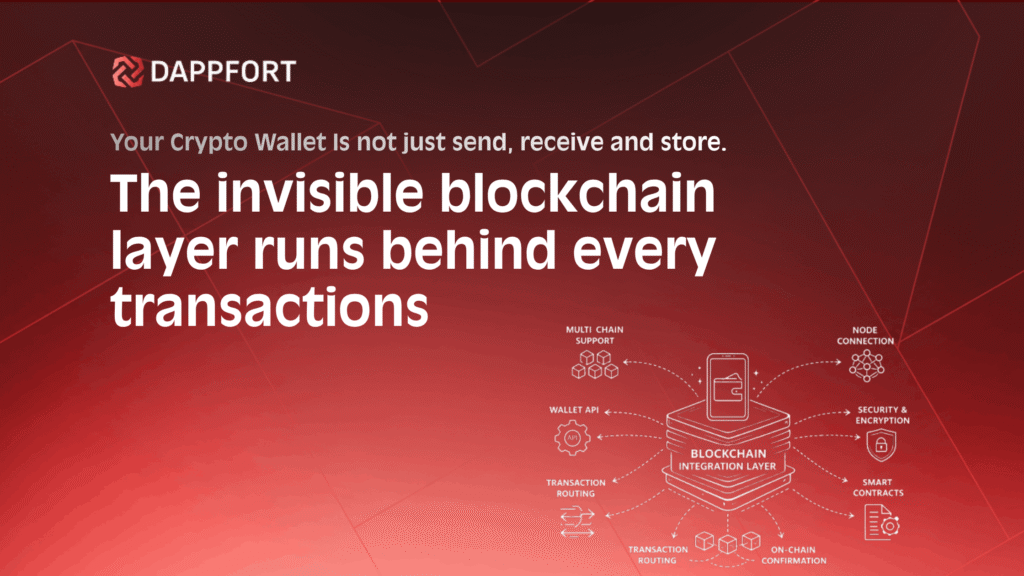
This communication runs through what engineers call the Blockchain Integration Layer.
Without this layer:
- Wallet balances cannot be retrieved.
- Transactions cannot be broadcast.
- Deposits cannot be detected.
- Blockchain data cannot be synchronized.
- Multi-chain functionality cannot exist.
In simple terms, the blockchain integration layer is the bridge between a crypto wallet and the blockchain networks it supports.
For exchanges, custodial wallets, Web3 platforms, fintech apps, and enterprise blockchain products, this layer is honestly one of the most critical pieces of infrastructure you need to get right.
The thing is, a lot of wallet projects hit a wall — not because their UI was bad or features were lacking, but because the blockchain integration architecture underneath just couldn’t handle the growth.
This guide walks through how the blockchain integration layer works, why it matters, and how modern wallet platforms actually build reliable multi-chain infrastructure. If you’re looking to get this right from day one, Dappfort’s crypto wallet development services are built around exactly this kind of infrastructure-first approach.
What Is the Blockchain Integration Layer?
The blockchain integration layer is the infrastructure that connects a wallet system to one or more blockchain networks. Its primary responsibility is enabling communication between the wallet application and external blockchains.
Whenever a user:
- Checks a balance
- Receives cryptocurrency
- Sends funds
- Views transaction history
- Interacts with a smart contract
- Swaps tokens
- Stakes assets
The blockchain integration layer performs the underlying communication required to complete those actions. It acts as a translator between wallet systems and blockchain networks. Without it, the wallet would have no way to understand what is happening on-chain.
Why Blockchain Integration Is More Important Than Most Founders Realize?
Many founders entering the crypto space focus heavily on front-end features.
They think about:
- User experience
- Trading interfaces
- Wallet design
- Mobile applications
- Dashboard functionality
While these areas are important, users ultimately judge a wallet based on reliability.
- Can balances load instantly?
- Do transactions process correctly?
- Are deposits detected quickly?
- Does the wallet support multiple networks?
- Can new blockchains be added easily?
The answers to these questions are determined by blockchain integration architecture. A beautiful wallet with weak blockchain connectivity will eventually lose user trust.
A well-engineered blockchain integration layer creates a stable foundation for future growth. This is exactly why businesses today look for a reliable cryptocurrency wallet development company that treats integration as a core infrastructure priority — not an afterthought.
How Wallets Actually Communicate With Blockchains?
A common misconception is that wallets store cryptocurrency. They do not. Assets always remain on the blockchain. The wallet simply provides access to those assets.
To provide that access, the wallet must communicate with blockchain nodes. A blockchain node is a system that maintains a copy of blockchain data and participates in network operations. When a wallet needs information, it sends requests to blockchain nodes.
The nodes respond with data such as:
- Account balances
- Transaction records
- Block information
- Smart contract data
- Network status
This communication occurs continuously. Every wallet interaction depends on it.
The Core Components of a Blockchain Integration Layer
Node Infrastructure
At the heart of every blockchain integration layer are nodes. Nodes provide direct access to blockchain networks.
They allow wallets to:
- Read blockchain data
- Monitor transactions
- Broadcast transfers
- Verify balances
A wallet that supports multiple blockchains often requires access to multiple node environments simultaneously.
For example:
- Bitcoin nodes
- Ethereum nodes
- TRON nodes
- Solana validators
- Polygon nodes
As blockchain support expands, node management becomes increasingly complex.
Blockchain Data Synchronization
Wallets must continuously stay synchronized with blockchain networks.
Synchronization allows the platform to detect:
- Incoming deposits
- Outgoing transactions
- Balance changes
- Smart contract activity
- Network events
Without synchronization, wallet data becomes inaccurate. Users may see incorrect balances. Transactions may fail to update. Operational issues may increase. This is why modern wallets implement automated blockchain monitoring systems that continuously track network activity.
Transaction Broadcasting
Whenever a user initiates a transaction, the wallet signs the request and submits it to the blockchain network. The integration layer is responsible for broadcasting the signed transaction.
This process includes:
- Receiving the signed transaction
- Validating transaction formatting
- Communicating with blockchain nodes
- Submitting the transaction to the network
- Monitoring confirmation status
Transaction broadcasting may seem simple, but at scale it becomes one of the most important responsibilities of wallet infrastructure.
Address Management
Each blockchain operates differently. Bitcoin addresses differ from Ethereum addresses. Ethereum differs from Solana. Solana differs from TRON. The blockchain integration layer manages these differences.
It ensures:
- Address generation
- Address validation
- Blockchain-specific formatting
- Network compatibility
Without proper address management, transaction failures can increase significantly.
Multi-Chain Wallet Infrastructure
The cryptocurrency industry is no longer dominated by a single blockchain. Users expect access to multiple ecosystems.
A modern wallet may support:
- Bitcoin
- Ethereum
- BNB Chain
- Polygon
- Avalanche
- Solana
- TRON
- Arbitrum
- Optimism
Each blockchain introduces unique technical requirements. Different consensus mechanisms. Different transaction structures. Different fee systems. Different smart contract models.
Managing these differences is one of the biggest challenges in wallet development. This is why scalable blockchain wallet development relies heavily on a modular blockchain integration layer.
The Evolution From Single-Chain to Multi-Chain Architecture
Early cryptocurrency wallets often focused on a single blockchain. Bitcoin wallets supported Bitcoin. Ethereum wallets supported Ethereum. Today’s market is different.
Users want:
- Multi-chain asset management
- Cross-chain visibility
- Unified wallet experiences
- Simplified asset movement
As a result, blockchain integration has evolved from a simple connectivity feature into a strategic infrastructure layer. Businesses that build scalable integration architecture gain a significant competitive advantage.
Challenges of Multi-Chain Wallet Development
Supporting multiple blockchains creates significant complexity.
Network Differences — Every blockchain has unique protocols and operational requirements.
Scalability Issues — Transaction volume increases infrastructure demands.
Node Maintenance — Managing multiple nodes requires ongoing monitoring.
Blockchain Upgrades — Networks evolve constantly.
Security Risks — Additional integrations increase operational complexity.
This is why many wallet projects underestimate the engineering effort required for multi-chain support. The challenge is not adding one blockchain. The challenge is maintaining many blockchains efficiently.
API-Based Integration vs Dedicated Node Infrastructure
When building wallet platforms, businesses generally choose between two integration approaches.
Third-Party API Providers
External infrastructure providers simplify development.
Benefits include:
- Faster deployment
- Reduced maintenance
- Lower operational complexity
However, businesses become dependent on external services.
Dedicated Node Infrastructure
Running dedicated nodes provides greater control.
Benefits include:
- Improved reliability
- Better performance
- Greater customization
- Reduced third-party dependency
The tradeoff is increased operational responsibility. As platforms scale, many businesses transition toward dedicated node environments.
How Blockchain Integration Impacts Wallet Scalability?
One of the biggest mistakes in wallet development is assuming scalability is purely a backend challenge. In reality, blockchain integration often becomes the bottleneck.
As user activity increases:
- API requests increase
- Node traffic increases
- Blockchain synchronization workload increases
- Monitoring requirements increase
Without scalable architecture, performance begins to degrade. This is why enterprise wallet platforms design blockchain integration systems with future growth in mind.
Security Considerations in Blockchain Integration
The blockchain integration layer directly interacts with external networks. Because of this, security is critical.
Key considerations include:
- Secure API communication
- Access control policies
- Infrastructure monitoring
- Transaction verification
- Network redundancy
- Operational auditing
Businesses that prioritize secure wallet infrastructure from day one avoid costly vulnerabilities down the road. Security should never be treated as a feature. It should be embedded throughout the integration architecture.
What Founders Should Understand Before Building a Wallet?
Many founders focus on wallet features.
They ask:
- Which assets should we support?
- Should we add staking?
- Should we include swaps?
- Should we integrate DeFi?
A more important question often gets overlooked:
How will the wallet communicate with blockchain networks at scale?
The answer determines:
- Performance
- Reliability
- Scalability
- User experience
- Operational costs
Strong blockchain integration architecture creates a foundation for growth. Weak architecture creates limitations that become expensive to fix later.
How Dappfort Approaches Blockchain Integration Architecture?
At Dappfort, we view blockchain integration as a core infrastructure layer rather than a simple connectivity feature. Our wallet development experts help businesses design scalable environments capable of supporting long-term growth across multiple blockchain ecosystems.
We help businesses design:
- Multi-chain wallet infrastructure
- Node architecture planning
- Blockchain synchronization systems
- Transaction broadcasting workflows
- Wallet scalability frameworks
- Enterprise blockchain integrations
- Monitoring and operational systems
By focusing on infrastructure-first architecture, businesses can build wallet platforms capable of handling future expansion without rebuilding from scratch every time.
Final Thoughts
The blockchain integration layer is honestly one of the biggest pieces of crypto wallet architecture that people overlook.
It works quietly in the background connecting wallets to blockchain networks, pulling balances, sending out transactions, keeping an eye on activity, and holding multi-chain ecosystems together.
Most users never actually see this layer, but they run into its effects each time they pull up a wallet. Fast transactions. Reliable balances. Accurate deposits. Multi-chain support. All of these outcomes are created by strong integration architecture.
As digital asset ecosystems continue expanding, businesses that invest in scalable blockchain integration infrastructure will be better positioned to support growth, improve user trust, and deliver long-term operational stability.
Because in cryptocurrency, the wallet is only as powerful as the blockchain infrastructure connected behind it.
Ready to Build a Scalable Crypto Wallet?
From blockchain integrations and node architecture to multi-chain wallet infrastructure, Dappfort delivers the foundation needed to launch secure, reliable, and growth-ready crypto wallet platforms.
FAQ
What is a blockchain integration layer?
A blockchain integration layer is the infrastructure that links a cryptocurrency wallet to blockchain networks, handling balance checks, pushing transactions, syncing data, and keeping network communication running.
Why is blockchain integration important in wallet development?
It gives wallets a way to talk to blockchain networks and covers the core stuff — balance tracking, transaction processing, and multi-chain support.
Do crypto wallets store cryptocurrency?
No. Cryptocurrency remains on the blockchain. Wallets provide access and interaction with blockchain assets.
What are blockchain nodes?
Nodes are systems that maintain blockchain data and allow wallets to read information and broadcast transactions.
Why is multi-chain wallet development challenging?
Each blockchain operates differently and requires unique integration logic, synchronization processes, and infrastructure management.
Should businesses use APIs or run dedicated nodes?
API providers enable faster deployment, while dedicated nodes offer greater control, reliability, and scalability for growing platforms.
How does blockchain integration affect wallet scalability?
Poor integration architecture can create performance bottlenecks as user activity and transaction volume increase.
How does Dappfort help with blockchain integration?
Dappfort helps businesses build scalable blockchain integration layers, node infrastructure, multi-chain wallet systems, transaction broadcasting frameworks, and enterprise-grade wallet architectures.
Related Readings:
- Cryptocurrency Wallet Development Blueprint
- Crypto Wallet Architecture Explained
- Custodial vs Non-Custodial Cryptocurrency Wallet Business Model Comparison for Fintech & Web3 Startups
- How Account Abstraction Makes AI Crypto Wallets Smarter & Scalable