Launching a crypto exchange has never been more accessible. Building a secure one is a different challenge altogether.
Over the past few years, the fintech industry has seen some of the most sophisticated cyberattacks yet. Attack techniques keep evolving, but post-incident investigations often reveal a familiar pattern, security failures rarely come down to a single vulnerability. They result from weaknesses across architecture, infrastructure, operations, and access controls.
At Dappfort, we’ve found that many founders think about security in terms of individual features, multi-factor authentication, encrypted wallets, or DDoS protection. These controls matter, but they’re only one layer of a much larger security strategy.
Effective exchange security begins at the architectural level. The decisions made during platform design determine how resilient your exchange will be against infrastructure failures, insider threats, credential compromise, and increasingly sophisticated attacks.
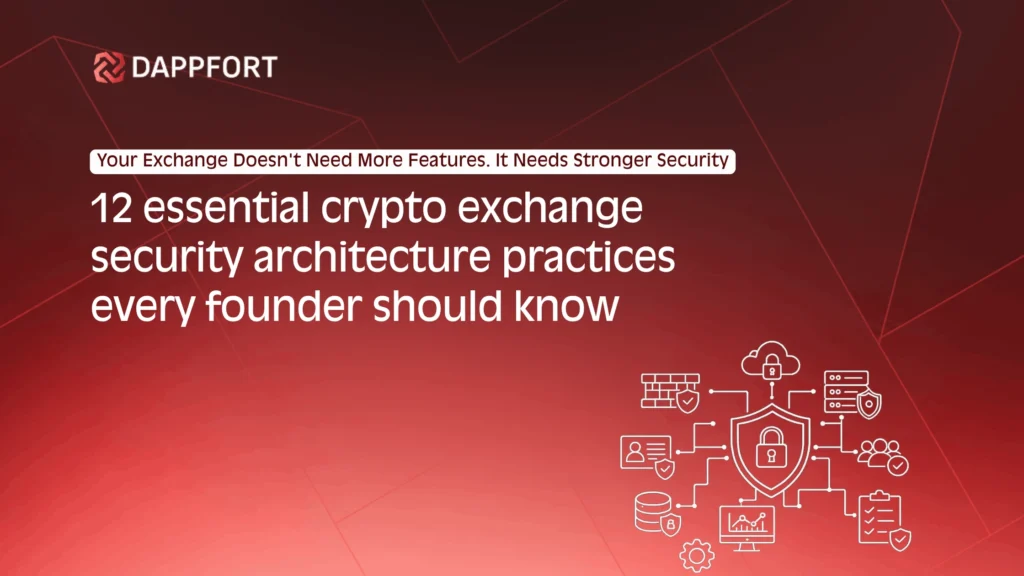
This guide covers the crypto exchange security architecture best practices every founder and CTO should put in place before launch to build a platform that prioritizes resilience, operational security, and long-term trust.
Crypto Exchange Security Architecture Best Practices: Security Starts Long Before Launch
Crypto exchanges operate some of the most security-sensitive infrastructure in the digital asset ecosystem. Protecting customer assets takes more than isolated security controls it demands a layered architecture built to reduce risk across wallets, networks, applications, infrastructure, and operations.
The strongest exchanges treat security as an ongoing architectural discipline, not a post-development checklist.
The following best practices represent the foundational controls every exchange should evaluate before moving into production.
1. Design a Multi-Layer Custody Architecture
Custody remains one of the most critical components of exchange security.
Rather than storing all assets within a single wallet infrastructure, exchanges should separate funds across multiple storage environments based on operational requirements and risk.
A typical architecture includes:
- Cold wallets for long-term reserves
- Warm wallets for operational liquidity
- Hot wallets for daily withdrawals
This layered approach reduces the amount of capital exposed to internet-connected systems while maintaining operational efficiency.
Why it matters
If a hot wallet is compromised, properly designed custody architecture limits the potential impact instead of exposing the exchange’s full asset reserves.
2. Keep the Majority of Assets in Cold Storage
One of the most widely adopted crypto exchange security architecture best practices is maintaining the majority of customer assets in offline cold storage.
Cold wallets remain disconnected from public networks, significantly reducing exposure to remote attacks.
Founders should define:
- Cold storage allocation policies
- Withdrawal approval procedures
- Secure backup processes
- Disaster recovery plans
- Key recovery mechanisms
Cold storage should be viewed as part of a broader operational security model rather than a standalone feature.
3. Implement Strong Key Management
Private keys represent one of the most valuable assets within any crypto exchange. Protecting them requires more than encryption.
A mature key management strategy should include:
- Hardware Security Modules (HSMs) where appropriate
- Multi-party approval processes
- Secure key generation
- Key rotation policies
- Backup and recovery procedures
- Restricted administrative access
Weak key management can undermine even the most sophisticated wallet infrastructure.
4. Apply Network Segmentation
Flat network architectures increase the potential impact of security incidents. Instead, exchanges should separate critical systems into isolated security zones.
Examples include:
- Wallet infrastructure
- Matching engine
- API gateways
- Administrative services
- Monitoring systems
- Internal management tools
Network segmentation limits how far an attacker can get once they’re inside part of the environment. It also means tighter operational control, and it makes monitoring a lot less of a headache.
5. Build Security Around Least-Privilege Access
Every employee, admin, service, and application should have access to exactly what it needs to do its job. Nothing more.
Least-privilege isn’t just a checkbox it cuts down insider risk and limits how much damage a compromised credential can actually do.
Access management should cover things like:
- Role-based permissions
- Multi-factor authentication
- Privileged access management
- Session monitoring
- Regular access reviews
And these permissions can’t be set once and forgotten. They need to shift as the organization does.
6. Secure APIs as Critical Infrastructure
APIs are the connective tissue of a modern crypto exchange linking trading interfaces, liquidity providers, custody systems, compliance services, and third-party integrations.
That means APIs often carry business-critical functionality, which makes them a high-value target, not something to bolt security onto later.
Access management should include:
- Role-based permissions
- Multi-factor authentication
- Privileged access management
- Session monitoring
- Regular access reviews
Access permissions should evolve alongside organizational changes rather than remaining static.
6. Secure APIs as Critical Infrastructure
Modern crypto exchanges rely heavily on APIs to connect trading interfaces, liquidity providers, custody systems, compliance services, and third-party integrations.
Because APIs often expose business-critical functionality, they should be treated as high-value attack surfaces.
Key protections include:
- Strong authentication
- Request validation
- Rate limiting
- API gateway monitoring
- Encryption in transit
- Comprehensive audit logging
Securing APIs helps protect both exchange operations and customer interactions.
Dappfort Insight
One misconception we keep running into is the idea that security gets bolted on once development is finished.
The truth is, security architecture touches almost every technical decision a team makes, infrastructure design, wallet management, deployment pipelines, day-to-day operations, all of it.
Retrofitting security after launch is usually a lot more expensive and disruptive than just building it in from the start, during the architecture phase. That’s part of why we push founders to treat security as a core design principle rather than something you deal with at the end.
Need a Secure Exchange Architecture Before Development Starts?
Discuss your business requirements with blockchain specialists and receive a roadmap for building a secure, scalable trading platform.
Building Operational Resilience Beyond Infrastructure
Security doesn’t stop at wallets, networks, or encryption. As exchanges scale up, operational processes end up mattering just as much as the technical controls underneath them. Look at most of the high-profile breaches out there, they rarely came from some clever exploit. Usually it’s sloppy operational habits, misconfigurations, or credentials that slipped out.
For founders and CTOs, the goal isn’t only to resist attacks. It’s to build something that can spot trouble, respond to it, and bounce back quickly when something does go wrong.
7. Implement Continuous Security Monitoring
Prevention alone doesn’t cut it. Continuous monitoring is what flags suspicious activity before it snowballs into a real incident.
Critical monitoring areas include:
- Login anomalies
- Privileged account activity
- Wallet transactions
- API traffic
- Infrastructure health
- Network behavior
- Configuration changes
Real-time visibility enables security teams to investigate unusual behavior and respond more effectively.
8. Build Security Into the Development Lifecycle
One of the most overlooked crypto exchange security architecture best practices is integrating security throughout the software development process.
Rather than reviewing security only before deployment, development teams should include security controls at every stage.
A secure development lifecycle should include:
- Secure coding standards
- Peer code reviews
- Dependency management
- Static application security testing (SAST)
- Dynamic application security testing (DAST)
- Penetration testing before production releases
Finding vulnerabilities during development is significantly more efficient than addressing them after launch.
Security is far more effective when it’s built into the platform from the beginning rather than added after deployment. Businesses planning a new exchange should also evaluate crypto exchange development services that prioritize secure architecture, liquidity integration, compliance, and long-term scalability before development begins.
9. Prepare for Infrastructure Failure
Security is closely connected to availability. Hardware failures, cloud outages, configuration errors, and network disruptions can affect exchange operations just as seriously as cyberattacks.
A resilient architecture should include:
- Redundant infrastructure
- Automated backups
- Geographic redundancy where appropriate
- Disaster recovery planning
- Business continuity procedures
The objective isn’t to eliminate failures but to minimize their impact on users and operations.
10. Maintain Comprehensive Logging and Audit Trails
Effective security requires visibility.
Detailed logging helps compliance, operations, and security teams understand system activity, investigate incidents, and demonstrate regulatory accountability.
Important events to record include:
- Authentication attempts
- Administrative actions
- Wallet operations
- API requests
- Trading activity
- Configuration updates
- System alerts
Logs should be protected from unauthorized modification and retained according to applicable regulatory and operational requirements.
11. Assess Third-Party Security Risks
Modern crypto exchanges depend on numerous external services, including:
- Custody providers
- Liquidity providers
- KYC and KYB platforms
- Payment gateways
- Cloud infrastructure
- Analytics tools
Every integration expands the platform’s attack surface.
Before integrating third-party services, evaluate:
- Security certifications
- Incident response capabilities
- Data protection practices
- Access permissions
- Business continuity measures
- Service-level commitments
Third-party risk assessments should become part of the vendor selection process not an afterthought.
12. Test Your Incident Response Plan
No security architecture can guarantee complete protection. What differentiates mature exchanges is their ability to respond effectively when incidents occur.
Every exchange should maintain an incident response plan covering:
- Security event detection
- Internal escalation procedures
- Technical containment
- Customer communication
- Regulatory reporting
- Post-incident reviews
Regular tabletop exercises and simulation testing help ensure teams understand their responsibilities before a real incident occurs.
Lessons from Past Exchange Security Incidents
Although every security incident is different, many share common architectural weaknesses.
Some recurring themes include:
- Excessive assets stored in internet-connected wallets
- Weak access management
- Poor key protection
- Limited network segmentation
- Insufficient operational monitoring
- Inadequate incident response preparation
The lesson isn’t simply to add more security tools. It’s to design systems where multiple layers of protection work together to reduce the likelihood and impact of compromise.
Dappfort Insight
One pattern we’ve consistently observed is that founders often ask, “What security features should our exchange include?”
A more valuable question is:
“How should security influence our architecture?”
Security shouldn’t be a bunch of separate controls bolted onto a system. It needs to shape infrastructure design, operational workflows, deployment strategies, and governance decisions right from the start of the project. When security becomes a core design principle rather than a checklist item, exchanges have an easier time adapting as threats, regulations, and business needs shift over time.
What We Recommend
From our work building blockchain infrastructure, we advise founders to take a defense-in-depth approach before an exchange goes live.
Focus on these areas:
- Work out your custody architecture before development starts.
- Keep hot wallet holdings to a minimum.
- Handle private keys using enterprise-grade key management.
- Isolate critical systems using network segmentation.
- Enforce least-privilege access throughout your infrastructure.
- Lock down APIs and admin interfaces.
- Keep watch over infrastructure and user activity on an ongoing basis.
- Weave security into every stage of the development lifecycle.
- Assess third-party vendors as part of your ongoing security program.
- Review, test, and update your incident response procedures regularly.
Security needs to grow alongside your platform, not sit static after launch.
Conclusion
Building a crypto exchange takes more than trading functionality alone. It calls for infrastructure built to protect digital assets, hold up operationally, and keep user trust intact in a threat landscape that keeps getting more advanced.
The best practices covered here give you a solid base for cutting operational risk before your platform launches. No security approach can block every threat, but a layered, architecture-driven strategy meaningfully strengthens an exchange’s ability to prevent, catch, and respond to incidents.
For founders and CTOs, the biggest security payoff doesn’t come from any single tool or feature, it comes from treating security as a core design principle across the entire exchange development lifecycle.
As the digital asset space keeps maturing, exchanges built with security in mind from the start will be better positioned to meet regulatory expectations, safeguard customer assets, and earn lasting trust in their platforms.
Ready to Build a Future-Ready Crypto Exchange?
Whether you’re launching a startup exchange or scaling an enterprise trading platform, our experts can help you plan, design, and develop a secure exchange tailored to your business goals.
Frequently Asked Questions
What is crypto exchange security architecture?
Crypto exchange security architecture refers to the overall design of the technical, operational, and infrastructure controls that protect an exchange from cyber threats, fraud, unauthorized access, and operational failures.
Why is cold storage important for crypto exchanges?
Cold storage keeps digital assets offline, significantly reducing exposure to remote attacks. Most exchanges use cold wallets to safeguard the majority of customer funds while maintaining limited balances in hot wallets for daily operations.
What is network segmentation?
Network segmentation isolates critical infrastructure into separate security zones, limiting an attacker’s ability to move laterally across systems if one component is compromised.
Why is key management critical?
Private keys control access to digital assets. Secure key generation, storage, rotation, backup, and access controls are essential for protecting customer funds.
How does least-privilege access improve security?
Least-privilege principles ensure users, applications, and administrators have only the permissions necessary to perform their responsibilities, reducing insider risk and limiting the impact of compromised credentials.
Should exchanges continuously monitor their infrastructure?
Yes. Continuous monitoring helps identify suspicious activity, infrastructure issues, unauthorized access attempts, and operational anomalies before they develop into major incidents.
How often should security architecture be reviewed?
Security architecture should be reviewed regularly and whenever significant infrastructure, regulatory, or business changes occur. Periodic penetration testing, architecture assessments, and incident response exercises help maintain an effective security posture.
Is security architecture only important for large exchanges?
No. Security architecture should be considered from the earliest stages of development. Building secure foundations before launch is generally more effective and cost-efficient than retrofitting security controls after the platform is in production.
Related Reading
- Security Measures Top Crypto Exchanges Use to Prevent Asset Theft
- Crypto Exchange Custody Architecture
- Preventing Exchange Hacks: Best Practices in Crypto Exchange Development
- Crypto Exchange Risk Management Framework