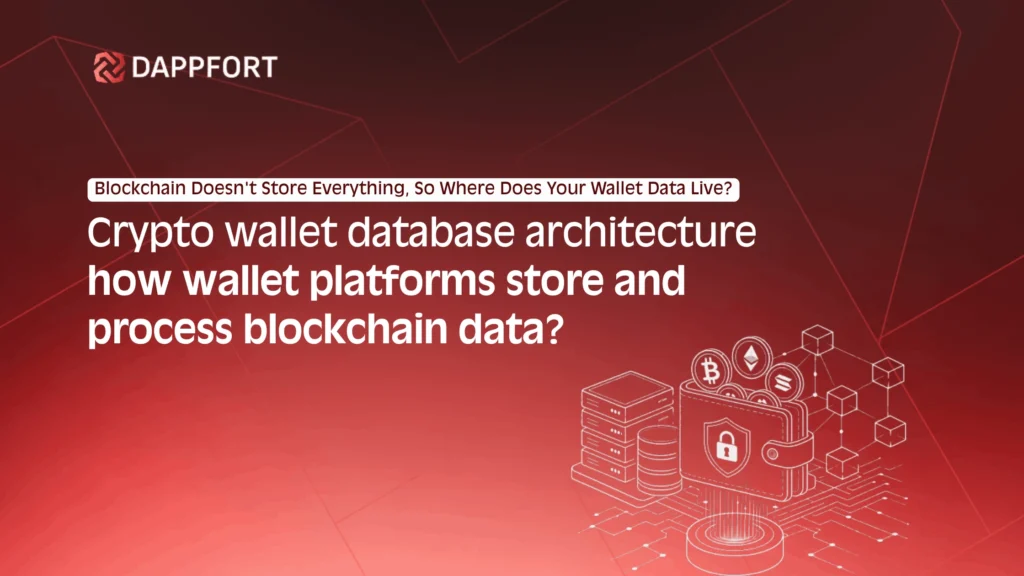
A Blockchain Isn’t Your Database And That’s One of the Biggest Misconceptions in Wallet Development
One assumption founders often run into: since blockchain already stores transactions, a crypto wallet shouldn’t need its own database.
Technically, that’s true every transaction is recorded on-chain.
Practically, though, relying on blockchain data alone would make a wallet slow, expensive to run, and hard to scale.
At Dappfort, this is usually one of the first architecture conversations we have with businesses building wallet platforms. Blockchain does give you decentralized records that’s not in question. What it doesn’t give you is the fast, searchable, user-friendly experience people now expect from a modern app.
When a user opens a wallet, they expect to see:
- Updated balances
- Complete transaction history
- Token portfolios
- NFT collections
- Recent activity
- Price information
all within a few seconds.
Fetching all of this directly from blockchain nodes every time a user opens the app would create unnecessary delays and significantly increase infrastructure costs.
That’s why the wallet platforms that actually succeed don’t rely on the blockchain alone they build a dedicated database architecture that works alongside it, not in place of it.
The blockchain stays the source of truth. The database is what powers the actual app experience.
In this guide, we’ll walk through how wallet platforms store and process blockchain data, why a database becomes essential for performance, and the infrastructure decisions founders need to weigh when building a wallet that can actually scale.
Why Crypto Wallets Need Their Own Database?
Think of the blockchain as a public ledger. It’s excellent at recording transactions securely and transparently but it wasn’t built for fast application queries.
Every time a wallet asks a blockchain node for information directly, that node has to search through the chain’s data, verify the latest network state, and return what was asked for. Do that for one user, no problem. Do it for thousands of users at the same time, and things slow down fast.
A dedicated wallet database gets around this by storing the information people access most often, in a format built for speed. Rather than querying the blockchain on every request, the wallet pulls most of what it needs from its own database, while syncing with the blockchain continuously in the background. The result is an experience that feels faster and more responsive, without sacrificing accuracy.
What Data Does a Crypto Wallet Actually Store?
One of the biggest misconceptions out there is that wallets store cryptocurrency itself. They don’t. The digital assets stay on the blockchain. What the wallet stores is the information required to manage those assets efficiently.
A typical wallet database includes:
- User profiles
- Wallet addresses
- Supported blockchain networks
- Token metadata
- Transaction history
- Portfolio summaries
- Blockchain synchronization status
- User preferences
- Security settings
- Device information
By separating application data from blockchain data, the wallet can deliver faster responses while maintaining a clean and scalable architecture.
Blockchain vs. Wallet Database
Although they work together, the blockchain and the wallet database serve very different purposes.
| Blockchain | Wallet Database |
| Stores immutable transaction records | Stores application data |
| Validates network activity | Organizes user information |
| Maintains consensus | Optimizes application performance |
| Public and decentralized | Private and application-specific |
| Not optimized for fast queries | Designed for real-time user experience |
Understanding this distinction helps founders make better infrastructure decisions early in the development process.
The Core Components of a Wallet Database Architecture
Modern crypto wallets are built around several interconnected services rather than a single database.
A production-ready architecture typically includes:
- Primary application database
- Blockchain synchronization services
- Transaction indexing engine
- Caching layer
- Blockchain node infrastructure
- Analytics and monitoring systems
Each component plays its own role, letting the platform handle blockchain data efficiently while staying fast even as the user base grows.
User Balances Are Calculated, Not Stored on the Blockchain
Every wallet has to get one thing right: showing an accurate account balance.
The blockchain holds the full transaction history, sure, but turning that into a real-time balance takes extra work. Most wallet platforms keep an eye on blockchain activity as it happens, work out account balances from it, and save the latest numbers in the application database.
That’s what lets someone open their wallet and see their portfolio right away, instead of sitting through a string of blockchain queries. And as transaction volume climbs, this setup keeps things responsive while taking pressure off the blockchain nodes themselves.
Transaction History Needs More Than Raw Blockchain Data
A balance alone isn’t enough for most users. They want to see the full picture deposits, withdrawals, token transfers, smart contract interactions, all of it. Pulling that straight from multiple blockchain networks every single time would slow everything down for no good reason.
Instead, modern wallet platforms maintain structured transaction records that are continuously updated as new blockchain events occur. This enables fast searching, filtering, and reporting while keeping the user experience smooth across multiple blockchain networks.
Consultant’s Perspective
One question we often ask founders is:
“Are you building a blockchain application or a software product powered by blockchain?”
There’s a real difference between the two.
The blockchain gives you trust, transparency, and decentralization. Your database gives you speed, usability, and an experience customers actually want to use.
The platforms that get this right don’t try to swap one out for the other they build an architecture where both do their job: the blockchain stays the source of truth, and the database handles the performance users expect.
At Dappfort, that’s the foundation we build on. Because as your platform grows, the quality of your database architecture becomes just as important as the quality of your blockchain integrations.
Designing a High-Performance Wallet Database
A crypto wallet’s performance depends on more than blockchain nodes. Behind every fast balance update, transaction history, and portfolio dashboard is a database architecture designed to process large volumes of blockchain data efficiently.
At Dappfort, our take is that the database deserves to be treated as a core piece of wallet infrastructure, not just somewhere to dump storage. Get the architecture right, and you’re not only improving performance now, you’re setting yourself up for a much easier time scaling later.
PostgreSQL vs. MongoDB: Which One Actually Wins?
One of the first calls you’ll have to make is which database to build on. There isn’t a universal winner, each serves different purposes.
PostgreSQL
PostgreSQL is widely used for financial and blockchain applications because it provides:
- ACID-compliant transactions
- Strong data consistency
- Complex querying capabilities
- Reliable relational data management
- Excellent reporting and analytics
It’s well suited for storing:
- User accounts
- Wallet addresses
- Transaction records
- Asset portfolios
- Compliance data
For most production wallet platforms, PostgreSQL forms the foundation of the application database.
MongoDB
MongoDB stores data as flexible JSON-like documents instead of relational tables.
It’s useful for:
- Dynamic blockchain metadata
- Token information
- Application logs
- Analytics
- Rapidly changing datasets
Rather than replacing PostgreSQL, MongoDB is often used alongside it for specific workloads.
Redis: Making Wallets Feel Instant
Users expect wallet balances and portfolios to load almost immediately. Repeatedly querying databases or worse, blockchain nodes creates unnecessary delays.
This is where Redis becomes valuable. Redis stores frequently requested information in memory, allowing applications to retrieve data in milliseconds.
Common Redis use cases include:
- Wallet balances
- Token prices
- Session management
- Frequently accessed portfolio data
- API response caching
A well-designed caching strategy reduces infrastructure load while significantly improving response times.
Blockchain Event Indexing
Blockchains continuously generate new blocks, transactions, token transfers, and smart contract events. Instead of searching the blockchain every time a user opens the wallet, modern platforms use an event indexing service. The indexer listens for blockchain events, processes them, and stores structured records in the application database.
Typical indexed data includes:
- Incoming transactions
- Outgoing transactions
- Token transfers
- NFT activity
- Smart contract events
- Block confirmations
Indexing enables fast searching, filtering, and reporting without repeatedly scanning the blockchain.
Blockchain Synchronization
Keeping the database synchronized with blockchain networks is essential.
Every new block may introduce:
- Updated balances
- New transactions
- Token transfers
- Smart contract events
Synchronization services continuously monitor blockchain nodes and update the wallet database whenever new activity is detected. A reliable synchronization process ensures users always see accurate information while reducing direct blockchain queries.
High-Performance Database Architecture
As wallet usage grows, database performance becomes increasingly important. Production-ready platforms are typically designed around several independent services instead of one large database.
A scalable architecture often includes:
- Primary relational database
- Blockchain indexing service
- Redis caching layer
- Read replicas for reporting
- Backup and disaster recovery systems
- Monitoring and performance analytics
Separating these responsibilities improves reliability and allows individual components to scale independently.
Designing for Millions of Users
Infrastructure that supports 10,000 users may struggle with one million.
Scalable wallet platforms prepare for growth by implementing:
- Database indexing for faster queries
- Read/write separation
- Horizontal scaling
- Distributed caching
- Queue-based event processing
- Automated backups
Planning for scalability early helps avoid expensive architectural changes as the platform expands.
Consultant’s Perspective
One of the biggest database mistakes we see isn’t picking the wrong technology, it’s expecting one database to do everything.
A modern crypto wallet needs to bring together relational databases, caching layers, indexing services, and blockchain sync, each one handling a specific job within a layered setup.
At Dappfort, this is the principle we build around. Businesses planning to build secure, scalable, and multi-chain wallet platforms often need more than database optimization alone. They require complete crypto wallet development services covering architecture design, blockchain integration, security, and long-term scalability from a single development partner.
Need a Database Architecture That Won’t Break at Scale?
Dappfort helps founders design wallet infrastructure from blockchain sync to caching to indexing built to handle real transaction volume, not just a demo.
Building a Scalable Wallet Database for Long-Term Growth
As a wallet scales, the database quickly becomes one of the most critical pieces of the whole system. A solid architecture means faster queries, dependable sync, and steady performance, even as more chains and more transactions get added to the mix.
The goal isn’t just storing blockchain data, it’s processing, organizing, and delivering that data quickly and reliably.
Common Database Architecture Mistakes
A lot of wallet platforms run into performance trouble simply because database planning gets pushed aside during development.
Some of the mistakes we see most often:
- Querying blockchain nodes for every user request
- Storing all data in a single database
- Ignoring caching strategies
- Poor indexing of transaction records
- Not planning for horizontal scaling
Addressing these issues early helps reduce technical debt and supports future growth.
Best Practices for Scalable Wallet Infrastructure
A production-ready crypto wallet should be designed to:
- Synchronize blockchain data continuously
- Cache frequently accessed information
- Separate transactional and analytical workloads
- Monitor database performance in real time
- Scale independently as users and transactions increase
These practices improve both application performance and operational reliability.
How Dappfort Designs Wallet Database Architecture?
At Dappfort, we build wallet infrastructure with scalability and maintainability in mind.
Our approach includes:
- High-performance relational databases
- Blockchain event indexing
- Redis-powered caching
- Real-time synchronization services
- Modular backend architecture
- Infrastructure designed for multi-chain expansion
Rather than focusing only on launch, we help businesses build platforms capable of supporting long-term product growth.
Frequently Asked Questions
Does a crypto wallet store cryptocurrency?
No. The actual assets never leave the blockchain. What the wallet stores is application-level data things like wallet addresses, transaction history, user preferences, and indexed blockchain records.
Which database is best for crypto wallet development?
Most enterprise-grade wallets rely on PostgreSQL as their core database, usually paired with Redis for caching, plus other tools handling blockchain indexing and analytics on top.
Why is blockchain indexing important?
Indexing takes raw blockchain events and turns them into organized, searchable records, that’s what lets a wallet pull up balances and transaction history in a fraction of the time it’d take to query blockchain nodes directly.
Final Thoughts
A crypto wallet’s success comes down to more than just being connected to the blockchain. It’s the database architecture underneath that decides how fast users can pull up their balance, scroll through past transactions, or interact with their assets at all.
For founders, putting effort into a scalable database early on tends to pay off lower development costs down the line, better app performance, and infrastructure that can actually keep up as the business grows.
At Dappfort, we build crypto wallet database architecture around three things: blockchain sync, efficient data handling, and infrastructure that performs under load. Whether it’s a consumer-facing wallet, an institutional platform, or a larger enterprise Web3 product, getting the database foundation right is what keeps things reliable and scalable as the platform grows.
Consultant’s Insight: Blockchain gives you trust. Databases give you speed. The platforms that really succeed aren’t picking one over the other, they’re combining both, so the end result is secure, fast, and smooth for the people actually using it.
Ready to Build a Wallet That Scales From Day One?
From PostgreSQL and Redis to blockchain indexing and sync Dappfort builds crypto wallet infrastructure designed for growth, not just launch.
Related Readings:
- Crypto Wallet Architecture Explained: The Blueprint Behind Secure Wallet Development
- Blockchain Integration Layer for Crypto Wallet
- Hot Wallet vs Cold Wallet Architecture
- Multi-Currency Wallet Infrastructure Explained
- Why Crypto Wallet Development Process Is Critical for a Successful Launch