Table of Contents
Choosing the right settlement model is one of the most important architectural decisions a crypto exchange can make. Settlement directly affects transaction costs, execution speed, user trust, regulatory compliance, and long-term scalability. A poor choice leads to liquidity fragmentation, high operational risk, and limited growth.
This guide explains off-chain vs on-chain settlement for crypto exchanges in a clear, practical way. It’s written for founders, CTOs, architects, and product leaders who want to make informed decisions—without marketing hype or unnecessary complexity.
Why Settlement Models Matter for Crypto Exchange Performance and Trust?
Settlement defines how and when assets actually move after a trade is executed. In crypto exchanges, inefficient settlement increases gas fees, delays withdrawals, and exposes users to counterparty risk. These issues directly impact liquidity, retention, and regulatory credibility.
Choosing the right settlement architecture ensures faster transaction finality, predictable costs, and transparent fund movement. For growing exchanges, settlement is not just a backend concern—it’s a core trust and scalability decision.
What Is On chain Settlement in Crypto Exchanges and How Does It Work?
On-chain settlement means that trade execution results are finalized directly on the blockchain. Every balance update, asset transfer, or payment confirmation is recorded through smart contracts and validated by the network.
This model prioritizes transparency and trustlessness, making it especially attractive for non-custodial and compliance-focused exchanges.
Trade Settlement Flow in On-Chain Models
On-chain settlement is a process where completed trades are settled directly on the blockchain using smart contracts. Asset transfers occur transparently, are publicly verifiable, and achieve cryptographic finality once confirmed by the network.
- Trade execution
Once a buy and sell order are matched, the trade execution triggers a settlement request. This request includes asset amounts, wallet addresses, and smart contract instructions required to finalize the transaction on-chain. - Smart contract validation
The blockchain validates the transaction using smart contract logic. This step enforces rules such as balance sufficiency, authorization, and compliance conditions before the transaction is allowed to proceed. - Blockchain confirmation
The transaction is included in a block and confirmed by the network. Confirmation time depends on network congestion, gas fees, and block finality rules. - Final asset transfer
After confirmation, assets are permanently transferred between wallets. The transaction becomes immutable and publicly auditable, completing the settlement process.
What Is Off chain Settlement and Why Do Crypto Exchanges Use It?
Off-chain settlement occurs outside the blockchain using internal ledgers maintained by the exchange. Trades are executed and settled instantly within the platform, with blockchain transactions used only when users deposit or withdraw funds.
This model prioritizes speed, scalability, and cost efficiency—especially for exchanges handling high trading volumes.
How Off-Chain Settlement Works in Crypto Exchanges
Off-chain settlement uses an exchange-controlled accounting system to update user balances after trades. Actual blockchain transactions are deferred or batched, allowing faster execution and significantly lower transaction costs.
- Internal balance updates
After a trade is executed, the exchange updates user balances within its internal ledger. This allows instant settlement without waiting for blockchain confirmation. - Netting and reconciliation
Multiple trades are netted internally, reducing the number of blockchain transactions required. This lowers gas fees and improves operational efficiency. - Deferred blockchain interaction
Blockchain transactions occur only during deposits, withdrawals, or periodic reconciliation, minimizing on-chain activity while maintaining overall fund accuracy. - Operational oversight
Because the exchange controls settlement, strong internal controls, audits, and security practices are required to manage custodial risk responsibly.
Off Chain vs On Chain Settlement for Crypto Exchanges: Key Differences
Choosing between off-chain and on-chain settlement has long-term implications for performance, security, and user trust. Many exchanges struggle not because of poor execution engines, but due to settlement models that don’t align with their trading volume, cost structure, or compliance needs. The comparison below highlights where each model excels and where trade-offs exist.
| Criteria | On-chain Settlement | Off chain Settlement |
| Transaction speed | Depends on blockchain block confirmation times, which can slow execution during network congestion and peak usage periods. | Delivers near-instant execution since trades are settled internally, making it ideal for active traders and high-frequency trading environments. |
| Gas fees and costs | Requires gas fees for every transaction, which can increase significantly during high network demand. | Minimizes blockchain interactions by settling trades internally, resulting in substantially lower transaction costs. |
| Scalability | Scales with the underlying blockchain’s throughput, which may become a bottleneck as trading volume grows. | Scales independently of blockchain limits, allowing exchanges to handle large volumes without performance degradation. |
| Security and trust | Offers maximum transparency and trustlessness, with settlements verified and recorded on the blockchain. | Relies on the exchange’s internal security, governance, and custody practices, increasing operational responsibility. |
| Best-fit use cases | Best suited for non-custodial platforms, payment-focused exchanges, and compliance-heavy use cases requiring full transparency. | Ideal for trading-heavy exchanges that prioritize execution speed, deep liquidity, and cost efficiency. |
Security and Risk Considerations in Off-Chain vs On-Chain Settlement
Settlement architecture is not just about speed or cost—it directly impacts security, user trust, and regulatory compliance. Both off-chain and on-chain models carry unique risks that crypto exchange operators must understand and mitigate before scaling operations.
- Counterparty risk
Off-chain settlement introduces counterparty risk since users trust the exchange to manage funds accurately. On-chain settlement reduces this risk by enforcing asset movement through smart contracts. - Custodial exposure
Off-chain models require exchanges to custody user funds, increasing responsibility and regulatory scrutiny. On-chain settlement reduces custodial risk by enabling non-custodial or semi-custodial models. - Smart contract risk
On-chain settlement relies heavily on smart contract security. Poorly audited contracts can introduce vulnerabilities, making rigorous testing and audits essential. - Auditability and compliance
On-chain settlement offers transparent audit trails. Off-chain settlement requires detailed internal records and reporting to meet compliance standards.
Why Hybrid Exchanges Combine Off Chain and On Chain Settlement
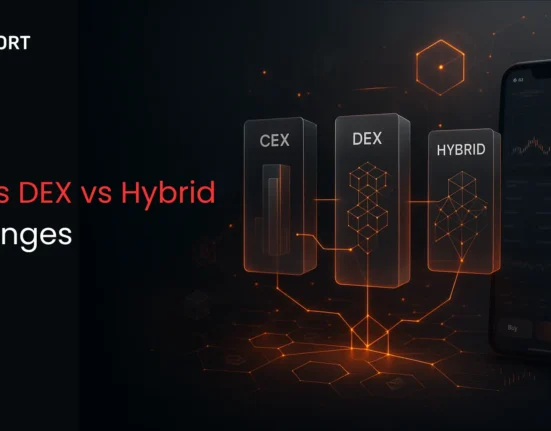
Most modern crypto exchanges adopt a hybrid approach. Trades are executed and settled off-chain for speed, while final asset custody and withdrawals are settled on-chain for transparency and security.
This hybrid settlement model delivers the performance of centralized exchanges with the trust guarantees of blockchain settlement.
👉 This is where partnering with a hybrid exchange development company becomes critical. A well-designed hybrid architecture balances speed, cost efficiency, and regulatory alignment without compromising user trust.
How to Choose the Right Settlement Model for Your Crypto Exchange
Choosing the right settlement model is critical for balancing performance, cost, security, and user trust. A structured decision framework helps crypto exchange teams align their architecture with business goals, trading patterns, and regulatory obligations.
- Trading volume and frequency
High-frequency trading platforms benefit from off-chain settlement, while lower-volume platforms can afford on-chain settlement without major cost issues. - Regulatory environment
Exchanges operating in strict jurisdictions may prefer on-chain settlement for auditability, while others may rely on off-chain systems with robust compliance controls. - User trust expectations
Non-custodial users prefer on-chain settlement, while professional traders often prioritize speed over full decentralization. - Growth roadmap
Platforms planning rapid scaling should design settlement systems that can evolve into hybrid models as volume increases.
Real-World Use Cases of Off-Chain and On-Chain Settlement
- Retail crypto exchanges : Retail platforms often use off-chain settlement to support frequent trades, while relying on on-chain settlement for deposits and withdrawals.
- Institutional trading platforms : Institutional exchanges combine off-chain execution with on-chain settlement to balance performance with compliance and reporting requirements.
- Payment-focused exchanges : Platforms focused on crypto payments often prefer on-chain settlement to ensure transaction finality and transparency.
- Cross-border settlement systems : On-chain settlement enables faster, more transparent cross-border transfers compared to traditional banking rails.
Implementing Settlement Architecture in Crypto Exchanges
Designing and deploying a settlement system requires careful planning, robust infrastructure, and ongoing oversight. This level of settlement design is typically addressed during Crypto Exchange Development Services, not as a post-deployment adjustment.
- Define settlement objectives
Start by identifying performance, cost, and compliance priorities to guide architectural decisions. - Select blockchain infrastructure
Choose networks based on throughput, fees, and ecosystem maturity. - Design off-chain accounting logic
If using off-chain settlement, ensure internal ledgers are accurate, auditable, and secure. - Deploy and audit smart contracts
On-chain components must undergo rigorous security audits to prevent vulnerabilities. - Monitor and optimize continuously
Settlement systems require constant monitoring, fee optimization, and compliance updates as regulations evolve.
Final Thoughts
There is no single “best” settlement model for all crypto exchanges. The right choice depends on your users, volume, regulatory environment, and long-term strategy. What matters most is designing settlement architecture that balances performance, security, trust, and scalability—and evolves as your platform grows.
Frequently Asked Questions
What is the difference between off-chain and on-chain Transactions?
On chain Transactions finalizes trades directly on the blockchain, while off chain Transactions uses internal ledgers with deferred blockchain interaction.
Which settlement model is more secure?
On-chain settlement offers higher transparency, while off-chain settlement relies on strong internal security and governance controls.
Can crypto exchanges use both models?
Yes. Most modern platforms use a hybrid model combining off-chain execution with on-chain settlement.
How does settlement choice affect gas fees?
On-chain settlement increases gas usage, while off-chain settlement significantly reduces transaction costs.
Are hybrid settlement models compliant?
When designed correctly, hybrid models can meet regulatory and audit requirements across multiple jurisdictions.