Running a crypto exchange has moved way past being a technical problem compliance is now the actual business foundation. In places like the United States where regulations are strict, no exchange survives or expands without solid AML (Anti-Money Laundering) systems.
When it comes to AML compliance, two frameworks matter most: KYC (Know Your Customer) and KYB (Know Your Business). These systems decide who gets to trade, how risk gets handled, and whether an exchange holds up legally in institutional markets. Most crypto startups don’t fail because of product problems they fail because compliance was never treated as core infrastructure from the start.
What is KYC in Crypto Exchanges?
KYC (Know Your Customer) is the identity verification step that confirms who a user is before they can start trading. It is designed to prevent fraud, identity misuse, and illegal financial activity.
A typical KYC system includes:
- Government-issued ID verification
- Facial recognition or liveness detection
- Address verification
- Risk scoring and user profiling
In modern exchanges, KYC is not just onboarding it is a continuous risk monitoring layer that evolves with user behavior.
What is KYB in Crypto Exchanges?
KYB (Know Your Business) extends compliance beyond individuals to organizations and institutional entities. It verifies businesses such as trading firms, hedge funds, liquidity providers, and corporate accounts.
KYB typically includes:
- Business registration and legal verification
- Beneficial ownership (UBO) identification
- Corporate structure validation
- Regulatory and sanctions screening
KYB is essential for exchanges targeting institutional liquidity and enterprise trading volume.
KYC vs KYB: Key Difference
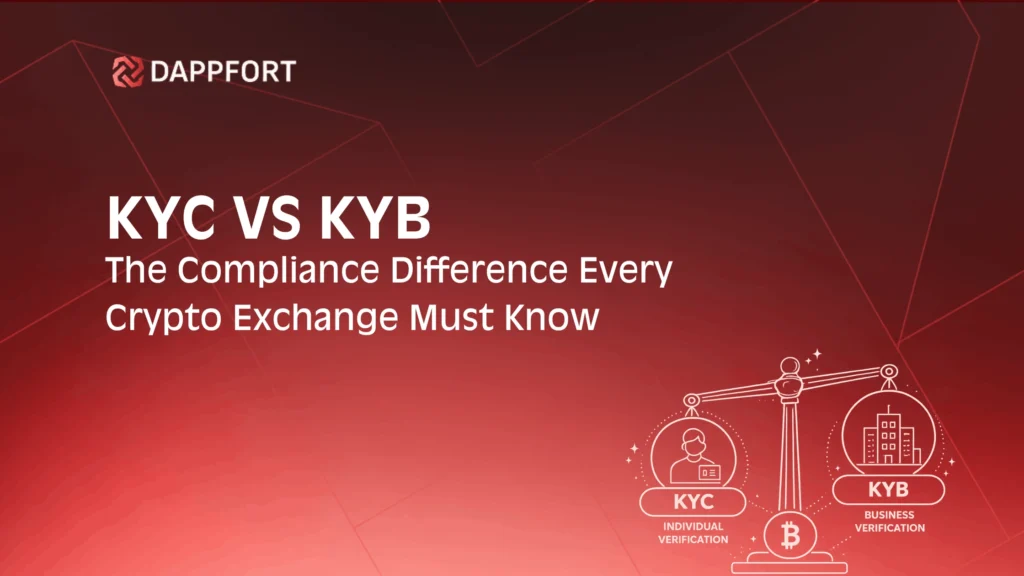
KYC focuses on individual identity verification, while KYB focuses on business legitimacy verification.
- KYC = Retail users and individuals
- KYB = Institutions and organizations
Both systems must work together as part of a unified compliance architecture inside the exchange. Without both layers, an exchange cannot scale safely in regulated markets.
Why KYC and KYB Matter in Crypto Exchange Development?
For startups building crypto exchanges, compliance directly determines survival and scalability. Whether you’re developing a platform from scratch or working with a cryptocurrency exchange development company, KYC and KYB directly influence regulatory readiness, banking access, and institutional trust.
Without proper KYC/KYB systems:
- Exchanges cannot operate in regulated regions like the US
- Banking partnerships become restricted
- Institutional investors avoid the platform
- Regulatory penalties or shutdown risks increase
Compliance is not a legal formality it is a business growth enabler.
AML Compliance in Exchange Architecture
AML compliance must be embedded into the exchange infrastructure—not added later.
A production-grade exchange integrates:
- KYC/KYB onboarding systems
- Real-time transaction monitoring
- Risk scoring engines
- Suspicious activity detection
- Audit-ready logging systems
This ensures compliance is continuous, automated, and scalable.
Startup Challenges in Implementing KYC vs KYB
Implementing KYC and KYB is often more complex than startups expect, requiring seamless verification workflows, scalable infrastructure, and a balance between compliance and user experience.
Most startups face three major challenges when implementing compliance systems:
- Complex integration with identity verification providers
- Balancing compliance with smooth onboarding experience
- Scaling verification systems during high user growth
Poor architecture leads to slow onboarding and reduced user conversion.
Strategic Insight
KYC and KYB should not be treated as external plugins. In modern exchange development, they must be designed as core infrastructure layers tightly integrated with trading, wallet, and risk systems. This ensures compliance does not slow down the exchange—it strengthens trust and scalability.
Why Dappfort Approach Matters
At Dappfort, we build crypto exchange systems where KYC, KYB, and AML compliance are embedded directly into the core trading architecture.
This ensures:
- Regulatory readiness from day one
- Seamless onboarding for retail and institutional users
- Scalable compliance systems for global expansion
- Secure and audit-ready exchange infrastructure
We design exchanges not just for launch but for long-term regulatory and institutional survival.
Conclusion
KYC and KYB are not optional features in crypto exchange development they are foundational compliance layers.
Startups that implement them early gain a strong advantage in:
- Regulatory approval
- Institutional adoption
- Market trust and liquidity access
In modern crypto infrastructure, compliance architecture is as critical as the matching engine itself.
Explore More Crypto Exchange Insights:
- How to Start a Cryptocurrency Exchange Business
- White Label vs Custom Crypto Exchange Development
- How Liquidity Impacts Crypto Exchange Profitability
- Incredible Crypto Exchange Features You Have To Try in 2026
- The Real Cost of Crypto Exchange Development
FAQ
1. What compliance requirements are needed to launch a crypto exchange?
Launching a crypto exchange typically requires KYC verification, KYB verification, AML monitoring, transaction screening, audit logging, and regulatory reporting systems. These compliance frameworks help exchanges operate legally and scale in regulated markets.
2. How do KYC, KYB, and AML work together in a crypto exchange?
KYC verifies individual users, KYB verifies businesses, and AML continuously monitors transactions for suspicious activity. Together, they create a complete compliance framework that helps exchanges reduce risk, prevent fraud, and meet regulatory requirements.
3. Why is compliance infrastructure critical for crypto exchange growth?
Compliance infrastructure enables exchanges to secure banking partnerships, onboard institutional investors, access regulated markets, and build long-term trust. Without proper compliance systems, scaling becomes significantly more difficult.
4. Can institutional investors trade on a crypto exchange without KYB verification?
No. Most regulated exchanges require KYB verification before onboarding institutional clients, corporate trading firms, hedge funds, or liquidity providers. KYB helps validate business legitimacy and ownership structures.
5. When should startups implement KYC and KYB in crypto exchange development?
The best time to implement KYC and KYB is during the initial exchange architecture phase. Building compliance into the platform from day one reduces future costs, improves scalability, and simplifies regulatory approval processes.
Reading About KYC vs KYB Is Easy. Building It Correctly Is Where Most Exchanges Fail
Avoid costly compliance mistakes before they become regulatory problems. Dappfort helps crypto startups launch secure, scalable, and compliance-ready exchanges with confidence.