Five years ago, a crypto exchange needed a matching engine, an order book, and basic fraud rules. That was enough. Today it isn’t — not even close.
Trading volumes are bigger. Hackers are smarter. Regulators have real teeth now. And the traders who actually keep an exchange profitable have plenty of options. They will leave a platform that can’t keep up with what competitors are offering.
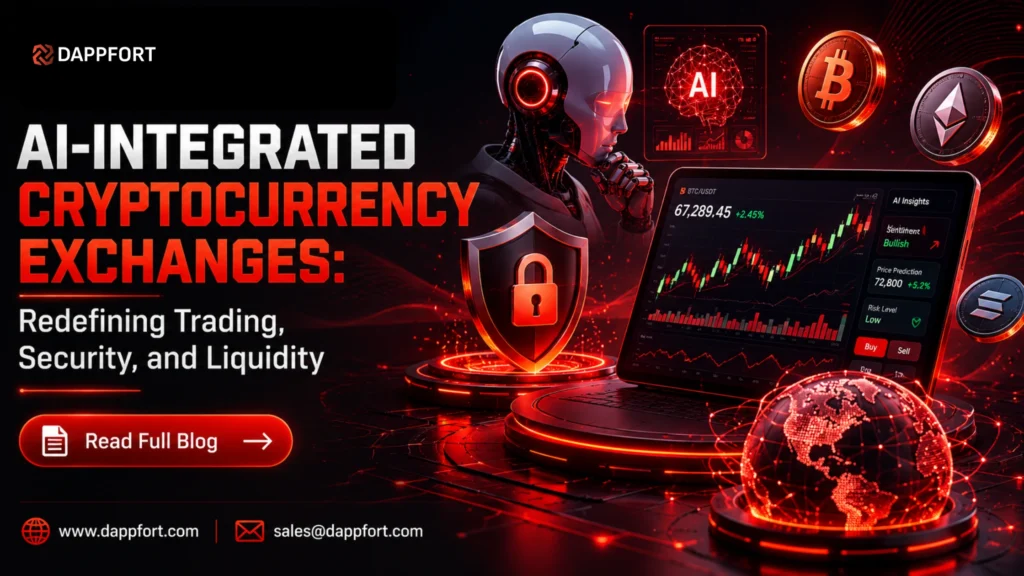
That’s where AI comes in. Exchanges that have built AI into their core systems are pulling ahead — in trade execution, security, and liquidity management. The ones still running on older systems are starting to feel it.
The Numbers Behind This Shift
The market data here tells a clear story about where things are heading and how fast.
After reviewing the chart and stats above, here’s what they mean in plain terms — 67% of the top 50 exchanges are already using AI tools in some form. The ones that aren’t are in the minority and shrinking. AI fraud detection catches threats with over 94% accuracy compared to around 60% for older rule-based systems. And exchanges using AI for liquidity management are seeing 30–45% improvements in order book depth.
These aren’t small gains. They’re the kind of numbers that show up in user retention, trading volume, and revenue.
What AI Actually Does Inside a Crypto Exchange?
The phrase AI-powered crypto exchange development gets thrown around a lot without much explanation. So let’s break down what it actually means in practice — across the three areas that matter most.
Trading — Faster, Smarter, More Profitable
Smart order execution
When a user places a large order, a basic exchange processes it straight through the order book. An AI-powered exchange looks at current market conditions, available liquidity, and price impact — then decides the best way to fill that order. Sometimes that means splitting it across multiple price levels. Sometimes it means timing the execution to reduce slippage.
The result for users is better fill prices. The result for the exchange is happier traders who stick around.
Market prediction tools
AI systems can process huge amounts of data — price history, order flow, trading volume, on-chain activity — and find patterns that humans simply can’t spot manually at that speed. Traders on AI-equipped platforms get signals and insights that give them an edge.
Personalised trading experience
AI can learn how individual users trade — which pairs they prefer, how big their orders usually are, what kind of information they care about — and adjust the interface to match. For active traders who drive most of an exchange’s volume, this kind of personalisation makes a real difference in whether they stay or leave.
Automated market making
In DeFi exchanges, AI helps liquidity providers manage their positions automatically. Instead of setting fixed parameters and leaving them, AI adjusts positions based on current volatility, fee income, and risk — consistently outperforming manual strategies.
Security — Where AI Has the Highest Stakes
Real-time fraud detection
Old fraud systems worked on fixed rules — flag anything above a certain amount, from a certain location, or matching a known pattern. Attackers learned those rules and designed around them.
AI-based fraud detection works differently. It builds a picture of what normal looks like for each account and flags anything that deviates from that. The accuracy goes up dramatically, and the number of false alarms goes down — which matters because security teams that get too many false alerts start ignoring them.
Infrastructure monitoring
AI watches for unusual activity at the system level — strange API call patterns, abnormal internal traffic, access attempts that don’t fit normal operating behaviour. It can trigger automatic responses before any user is affected, often before a human analyst would even notice something is wrong.
Market manipulation detection
Wash trading, spoofing, layering — these are tactics bad actors use to manipulate prices and deceive other traders. AI can spot the patterns these tactics leave behind and flag them for review faster than any manual monitoring process.
Automated KYC and AML
Manual identity checks are slow and expensive. AI-assisted verification — document checking, liveness detection, identity matching — brings onboarding time down from hours to minutes without sacrificing accuracy. On the transaction monitoring side, AI learns what suspicious looks like in your actual user base rather than applying generic rules that generate too much noise.
Liquidity — The Problem AI Was Made For
Liquidity is one of those exchange problems that never fully gets solved — it just gets better or worse depending on how well you manage it. And managing it well requires processing more information faster than any human team can handle.
Dynamic market making
AI adjusts bid-ask spreads and order placement in real time based on volatility, inventory levels, and what competitor order books look like. Fixed strategies can’t do this — they’re either too tight when markets get volatile or too wide when things calm down. AI adapts continuously, which means better spreads for traders and more consistent income for the exchange.
Liquidity pool management
In DeFi, managing capital across multiple pools involves constant decisions about where to place funds based on fee income, impermanent loss risk, and rebalancing costs. Even experienced manual strategies leave money on the table compared to AI-optimised approaches.
Cross-exchange liquidity routing
When a user places an order, AI can route it across multiple liquidity sources — internal order books, other exchanges, OTC desks — to get the best possible fill. This decision involves comparing prices, estimating execution costs, and accounting for latency across multiple sources simultaneously. No human can do this fast enough. AI can.
Compliance — Turning a Cost Into a Process
Compliance used to be a manual, expensive headache. AI is turning it into something much more manageable.
Travel Rule compliance — sharing sender and receiver details for transactions above a certain size — creates data processing work that grows directly with transaction volume. AI handles the matching, verification, and reporting automatically.
Sanctions screening in real time, across every transaction as it happens rather than in overnight batch runs, is only practical with AI assistance. Checking every transaction against OFAC, EU, and UN sanctions lists manually is simply not possible at the speed modern exchanges operate.
Regulatory reporting — the transaction reports, suspicious activity reports, and data submissions regulators require — gets automated. Compliance staff spend their time on decisions that actually need human judgement instead of processing paperwork.
What Building an AI Exchange Actually Requires?
This part of the conversation gets skipped too often.
AI features don’t just get added to an existing exchange platform the way you’d add a new payment method. The infrastructure has to be built to support them from the start. This is why selecting the right crypto exchange technology stack early is critical, as every layer of the platform affects AI performance, scalability, and operational efficiency.
Clean data pipelines are the foundation. An AI system is only as useful as the data it runs on. Exchanges without well-structured, real-time data flows will see poor performance from their AI tools regardless of how sophisticated those tools are.
Low latency architecture is non-negotiable for trading AI. Building a scalable exchange infrastructure also ensures the platform can handle increasing transaction volumes, larger datasets, and more complex AI workloads without sacrificing performance.A fraud detection system that adds a quarter of a second to every transaction is unacceptable in a trading environment where milliseconds affect execution quality.
Model maintenance infrastructure is something most people don’t think about until it’s too late. AI models trained on old data degrade over time as market conditions change. You need the systems to retrain models regularly, measure their performance continuously, and update them without taking anything offline.
Getting all of this right is much easier when it’s designed in from the start. Retrofitting AI capabilities into an exchange that wasn’t built for them is expensive, slow, and usually produces results that don’t justify the investment.
Building This With Dappfort
The difference between an exchange that uses AI effectively and one that just has AI features on the marketing page comes down to how the platform was designed and who built it.
Dappfort builds crypto exchange platforms where AI integration is part of the architecture from day one — not bolted on afterward. Its Dappfort crypto exchange development services focus on building trading systems that can support AI-driven execution, security, liquidity, and compliance at scale.
The exchanges winning in 2026 got these decisions right early. If you are planning an exchange build or a significant upgrade to an existing platform, now is the right time to have the conversation before the architecture decisions are locked in and harder to change.
Build an AI-Powered Crypto Exchange for the Future
Create a smarter, faster, and more secure crypto exchange platform with Dappfort’s advanced AI-driven trading, security, and liquidity solutions.