Table of Contents
The cryptocurrency market has matured far beyond simple spot trading. Today, crypto derivatives dominate global trading volume, driven by professional traders, institutions, and high-frequency market participants. Futures, perpetual contracts, and options have become essential financial instruments for hedging risk, speculating on price movements, and improving capital efficiency.
As demand continues to grow, many entrepreneurs and fintech companies are exploring how to build their own crypto derivatives exchange instead of relying on third-party platforms. Owning a derivative exchange offers full control over revenue, branding, compliance, and long-term scalability.
This guide is written for startup founders, CTOs, product managers, and blockchain entrepreneurs who want a clear, realistic understanding of what it takes to build a crypto derivatives exchange—from concept to launch and beyond.
What Does It Mean to Build Your Own Crypto Derivatives Exchange?
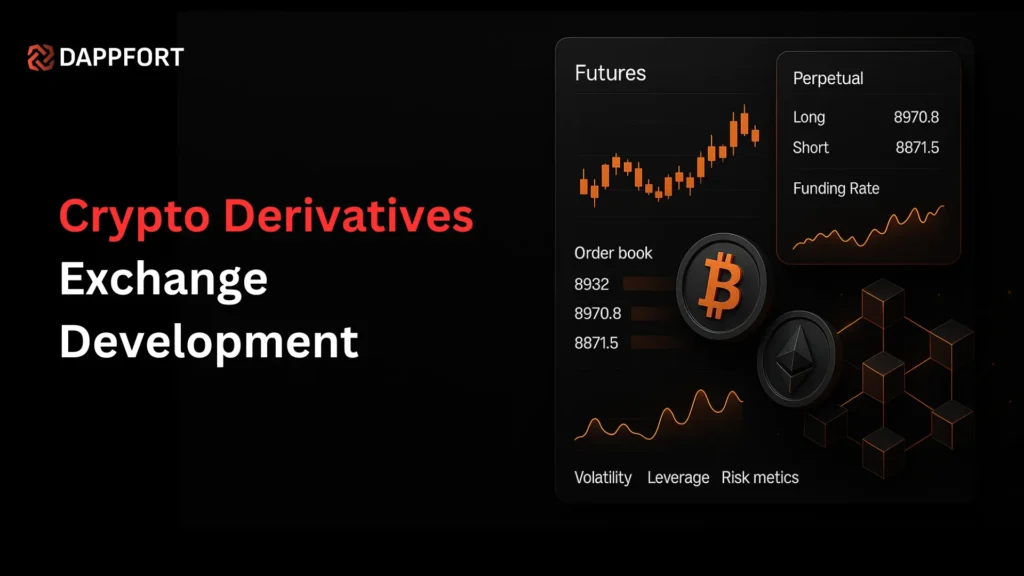
Building your own crypto derivatives exchange means developing a trading platform that allows users to trade contract-based crypto instruments rather than buying or selling cryptocurrencies directly.
These contracts derive their value from underlying assets such as Bitcoin (BTC), Ethereum (ETH), or other digital assets, enabling traders to profit from price movements without owning the asset itself.
Understanding Crypto Derivatives in Simple Terms
A crypto derivatives is a financial agreement between traders based on the future or ongoing price of a cryptocurrency. The trader does not receive the actual asset; instead, profits or losses are settled based on price changes.
Crypto derivatives are widely used for:
- Hedging portfolio risk
- Trading with leverage
- Short-selling in bearish markets
- Professional and institutional strategies
Difference Between Spot Exchanges and Derivative Exchanges
Spot exchanges focus on direct asset ownership. When a user buys Bitcoin on a spot exchange, they own the asset immediately.
Derivative exchanges, on the other hand:
- Use margin and leverage systems
- Support long and short positions
- Include liquidation and risk engines
- Cater to advanced and professional traders
This fundamental difference makes Crypto derivatives exchange development significantly more complex than spot exchange development.
Who Should Build a Crypto Derivatives Exchange?
Building a derivative exchange is suitable for:
- Fintech startups entering crypto markets
- Established crypto exchange operators
- Institutional trading platforms
- Web3 entrepreneurs targeting niche markets
- Regional exchanges seeking differentiation
Why Build Your Own Crypto Derivatives Exchange Instead of Using Third-Party Platforms?
Many founders ask why they should build their own platform instead of trading on existing exchanges. The answer lies in control, revenue, and scalability.
Full Ownership of Revenue Streams
Owning your exchange means you control:
- Trading fees (maker/taker)
- Funding rate income
- Listing and premium service fees
- Institutional partnerships
Unlike third-party platforms, revenue is not shared or restricted.
Customization & Competitive Advantage
When you build your own exchange, you decide:
- Leverage limits
- Supported assets and markets
- Risk management logic
- Regional compliance rules
This flexibility allows you to tailor the platform to a specific audience or regulatory region.
Long-Term Brand & Valuation Growth
A proprietary derivative exchange becomes a long-term digital asset. With proper execution, it can evolve into a globally recognized trading platform with enterprise-level valuation.
Types of Crypto Derivatives Trading Platforms You Can Offer
A successful derivative exchange supports multiple contract types to attract diverse traders.
Crypto Futures Trading Platform
Futures contracts allow traders to buy or sell crypto at a fixed price on a specific future date. These expired-based contracts are widely used by institutions for hedging and structured trading strategies.
Perpetual Contract Exchange
Perpetual contracts are the most popular crypto derivatives product. They do not expire and rely on funding rates to keep prices aligned with spot markets. Perpetuals drives the highest trading volume, strong user retention, continuous fee generation
Crypto Options Trading
Options provide advanced flexibility by allowing traders to buy or sell at a predetermined price without obligation. Options are favored by professional traders for volatility strategies and risk management.
Margin & Leveraged Trading
Leverage allows users to trade larger positions with smaller capital. Proper margin logic (Cross/isolated margin) and liquidation systems are essential to prevent systemic risk.
Must-Have Features to Build a Crypto Derivatives Exchange
Feature completeness is a major ranking and conversion factor.
High-Performance Matching Engine
The matching engine is the core of the exchange. It must support:
- Thousands of orders per second
- Ultra-low latency execution
- Fair price discovery
- High concurrency
Margin, Leverage & Risk Engine
This system handles:
- Real-time margin calculation
- Liquidation triggers
- Cross and isolated margin modes
- Risk exposure monitoring
Poor risk management is the number one reason derivative exchanges fail.
Multi-Asset Wallet System
Wallet architecture must include:
- Hot wallets for liquidity
- Cold wallets for security
- Automated reconciliation
- Multi-chain asset support
Advanced Order Types
Professional traders expect:
- Market and limit orders
- Stop-loss and take-profit
- Conditional and trigger orders
Admin Dashboard & Controls
Admins must have visibility into:
- User activity
- Market risk
- Liquidity levels
- System health
Architecture & Tech Stack to Build Your Own Crypto Derivatives Exchange
A crypto derivatives exchange must process thousands of orders, price updates, and risk checks in real time without failure. The architecture and tech stack define how these systems communicate, scale under load, and recover from faults. Using well-structured cryptocurrency exchange development services helps ensure the platform can support complex derivatives trading while remaining stable as volume and users increase.
Backend Architecture
Modern exchanges use microservices for:
- Matching engine
- Risk engine
- Order management
- Wallet services
This approach improves scalability and fault isolation.
Frontend Architecture
The frontend must deliver:
- Real-time charts
- Fast order placement
- Responsive web and mobile UI
React-based frameworks are commonly used for trading dashboards.
APIs & Integrations
APIs enable:
- Algorithmic trading
- Liquidity provider access
- Market data streaming
WebSocket APIs are critical for low-latency updates.
Blockchain & Smart Contract Layer
Depending on the model, you may use:
- Custodial (CEX) architecture
- Non-custodial (DEX) smart contracts
- Hybrid approaches
Hybrid models balance performance and transparency.
Security & Risk Management When Building a Derivative Exchange
Security is non-negotiable in crypto derivatives exchange development.
Wallet & Fund Security
Best practices include:
- Cold wallet storage
- Multi-signature approvals
- Hardware security modules
Infrastructure & Network Security
Critical protections include:
- DDoS mitigation
- Load balancing
- Failover systems
- Continuous monitoring
Market Integrity & Fair Trading
Exchanges must implement:
- Mark price calculation
- Index price aggregation
- Anti-manipulation rules
Regulatory & Compliance Requirements (Global Perspective)
Regulatory readiness increases trust and longevity.
KYC & AML Compliance
Mandatory components include:
- Identity verification
- Transaction monitoring
- Reporting and record retention
Regional Compliance Considerations
- United States: CFTC and SEC oversight
- Europe: MiCA regulations
- Asia: Country-specific licensing
- Middle East: Regulated crypto hubs
Regulations vary and evolve continuously.
Cost to Build Your Own Crypto Derivatives Software
The cost to build a crypto derivatives exchange starts from $10,000, depending on the platform scope, supported contract types, security requirements, and compliance level.
Development Cost Breakdown
Major cost factors:
- Matching engine development
- Frontend and backend engineering
- Security audits
- Cloud infrastructure
- Legal and compliance setup
Timeline Estimates
| Phase | Estimated Time |
| Planning & design | 4–6 weeks |
| Core development | 3–5 months |
| Testing & audits | 1–2 months |
| Launch & scaling | Ongoing |
Our Crypto Derivatives Exchange Development Process
The crypto derivatives exchange development is a detailed process. While it’s straightforward, it requires careful planning. Here’s a step-by-step guide to help you understand the journey and set expectations.
Step 1: Initial Consultation
We begin with an in-depth consultation to fully understand your vision, objectives, and the scope of your project. Our team collaborates with you to determine the essential features and functionalities to be included in your crypto derivatives exchange. This foundational step ensures alignment and clarity, setting the stage for a successful project.
Step 2: Requirement Analysis And Gathering
In this phase, we carefully gather and analyze the specific requirements for your crypto derivatives exchange. Our team works closely with stakeholders to identify key features and define technical specifications. This thorough evaluation allows us to create a clear roadmap for the development process.
Step 3: Design And Prototyping
We focus on creating user-centric designs and prototypes that reflect your brand identity. Our design team emphasizes intuitive navigation and aesthetic appeal, resulting in a seamless user interface. Prototype testing allows for early feedback, ensuring that all design adjustments are made before development commences.
Step 4: Development And Integration
Using advanced technologies, our team builds the exchange platform, incorporating all features outlined in previous phases. We ensure smooth integration of key functionalities, including wallet solutions and trading APIs, to enable seamless trading operations. Regular progress updates keep you informed throughout the process.
Step 5: Quality Assurance And Testing
Our dedicated QA team conducts rigorous testing to identify and resolve any bugs or issues before the platform is released. We perform functional, performance, and security assessments to ensure that the platform operates optimally under various conditions, providing a secure and reliable trading environment.
Step 6: Deployment And Launch
Once the testing phase is completed, we move forward with deployment, ensuring all systems are ready for public access. Our experienced team manages the entire launch process, addressing any last-minute modifications. We focus on delivering a smooth transition, ensuring users can begin trading with ease.
Step 7: Post-Launch Support And Maintenance
After launch, we provide continuous support and maintenance to ensure the ongoing success of your exchange. Our team monitors performance, listens to user feedback, and implements regular updates as needed. This proactive support enhances operational efficiency and boosts user satisfaction over time.
Build from Scratch vs White Label Derivative Exchange
Choosing the right approach impacts speed and flexibility.
Build from Scratch
- Pros: Full control, scalability
- Cons: Higher cost, longer timeline
White-Label Solution
- Pros: Faster launch, lower cost
- Cons: Limited customization
Which Is Right for You?
Startups often begin with white-label solutions, while enterprises prefer custom builds.
Monetization Models for Crypto Derivatives Exchanges
A sustainable business model is critical.
Trading Fees
Maker/taker fees form the core revenue stream.
Funding Rate Revenue
Perpetual contracts generate continuous income.
Listing & Premium Services
Additional revenue includes:
- Token listings
- Advanced analytics
- Institutional tools
Final Thoughts – Is Building Your Own Crypto Derivatives Exchange Worth It?
Building a crypto derivatives exchange is a strategic long-term investment that goes beyond software development. Success depends on performance, security, risk management, and regulatory readiness—key factors that directly influence user trust and platform scalability.
With crypto derivatives driving the majority of global trading volume, businesses entering this space need more than basic exchange functionality. A robust matching engine, advanced margin and liquidation systems, and institutional-grade security are essential to compete with established platforms.
Partnering with an experienced crypto exchange development company like Dappfort helps reduce technical and operational risk. Dappfort focuses on building scalable, high-performance, and customizable derivative exchange solutions aligned with real trading and compliance requirements. Their expertise enables startups to launch faster and enterprises to scale confidently.
Get cost estimation on Whatsapp
Frequently Asked Questions (FAQ)
How long does it take to build a crypto derivative exchange?
Typically 4–8 months depending on complexity.
How much does it cost to develop a crypto derivative exchange?
Costs vary based on features, security, and compliance.
Is it legal to run a derivative exchange?
Yes, with proper regulatory compliance.
What is the biggest technical challenge?
Risk management and liquidation logic.
Can I start with perpetual contracts only?
Yes, many platforms launch with perps first.
Should I choose white-label or custom development?
It depends on budget, timeline, and scalability goals.