Hot Wallet vs Cold Wallet for Crypto Exchanges: Which Custody Model Is Safer?
As cryptocurrency adoption continues to grow globally, security remains one of the biggest concerns for crypto exchanges, institutional investors, and fintech companies. Every exchange must decide how to protect customer assets while maintaining enough liquidity for daily trading operations.
Whether you’re launching a new platform or working with a cryptocurrency exchange development company, wallet security remains one of the most important infrastructure decisions you’ll make.
This is where the debate between hot wallets and cold wallets becomes important.
While hot wallets enable instant transactions and operational efficiency, cold wallets provide stronger protection against cyberattacks and unauthorized access. Most successful exchanges today use a hybrid custody model that combines the strengths of both approaches.
This guide explains how hot wallets and cold wallets work, their advantages and risks, and the best practices used by leading U.S. cryptocurrency exchanges.
Hot Wallet vs Cold Wallet for Exchanges
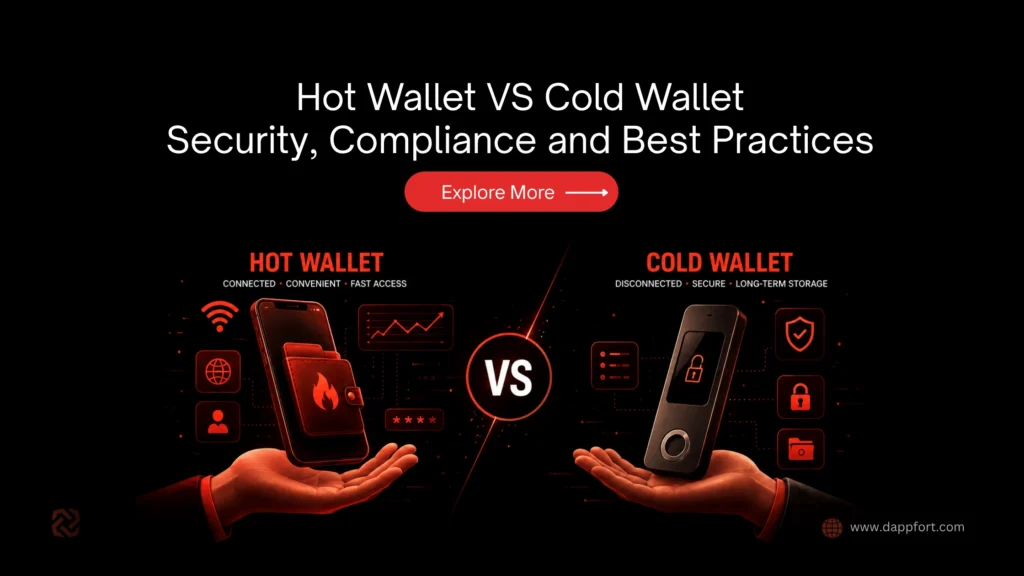
Hot wallets maintain a live internet connection, which makes them practical for handling deposits, withdrawals, and real-time trading.
Cold wallets sit completely offline disconnected from the web entirely which makes them the right place for funds that don’t need to be accessed constantly.
Most exchanges don’t put all their eggs in one basket. They divide holdings between hot and cold storage, keeping daily operations smooth without leaving the bulk of customer funds sitting in an exposed position.
In practice, that split usually looks something like this:
- Hot Wallet Storage: 1%–10% of assets
- Cold Wallet Storage: 90%–99% of assets
- Best Practice: Hybrid custody architecture
Keep just enough in hot wallets to cover what customers need day to day. Lock the rest away somewhere considerably harder to reach.
What Is a Hot Wallet?
A hot wallet is a crypto wallet with a permanent internet connection. Businesses investing in secure cryptocurrency wallet development services often implement both hot and cold wallet infrastructure to balance security and accessibility.
Exchanges depend on them constantly. Every withdrawal request, every deposit, every executed trade — something has to move those funds in real time. That something is a hot wallet.
Without them, an exchange simply can’t function the way modern users expect. Delays of any kind tend to erode trust fast in this space.
Common Uses of Hot Wallets
- Processing withdrawals
- Managing customer deposits
- Supporting trading liquidity
- Automated payment systems
- High-frequency transaction processing
Advantages of Hot Wallets
- Fast transaction processing
- Real-time access to funds
- Improved user experience
- Efficient operational workflows
Risks of Hot Wallets
- Exposure to cyberattacks
- Private key compromise
- Insider threats
- Malware and phishing attacks
- Increased attack surface
Being online around the clock means being a visible, active target. Attackers know hot wallets are always running, which makes them a natural focus point. Responsible exchanges treat them like a cash register — enough inside to run the day, not the whole vault.
What is a Cold Wallet?
A cold wallet stores crypto with zero internet connection.
There’s no active link for anyone to probe or exploit remotely. Reaching the private keys on a cold wallet requires physical presence — which is a completely different kind of challenge compared to a remote hack.
Exchanges use cold storage to protect the bulk of what they hold. It functions like a vault beneath the bank — the place where the real reserves sit, rarely touched, and heavily controlled.
Types of Cold Wallet Storage
- Hardware wallets
- Air-gapped devices
- Offline signing systems
- Institutional custody vaults
- Multi-signature cold storage systems
Advantages of Cold Wallets
- Maximum security
- Reduced cyberattack risk
- Better protection against hacking
- Stronger regulatory confidence
- Enhanced institutional trust
Limitations of Cold Wallets
- Slower access to funds
- Additional operational procedures
- More complex recovery processes
- Increased infrastructure requirements
Cold storage isn’t fast or particularly flexible. Moving funds in and out takes more steps and more planning. But for reserves that sit still most of the time, the trade-off makes complete sense.
Hot Wallet vs Cold Wallet: Key Differences
| Feature | Hot Wallet | Cold Wallet |
| Internet Connection | Yes | No |
| Transaction Speed | Instant | Slower |
| Security Level | Moderate | High |
| Daily Operations | Excellent | Limited |
| Hacking Risk | Higher | Lower |
| Asset Storage | Small Percentage | Majority of Funds |
| Regulatory Preference | Limited | Preferred |
For exchanges serving U.S. customers especially, holding significant reserves in cold storage has stopped being a recommendation and started being an expectation.
Why Leading Crypto Exchanges Use Both?
People new to running an exchange often assume it’s a straightforward choice — pick hot wallets or cold wallets and build around that decision.
The exchanges doing this well don’t think that way.
They use both, on purpose, because the two wallet types aren’t competing — they’re solving different problems. Hot wallets handle the fast-moving, transactional side of the business. Cold wallets handle protection of the reserves underneath. Each does something the other genuinely can’t.
Typical Exchange Custody Architecture
Hot Wallet Layer
Keeps enough liquidity on hand for:
- Customer withdrawals
- Trading settlements
- Platform operations
Cold Storage Layer
Secures long-term reserves through:
- Offline key storage
- Multi-signature authorization
- Segregated security controls
Running both layers together means an exchange can serve customers without delay while keeping most assets somewhere much harder to compromise.
How Much Crypto Should Exchanges Keep in Cold Storage?
There’s no single number that works for every operation. Volume, withdrawal patterns, risk tolerance, and business model all play a role. That said, most exchanges end up somewhere in a familiar range.
Small Exchanges
- 90%–95% cold storage
- 5%–10% hot wallet liquidity
Mid-Sized Exchanges
- 95%–98% cold storage
- 2%–5% hot wallet allocation
Institutional Exchanges
- 98%–99% cold storage
- 1%–2% operational liquidity
The logic doesn’t change much across the board — fund what customers need daily, and protect everything else.
Security Best Practices for Crypto Exchanges
Wallet strategy matters a great deal, but it doesn’t cover everything. A strong crypto exchange security architecture also includes multi-signature controls, monitoring systems, and secure custody practices. Exchanges serious about security build it in layers — not just at the wallet level, but across their entire operation.
Multi-Signature Authorization
No single person or system approves a transfer alone. Multiple sign-offs are required before funds go anywhere.
Hardware Security Modules (HSMs)
Cryptographic keys live in hardware built specifically to resist tampering and extraction attempts.
Multi-Party Computation (MPC)
Key control gets distributed across multiple parties, removing the single point where everything could fall apart.
Continuous Monitoring
Suspicious behavior gets flagged the moment it appears — not hours later during a routine log review.
Segregation of Duties
No individual has the access needed to both authorize and execute a fund transfer on their own.
Cold Storage Audits
Balances and custody procedures get checked on a regular schedule to make sure everything lines up correctly. Stack these practices on top of a solid wallet setup, and the overall security picture for an exchange gets considerably stronger.
Compliance Considerations for Exchange Business
Security has grown well beyond a technical checkbox. Modern exchanges must also address cryptocurrency exchange compliance requirements to satisfy regulators, institutional investors, and enterprise partners.
Regulators, institutional clients, and enterprise partners now treat custody practices as a genuine business evaluation — something they examine carefully, not skim over.
Before committing to an exchange, serious stakeholders typically want clear answers on:
- Asset protection policies
- Operational resilience
- Custody transparency
- Incident response procedures
- Independent security audits
- Customer asset segregation
Exchanges that answer those questions clearly with documentation and a real track record behind them — tend to build the kind of trust that actually lasts.
Hot Wallet vs Cold Wallet: Which Is Better?
The answer depends on the objective.
Choose Hot Wallets When:
- Fast transactions are essential
- Customer withdrawals are frequent
- Liquidity requirements are high
Choose Cold Wallets When:
- Protecting long-term reserves
- Managing institutional assets
- Reducing cyberattack exposure
- Meeting enterprise security expectations
Best Choice for Exchanges
For most exchanges, treating this as an either/or decision is the wrong starting point entirely. A hybrid model delivers speed where the business needs it and protection where the stakes are highest — which is exactly why it’s become the default architecture for platforms that are built to last.
Future Trends in Exchange Wallet Security
The security landscape keeps moving. Exchanges that were considered well-protected just a few years ago are actively rebuilding their infrastructure — not because they failed, but because better tools now exist and the threat environment has shifted.
Emerging technologies include:
- MPC Wallet Infrastructure
- Institutional Custody Platforms
- Hardware Security Modules
- Decentralized Custody Models
- Zero-Trust Security Frameworks
- Automated Risk Monitoring
Exchanges putting these into practice are finding genuine ways to tighten security without adding drag to daily operations — which is the combination everyone in this space is chasing.
Frequently Asked Questions
What is the main difference between a hot wallet and a cold wallet?
A hot wallet is connected to the internet and enables fast transactions, while a cold wallet remains offline to maximize security.
Why do crypto exchanges use hot wallets?
Hot wallets allow exchanges to process deposits, withdrawals, and trading activities in real time.
Are cold wallets completely safe?
No system is completely risk-free. However, cold wallets significantly reduce exposure to online attacks compared to internet-connected wallets.
What percentage of funds should be stored in cold wallets?
Most exchanges keep between 90% and 99% of customer assets in cold storage.
Do institutional investors prefer cold storage?
Yes. Institutional investors generally favor exchanges with strong cold storage policies and advanced custody controls.
Is a hybrid wallet strategy the industry standard?
Yes. Most major exchanges use a combination of hot wallets and cold wallets to balance security and liquidity.
Final Thoughts
The hot wallet versus cold wallet debate tends to get framed as a trade-off — speed on one side, security on the other. But that framing doesn’t match how the best exchanges actually operate.
Platforms handling serious volume don’t make that trade-off. They build systems where both happen simultaneously. Hot wallets keep the business running day to day. Cold wallets keep customer funds protected over the long term. Neither replaces the other — they work best when they work together.
For anyone building or running a crypto exchange, a hybrid custody model isn’t just a smart choice anymore. It’s becoming the baseline that customers, regulators, and institutional partners expect to see. Add multi-signature controls, continuous monitoring, and regular audits on top of that, and you’ve built something that can genuinely hold up under pressure.
The exchanges making those investments now are the ones positioned to keep growing — and keep earning trust — as this industry continues to mature.
Need a Secure Wallet Infrastructure for Your Crypto Exchange?
Implement hot wallets, cold storage, multi-signature security, and compliant custody solutions to protect customer assets while maintaining operational efficiency.