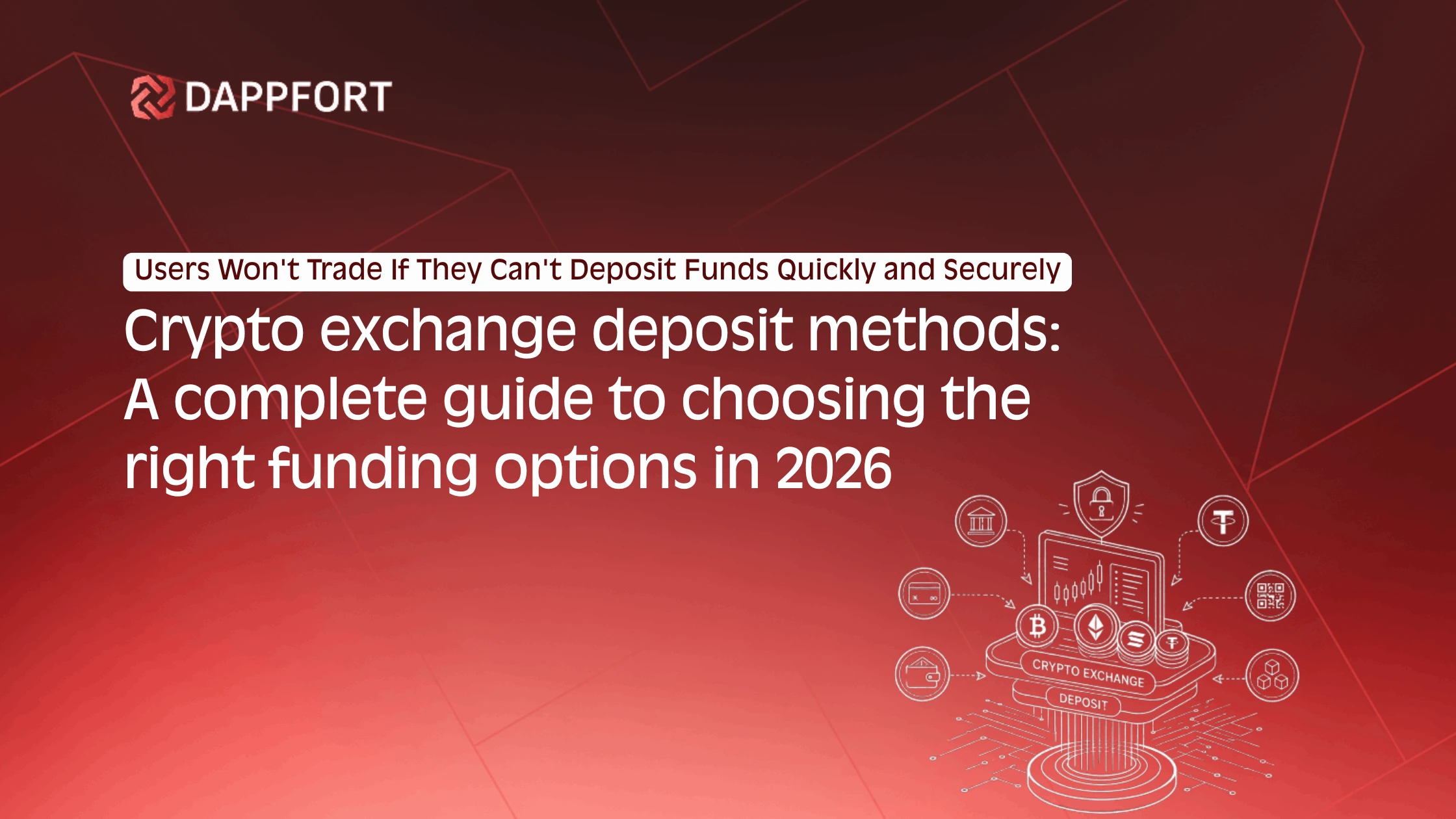
A cryptocurrency exchange succeeds long before a trader executes their first order. Success often begins with something far less exciting but significantly more important. Making the first deposit effortless.
Many startups invest months evaluating trading engines, liquidity providers, wallet infrastructure, and security architecture. These are all essential components of a modern exchange.
However, one area is consistently underestimated during product planning:
Deposit infrastructure. If users can’t fund their accounts quickly, securely, and with a payment method they’re comfortable using, many will abandon the platform before they ever place a trade.
For new exchanges this hits customer acquisition costs, onboarding conversion rates, and long-term retention directly. For institutional clients, limited funding options can be the deciding factor between one exchange and a competitor.
Deposit methods are no longer just payment features. They represent the first interaction users have with your platform’s financial infrastructure.
At Dappfort, we tell startups to treat deposit methods as part of their product strategy, not just another technical integration to bolt on. Every payment option brings its own set of operational trade-offs, compliance, settlement, fraud prevention, regional reach, and how the experience feels for the customer.
Get the right combination of deposit methods in place, and it can speed up growth. Choosing the wrong combination creates unnecessary friction before trading even begins.
This guide explores the deposit methods every cryptocurrency exchange should evaluate before launch and explains how thoughtful payment infrastructure contributes to a more scalable, user-friendly trading platform.
Why Deposit Methods Matter More Than Most Startups Realize?
When startups discuss exchange development, conversations usually revolve around trading features.
Questions typically include:
- Which matching engine should we use?
- How many trading pairs should we launch with?
- Which blockchain networks should we support?
- Should we build a custom exchange or use a white-label solution?
These are important decisions. But from a customer’s perspective, none of them matter until they can successfully fund their account. The deposit experience sets the tone for everything that follows. A complicated or slow funding process creates uncertainty. A simple and intuitive one builds confidence.
This is especially important for first-time cryptocurrency users who may already feel unfamiliar with digital asset platforms. The easier it is to complete that first deposit, the more likely users are to continue their journey and place their first trade.
Deposits Influence More Than User Experience
Deposit methods affect nearly every aspect of operating a cryptocurrency exchange.
Customer Acquisition
Marketing campaigns generate traffic. Deposit infrastructure determines how many visitors become active traders. A user who cannot access a preferred payment method is unlikely to complete registration.
Geographic Expansion
Payment preferences differ significantly across regions.
For example:
- ACH remains widely used in the United States.
- SEPA transfers are common throughout Europe.
- Open Banking adoption continues to grow across regulated European markets.
- Mobile payment solutions dominate parts of Asia.
Supporting regionally preferred payment methods improves accessibility and helps exchanges expand into new markets without redesigning their onboarding process.
Regulatory Compliance
Every fiat payment introduces compliance responsibilities.
Depending on the jurisdiction, exchanges may need to implement:
- Customer identity verification (KYC)
- Business verification (KYB)
- Anti-money laundering (AML) monitoring
- Transaction reporting
- Fraud prevention measures
Payment infrastructure should complement and not complicate your compliance strategy.
Operational Efficiency
Poorly integrated payment systems increase manual work. Compliance teams spend more time reviewing transactions. Support teams handle more funding inquiries. Finance teams reconcile multiple payment providers.
Well-designed payment workflows reduce operational complexity while improving visibility across the organization.
Before Choosing Deposit Methods, Define Your Business Model
There is no universal payment strategy for every cryptocurrency exchange. The right deposit methods depend on your business objectives, customer profile, and target markets. Before evaluating payment providers, startups should answer a few strategic questions.
Who Are Your Customers?
Different users expect different funding experiences.
For example:
| Customer Type | Primary Deposit Expectations |
| Retail Traders | Fast, simple, low-friction payments |
| Professional Traders | High funding limits and rapid settlement |
| Institutional Investors | Bank transfers, treasury workflows, compliance-ready onboarding |
| Corporate Clients | Secure account funding with comprehensive audit trails |
Knowing your audience helps you prioritize the integrations that create real business value.
Which Markets Will You Serve?
Payment preferences vary a lot depending on jurisdiction. Going global doesn’t mean you need every payment method live from day one. Instead, pick the regions that fit your early growth strategy.
For example:
- United States
- Canada
- European Union
- United Kingdom
- Middle East
- Southeast Asia
Each market has unique payment habits, banking infrastructure, and regulatory expectations. Selecting providers with strong regional coverage can simplify expansion later.
What Assets Will Users Deposit?
Funding methods extend beyond fiat currencies.
Most exchanges support a combination of:
- Cryptocurrency deposits
- Stablecoins
- Bank transfers
- Card payments
- Corporate treasury transfers
The mix should reflect your business model rather than industry trends. For example, a retail-focused exchange may prioritize instant card payments and stablecoin deposits, while an institutional platform may emphasize bank transfers and secure custody workflows.
Characteristics of an Effective Deposit Method
Not every payment option deserves a place on your platform. Every additional integration increases operational complexity, support requirements, and compliance responsibilities. Before adding a new funding method, evaluate it against several practical criteria.
Security
Customer funds should remain protected throughout the deposit process. This includes secure authentication, encryption, fraud detection, and transaction monitoring.
Speed
Settlement times influence user satisfaction. Instant or near-instant funding generally creates a smoother onboarding experience than methods requiring multiple business days.
Compliance Readiness
Payment providers should support applicable regulatory obligations, including identity verification, AML controls, and transaction reporting where required.
Cost Efficiency
Transaction fees directly affect profitability. Lower processing costs become increasingly important as trading volumes grow. However, lower cost should never come at the expense of reliability or customer trust.
Scalability
Can the payment method support higher transaction volumes as your exchange grows?
Can it expand into additional markets?
Can it integrate with future products?
Scalability should always be considered before launch—not after growth begins.
Designing a Flexible Payment Infrastructure
One of the most common mistakes we see is treating payment methods as permanent decisions. In reality, payment infrastructure should evolve alongside the business.
New regulations emerge. Customer preferences change. Regional expansion creates additional requirements.
Rather than tightly coupling payment providers into the core platform, exchanges should adopt a modular architecture where payment integrations can be added, replaced, or expanded without affecting the broader trading ecosystem.
This approach provides greater flexibility while reducing long-term development costs. It’s the same architectural principle we recommend for liquidity providers, compliance systems, and wallet infrastructure.
Dappfort Advisory Note
One of the clearest patterns we’ve observed across exchange launches is that startups often spend months refining trading functionality while dedicating relatively little time to funding workflows.
From a customer’s perspective, however, the first meaningful interaction with your platform isn’t placing a trade.
It’s making a deposit. If that experience feels slow, confusing, or unsupported in their region, many users will never reach the trading interface you’ve invested so heavily in building.
The most successful exchanges recognize this early. They don’t treat deposit methods as isolated payment integrations. They design a funding strategy that aligns with their target market, compliance obligations, and long-term growth objectives.
When payment infrastructure is planned strategically from the outset, it becomes more than an operational requirement it becomes a competitive advantage.
The 10 Crypto Exchange Deposit Methods Every Trading Platform Should Support
With your payment strategy defined, the next step is selecting the deposit methods that align with your business model and target audience. This is where many startups make an expensive mistake.
They assume offering every available payment option will attract more users. In reality, more integrations don’t necessarily create a better exchange.
Every additional deposit method introduces new considerations around compliance, settlement, reconciliation, fraud prevention, customer support, and infrastructure maintenance.
The goal isn’t to support every payment channel. It’s to build a payment ecosystem that provides customers with convenient funding options while remaining operationally efficient and scalable.
Let’s examine the deposit methods every cryptocurrency exchange should evaluate before launch.
1. Cryptocurrency Wallet Deposits
For every cryptocurrency exchange, wallet deposits form the foundation of the funding experience. Users transfer digital assets directly from personal wallets or other exchanges into their exchange wallet.
Common assets include:
- Bitcoin (BTC)
- Ethereum (ETH)
- USDT
- USDC
- Solana (SOL)
- BNB
- XRP
Best For
- Retail traders
- Experienced crypto users
- Global exchanges
- DeFi-focused platforms
Advantages
- Available worldwide
- No banking dependency
- Fast blockchain settlement
- Lower operational costs
- Supports multiple blockchain networks
Things startups Should Know
Supporting crypto deposits requires more than generating wallet addresses.
You’ll also need:
- Blockchain node infrastructure
- Deposit monitoring
- Confirmation tracking
- Wallet management
- Security controls
- Cold wallet integration
A secure wallet setup is one of the most important pieces of any exchange platform.
2. Bank Transfers (ACH, SEPA, SWIFT & Wire Transfers)
Bank transfers are still among the most trusted ways to fund a crypto exchange account.
They matter especially for:
- Institutional investors
- High-net-worth individuals
- Corporate clients
- Professional traders
Depending on which markets you’re targeting, this could include:
- ACH (United States)
- SEPA (European Union)
- SWIFT
- Domestic wire transfers
- Faster Payments (United Kingdom)
Best For
- Large deposits
- Institutional trading
- Fiat funding
- Corporate treasury operations
Advantages
- High transaction limits
- Strong customer trust
- Lower fees for large transfers
- Regulatory familiarity
Things startups Should Know
Bank integrations require close coordination with compliance processes, including:
- KYC
- KYB
- AML monitoring
- Source-of-funds verification
- Transaction reporting
Without well-designed onboarding workflows, manual reviews can slow funding significantly.
3. Credit and Debit Card Payments
Card payments remain one of the fastest ways for new users to purchase digital assets. For first-time crypto investors, they often provide the simplest onboarding experience.
Best For
- Retail customers
- Instant purchases
- Mobile applications
- Beginner investors
Advantages
- Immediate funding
- Familiar payment process
- Higher onboarding conversion
- Global accessibility
Things startups Should Know
Card payments typically involve:
- Higher processing fees
- Chargeback risk
- Fraud monitoring
- Identity verification
- Payment processor compliance requirements
Despite the additional costs, they often increase customer acquisition by reducing friction.
4. Fiat Payment Gateway Integrations
Rather than connecting directly with banking networks, many exchanges integrate payment gateway providers.
These platforms simplify:
- Fiat deposits
- Payment processing
- Regional payment methods
- Compliance workflows
- Settlement management
Best For
- Growing exchanges
- Multi-country expansion
- Retail onboarding
Advantages
- Faster implementation
- Broader payment coverage
- Simplified payment management
- Reduced infrastructure complexity
Choosing a gateway with strong regional support can significantly improve customer accessibility.
5. Fiat On-Ramp Providers
Many newer exchanges now partner with fiat on-ramp providers to simplify cryptocurrency purchases. Instead of building payment infrastructure internally, users purchase crypto through integrated third-party services.
Best For
- Startup exchanges
- White-label platforms
- Early-stage launches
Advantages
- Faster go-to-market
- Reduced compliance complexity
- Lower development effort
- Supports multiple payment methods
Things startups Should Know
While fiat on-ramp providers accelerate launch timelines, exchanges should evaluate:
- Geographic coverage
- Fee structure
- Customer experience
- Branding options
- API flexibility
The onboarding experience should feel consistent with the rest of the platform.
6. Stablecoin Deposits
Stablecoins have become one of the fastest-growing funding methods within the digital asset industry.
Many active traders prefer depositing:
- USDT
- USDC
- DAI
- FDUSD
rather than converting fiat currency before trading.
Best For
- Active traders
- Cross-border users
- International exchanges
Advantages
- Fast settlement
- Lower volatility
- Reduced banking dependency
- Efficient global transfers
Stablecoins have become especially valuable for exchanges serving customers across multiple jurisdictions.
7. Open Banking Payments
Open Banking continues to reshape payment infrastructure, particularly across Europe and other regulated markets. Rather than relying on card networks, customers authorize secure bank payments directly from their financial institutions.
Best For
- European exchanges
- PSD2-compliant markets
- Lower-cost payments
Advantages
- Faster settlements
- Reduced payment costs
- Strong customer authentication
- Lower fraud exposure
As Open Banking adoption grows, it is becoming an increasingly attractive alternative to traditional card payments.
8. Apple Pay and Google Pay
Mobile-first users increasingly expect digital wallet payments. Supporting Apple Pay and Google Pay creates a familiar payment experience while reducing checkout friction.
Best For
- Mobile trading apps
- Retail exchanges
- Younger demographics
Advantages
- Simple user experience
- Faster payments
- Improved mobile conversion
- Trusted payment environment
While these wallets typically link back to existing payment processors, they can noticeably ease mobile onboarding.
9. Peer-to-Peer (P2P) Funding
A number of exchanges let users fund accounts through peer-to-peer models, so people can transact directly with each other.
This method is common in regions where banking access is limited or payment infrastructure hasn’t fully developed.
Best For
- Emerging markets
- Regional exchanges
- Community-driven platforms
Advantages
- Expanded accessibility
- Flexible payment methods
- Local currency support
Things startups Should Know
P2P funding introduces additional operational responsibilities around:
- Escrow management
- Fraud prevention
- Dispute resolution
- User verification
- Transaction monitoring
Strong moderation and compliance processes are essential.
10. Institutional and Corporate Treasury Deposits
As institutional participation in digital assets continues to grow, exchanges increasingly support dedicated funding workflows for business clients.
Unlike retail deposits, institutional funding often involves:
- High-value wire transfers
- Corporate bank accounts
- Treasury management processes
- Internal approval workflows
- Enhanced compliance reviews
Best For
- OTC platforms
- Institutional exchanges
- Corporate trading desks
- Asset managers
Advantages
- Higher deposit values
- Long-term customer relationships
- Increased trading volume
- Stronger revenue opportunities
Supporting institutional funding requires close alignment between payment infrastructure, KYB verification, AML controls, and operational workflows.
Comparison: Which Deposit Method Fits Your Exchange?
| Deposit Method | Speed | Typical Cost | Best For |
| Cryptocurrency Wallets | Fast | Low | All exchanges |
| Bank Transfers (ACH/SEPA/SWIFT) | Medium | Low | Institutional & high-value deposits |
| Credit & Debit Cards | Instant | Higher | Retail onboarding |
| Fiat Payment Gateways | Fast | Medium | Multi-region exchanges |
| Fiat On-Ramp Providers | Fast | Medium | Startup exchanges |
| Stablecoins | Very Fast | Low | Global traders |
| Open Banking | Fast | Low | European markets |
| Apple Pay & Google Pay | Instant | Medium | Mobile-first users |
| Peer-to-Peer Funding | Varies | Low | Emerging markets |
| Corporate Treasury Deposits | Medium | Low | Institutional clients |
Not Sure Which Deposit Methods Fit Your Exchange?
Every exchange’s ideal funding mix depends on your target market and compliance obligations. Get a quick assessment from Dappfort’s team before you lock in your payment stack.
Dappfort Advisory Note
One misconception we often encounter is that supporting more deposit methods automatically creates a better exchange.
In practice, that’s rarely how it goes. The strongest platforms don’t try to support every payment method on day one. Instead, they focus on the ones that suit their target users, regulatory obligations, and growth plans.
A retail exchange serving U.S. customers might lean toward ACH transfers, debit cards, and stablecoin deposits. An institutional platform aimed at European financial firms will more likely prioritize SEPA transfers, Open Banking, and treasury workflows.
The objective isn’t to offer the widest selection of payment methods.
It’s to create a funding experience that feels seamless for the customers you actually want to attract.
Building a Scalable Payment Infrastructure for Your Crypto Exchange
Choosing the right deposit methods is only one part of the equation. The real challenge is building an infrastructure that continues to perform as your exchange grows.
Many exchanges launch successfully with a handful of payment integrations, only to encounter operational bottlenecks months later. Customer volumes increase, new markets are added, compliance requirements evolve, and suddenly the original payment architecture is no longer sufficient.
The exchanges that scale successfully don’t necessarily have the largest engineering teams. They have a payment infrastructure designed with growth in mind.
Common Deposit Infrastructure Mistakes Startups Make
Building a cryptocurrency exchange is a significant investment. Unfortunately, many payment-related challenges stem from decisions made during the earliest planning stages.
Here are the mistakes we encounter most often.
1. Supporting Too Many Deposit Methods Too Early
It’s tempting to launch with every payment option available.
- Bank transfers.
- Credit cards.
- Apple Pay.
- Google Pay.
- Open Banking.
- Stablecoins.
- P2P funding.
- Regional payment methods.
While this appears customer-friendly, every additional integration introduces:
- More compliance obligations
- Additional vendor management
- Higher maintenance costs
- More reconciliation work
- Increased testing requirements
- Greater security responsibilities
A better strategy is to launch with the payment methods that best serve your initial customer base and expand based on real usage data.
2. Ignoring Regional Payment Preferences
Payment behavior varies dramatically around the world.
For example:
- ACH remains a preferred funding method in the United States.
- SEPA transfers are widely used across the European Union.
- Open Banking adoption continues to grow in Europe.
- Mobile wallets dominate in many Asian markets.
- Stablecoins are increasingly used for international transfers.
Supporting payment methods your customers don’t actually use adds unnecessary complexity without improving conversions. Successful exchanges localize their funding experience instead of applying a one-size-fits-all payment strategy.
3. Separating Payments From Compliance
Deposits and compliance should never operate independently.
Every fiat deposit can trigger compliance obligations, including:
- KYC verification
- KYB verification
- AML screening
- Transaction monitoring
- Source-of-funds validation
- Risk scoring
When payment systems and compliance tools operate in isolation, teams often end up depending on manual reviews, duplicate data entry, and slow-moving approval processes.
A connected workflow supports faster onboarding while still preserving strong regulatory oversight.
4. Underestimating Fraud Prevention
As exchanges expand, they naturally become more appealing targets for fraud.
Common risks include:
- Stolen payment cards
- Account takeovers
- Identity fraud
- Chargeback abuse
- Synthetic identities
- Money laundering attempts
Fraud prevention should be incorporated into the payment architecture from the beginning not added after incidents occur. Strong monitoring, transaction analysis, velocity checks, and risk scoring all contribute to a more resilient platform.
5. Building a Rigid Payment Architecture
Markets evolve. Payment providers change. Banking regulations are updated. New funding methods emerge. If replacing a payment provider requires rebuilding your exchange, the architecture has become a liability.
A modular payment layer allows new providers to be added or replaced with minimal disruption. This flexibility becomes increasingly valuable as the business expands internationally.
Designing a Future-Ready Deposit Infrastructure
The most successful exchanges treat payments as an ecosystem rather than a collection of individual integrations.
Instead of connecting providers directly into the trading platform, they build an architecture where payment services operate through standardized integration layers.
A modern payment ecosystem typically includes:
Customer Funding Layer
- Cryptocurrency deposits
- Fiat deposits
- Stablecoin funding
- Institutional funding
↓
Payment Processing Layer
- Payment gateways
- Banking integrations
- Fiat on-ramp providers
- Open Banking services
↓
Compliance Layer
- KYC verification
- KYB verification
- AML screening
- Transaction monitoring
- Risk assessment
↓
Wallet Infrastructure
- Hot wallets
- Cold wallets
- Address generation
- Blockchain monitoring
↓
Trading Platform
- Account balances
- Order execution
- Withdrawals
- Portfolio management
↓
Reporting & Monitoring
- Financial reconciliation
- Compliance reporting
- Operational dashboards
- Audit logs
Each layer carries out its own specific role, all communicating through secure APIs. This modular design eases maintenance, cuts down operational risk, and makes future upgrades much simpler.
Why Payment Flexibility Matters for Long-Term Growth?
Your launch strategy isn’t your five-year strategy. Many exchanges begin by serving retail customers in a single market before expanding into new regions or introducing institutional services. As the business evolves, payment expectations evolve as well.
You may eventually need to support:
- Additional fiat currencies
- Local banking networks
- Corporate treasury funding
- Stablecoin settlements
- Regional payment gateways
- New blockchain ecosystems
A flexible architecture allows your payment infrastructure to grow alongside your business without requiring major redevelopment. Planning for change is often more valuable than optimizing for today’s requirements alone.
How Dappfort Approaches Payment Infrastructure?
At Dappfort, a cryptocurrency exchange development company, we don’t start by recommending payment providers.
Before designing any payment workflow, we work with clients to answer questions such as:
- Which customer segments are you targeting?
- Which jurisdictions will you operate in?
- Will you prioritize retail users, institutional investors, or both?
- Which regulatory requirements apply to your business model?
- How do you expect your exchange to evolve over the next three to five years?
Only after these questions are answered do we recommend an integration strategy. Our approach focuses on building a payment ecosystem that works alongside the rest of the exchange infrastructure.
That typically includes seamless integration with:
- Wallet management systems
- KYC and KYB workflows
- AML monitoring platforms
- Trading engines
- Liquidity providers
- Customer notification services
- Analytics and reporting dashboards
By designing payments as part of a connected architecture rather than isolated integrations, exchanges gain:
- Faster onboarding
- Better operational visibility
- Lower maintenance costs
- Stronger compliance readiness
- Easier expansion into new markets
- Greater flexibility when replacing providers
Technology alone doesn’t create operational efficiency. Thoughtful system design does.
Dappfort Advisory Note
One thing we’ve learned from working with crypto exchange startups: payment infrastructure isn’t something to treat as a pre-launch checklist item. It’s actually one of the biggest factors behind customer acquisition, operational efficiency, and long-term scalability.
Startups often spend months polishing trading features, assuming payment integrations can be sorted out later. But in reality, users form their first impression of your platform during the funding process. If deposits are slow, confusing, or unavailable in their region, plenty of users won’t stick around long enough to see the trading features you worked so hard on.
The exchanges that consistently pull ahead of competitors aren’t the ones offering the most payment options. They’re the ones that build funding experiences around customer expectations, compliance needs, and where the business is headed. That’s a strategic edge not just a technical checkbox.
Frequently Asked Questions
What’s the best deposit method for a new crypto exchange?
There’s no single right answer here. Most new exchanges start out with crypto wallet deposits, bank transfers, and debit or credit card payments. The right mix really comes down to your target market, your customer base, and the regulatory environment you’re operating in.
Should a crypto exchange support both fiat and cryptocurrency deposits?
In most cases, yes. Crypto deposits suit experienced users well, while fiat options make it easier for newcomers to get started. Offering both usually leads to a smoother overall onboarding experience.
What is a fiat on-ramp?
A fiat on-ramp is what lets users buy crypto using familiar payment methods — bank transfers, cards, and the like. A lot of exchanges bring in third-party on-ramp providers to make setup and compliance simpler.
Which deposit methods are most popular in the United States?
ACH transfers, wire transfers, debit and credit cards, and stablecoin deposits are among the go-to options for exchanges focused on the U.S. market.
Which payment methods are commonly used in Europe?
Across Europe, SEPA transfers, Open Banking, payment cards, and stablecoin deposits see wide use, though this varies with local regulations and customer habits.
How can exchanges reduce payment fraud?
Solid fraud prevention pulls together identity verification, transaction monitoring, behavioral analysis, risk scoring, secure authentication, and continuous monitoring. It works best woven directly into the payment workflow, rather than added on as a separate layer.
Can payment methods be added after launch?
Yes — and exchanges built on modular, API-driven architecture tend to add new payment providers much more smoothly than those running on tightly coupled systems.
Final Thoughts
Deposit methods aren’t just payment options, they set the tone for how users experience your exchange right from their first interaction with it.
A thoughtful funding strategy boosts customer acquisition, strengthens compliance, reduces operational complexity, and opens the door to future expansion. Instead of chasing every payment method available, the exchanges that come out ahead build a payment ecosystem tailored to their goals, their audience, and their regulatory obligations. As the platform scales, that kind of flexibility turns into one of its strongest competitive advantages.
At Dappfort, we help startups build crypto exchanges where payment infrastructure, compliance, wallet management, liquidity, and trading all function as one connected platform. Our API-first, scalable approach lets businesses launch with confidence, while laying the technical groundwork needed for long-term growth.
Whether the goal is a retail trading platform, an institutional exchange, or a global digital asset marketplace, payment infrastructure shapes every step of the customer’s journey. Getting that architecture right early makes it far easier to scale, adapt, and stay competitive in crypto through 2026 and beyond.
Ready to Build a Payment Infrastructure That Scales With You?
Dappfort helps startups design exchange platforms where deposits, compliance, wallets, and trading work as one connected system — built for where your business is headed, not just where it’s launching.
Related Reading:
- KYC and AML Requirements for Cryptocurrency Exchanges
- KYB Verification for Crypto Exchanges: A Practical Guide
- Crypto Exchange API Integration Guide
- Crypto Exchange Architecture: A Complete Guide for 2026