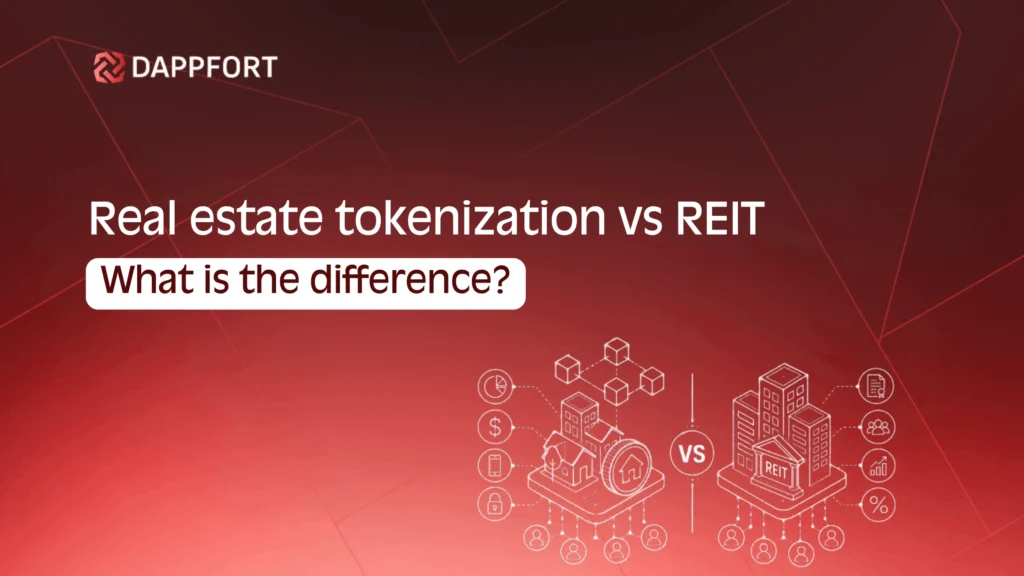
A REIT and a tokenized property can hold the exact same office building and still behave like completely different assets to an investor. The core difference in tokenization vs REIT structures comes down to how ownership is recorded and transferred: a REIT issues shares in a managed company that owns a portfolio of properties, while tokenization issues blockchain-based digital tokens tied to a specific property or a smaller special purpose vehicle, often with lower minimums and different liquidity mechanics.
Key Takeaways
- Entry point: Tokenized real estate can offer fractional ownership starting well below the price of one REIT share, while public REIT shares trade at whatever the market sets that day.
- Regulatory path: Public REITs register with the SEC and file regular reports; most tokenized offerings in the US rely on exemptions like Reg D, Reg S, or Reg A+, each with different investor limits.
- Liquidity reality: REITs listed on major exchanges trade with deep daily volume; tokenized assets depend on the depth of the secondary marketplace built around them, which is still maturing.
- Ownership scope: A REIT share gives exposure to a diversified pool of properties managed by one company; a token usually ties to one asset or a narrower pool, giving more direct but less diversified exposure.
- Infrastructure cost: Launching a tokenized offering requires smart contract development, custody, and KYC/AML systems built specifically for the platform, not an off-the-shelf brokerage account.
At a Glance: Tokenization vs REIT Comparison
| Factor | Real Estate Tokenization | REIT |
Typical minimum investment | Often $100–$1,000, sometimes lower on some platforms | Price of one share (varies by market, often $10–$100+) |
| Ownership structure | Digital token tied to a property or SPV, recorded on a blockchain | Equity shares in a corporation or trust that owns multiple properties |
| Primary US regulatory path | Reg D 506(c), Reg S, or Reg A+ exemptions | SEC registration under the Securities Act and Investment Company Act exemptions |
| Liquidity | Secondary marketplaces or ATS platforms; volume still developing | Public REITs trade on NYSE/Nasdaq daily; non-traded REITs have redemption limits |
| Diversification | Usually single-asset or narrow pool per token | Broad portfolio across dozens or hundreds of properties |
| Reporting cadence | Set by issuer and smart contract logic; not standardized across platforms | Quarterly (10-Q) and annual (10-K) filings for public REITs |
| Global investor access | Can be structured for cross-border access via Reg S and jurisdiction-specific rules | Accessible via international brokerage accounts, subject to local tax treaties |

1. Understand What Each Structure Actually Is
A REIT (Real Estate Investment Trust) is a corporation or trust that owns, operates, or finances income-producing real estate. Congress created the REIT structure in 1960 to let everyday investors buy into large-scale, income-producing real estate the same way they buy stock. To qualify, a REIT must distribute at least 90% of its taxable income to shareholders as dividends, hold most of its assets in real estate, and meet specific ownership diversification rules under the SEC’s REIT guidance.
Real estate tokenization takes a different route. It converts ownership rights in a property, or in the entity that holds that property, into digital tokens recorded on a blockchain.To gain a broader understanding of how tokenization extends beyond real estate into assets such as commodities, intellectual property, and financial instruments, explore our guide on real world asset (RWA) tokenization.
Each token represents a fractional claim on the asset’s value, its rental income, or both. Instead of buying a share in a diversified company, an investor buys a token tied to a specific building, development project, or a small pool of assets bundled into a special purpose vehicle.
The distinction matters for a fintech company or asset manager evaluating which model to build or invest in. A REIT is a mature, well-litigated legal wrapper with decades of case law and SEC precedent behind it. Tokenization is a newer technical and legal pattern that borrows securities law concepts but applies them through smart contracts, digital wallets, and blockchain-based cap tables instead of a transfer agent’s spreadsheet.
2. Compare Accessibility and Minimum Investment
Public REITs are bought through a standard brokerage account, the same way an investor buys any listed stock. The entry cost is simply the price of one share, which fluctuates with the market. There’s no special onboarding beyond what any brokerage already requires.
Tokenized real estate is built around fractional access from the ground up. A single property worth several million dollars can be split into thousands of tokens, letting an issuer set a minimum investment far below the cost of a REIT share or a down payment on physical property. That said, access still depends heavily on which securities exemption the issuer uses:
- Reg D 506(c): Limited to accredited investors, but allows general solicitation.
- Reg A+: Opens the offering to non-accredited investors, with a cap on how much can be raised annually.
- Reg S: Targets non-US investors, often used alongside a US exemption for cross-border raises.
Both models require investor onboarding before money moves. REITs rely on the brokerage’s existing KYC checks. Tokenization platforms need their own KYC/AML verification layer built directly into the issuance and trading flow, since there’s no intermediary brokerage doing that work by default. This is one of the areas where the technical build matters as much as the legal structure, and it’s a common gap teams underestimate when they start building a real estate tokenization development company engagement without planning compliance infrastructure from day one.
3. Compare Liquidity and Exit Options
Liquidity is where the two models diverge the most in practice. Publicly traded REITs sit on the NYSE or Nasdaq with continuous price discovery and deep daily trading volume. An investor can typically sell shares within seconds during market hours. Non-traded REITs are a different story: they often lock capital for years, with redemption windows that cap how much an investor can withdraw per quarter.

Tokenized real estate promises faster settlement in theory, since ownership transfers can happen through a smart contract instead of a multi-day escrow and title process. Several secondary marketplaces and alternative trading systems (ATS) now support trading of tokenized real estate assets. In practice, though, liquidity depends entirely on how much trading activity that specific marketplace has attracted.
A token with no active buyers on its platform is no more liquid than an illiquid private REIT interest, regardless of how fast the underlying blockchain settles trades.
Where tokenization has a structural edge is settlement speed and transfer automation. A well-built platform can programmatically enforce transfer restrictions (accredited-investor-only trading, holding periods, jurisdiction limits) at the smart contract level, cutting down the manual compliance checks that slow secondary trades in traditional private real estate.
That’s a meaningful operational advantage for firms managing large investor rosters, but it doesn’t automatically create market depth. Building that depth still requires marketing the marketplace itself, attracting market makers, and in some cases pairing with a registered ATS.
4. Compare Regulatory and Compliance Requirements
REITs operate under one of the most established regulatory frameworks in US finance. Public REITs register with the SEC, file quarterly 10-Qs and annual 10-Ks, and follow listing standards set by their exchange. Investors get standardized, audited disclosures on a predictable schedule.
Tokenized real estate offerings in the United States generally rely on securities exemptions rather than full registration, because full IPO-style registration is expensive and slow for single-asset or small-pool deals.
The most common structures are:
- Reg D 506(c) for accredited-investor-only raises with no cap on amount raised.
- Reg A+ for offerings open to the general public, capped at $75 million in a 12-month period under current SEC rules.
- Reg S for offshore offerings to non-US persons, frequently combined with a domestic exemption for a global cap table.
For businesses operating across the United States, United Kingdom, Canada, Australia, Saudi Arabia, and other markets, the compliance picture gets more complex. Each jurisdiction treats tokenized securities differently: the UK’s FCA has its own digital securities sandbox rules, Canada applies provincial securities regulation on top of federal guidance, and Gulf jurisdictions like Saudi Arabia are still building out dedicated frameworks for tokenized real assets.
According to the SEC’s public releases on digital asset securities, the regulator continues to treat most token offerings tied to real-world assets as securities subject to existing law, not a separate category exempt from oversight.
None of this compliance burden disappears just because the asset is digital. Custody of investor funds, transfer agent-equivalent recordkeeping, and AML screening all still need to happen. The difference is where that logic lives: in a REIT, it’s largely handled by the transfer agent and the exchange. In a tokenized structure, it has to be engineered directly into the platform, the smart contracts, and the onboarding flow.
5. Compare Management, Fees, and Control
REITs are professionally managed by a board and executive team that make property acquisition, leasing, and financing decisions on behalf of shareholders. Investors get a say through shareholder votes on major matters, but day-to-day control sits entirely with management. Fees, including management fees and operating expense ratios, are baked into the REIT’s financials and reduce the dividend an investor ultimately receives.
Tokenized real estate spans a wider range of management models. Some platforms tokenize interests in a professionally managed SPV, similar in spirit to a REIT but scoped to one asset. Others tokenize a more direct ownership stake with lighter management overhead, shifting more decision-making (and more risk) to the token holder or a smaller sponsor group. Governance rights in a tokenized structure are only as strong as the legal wrapper and smart contract logic behind them. A token with no defined voting or information rights offers less practical control than a REIT share, regardless of how the marketing describes it.
One genuine advantage of the tokenized model is transparency between reporting cycles. Blockchain-based cap tables can show real-time ownership records and, depending on the platform’s design, income distribution history, instead of waiting for a quarterly filing. For asset managers who want to differentiate a product on transparency, that’s a real selling point, not just a technical footnote.
6. Decide Which Model Fits Your Business
The right choice depends on what problem the business is actually solving. A firm that wants proven liquidity, simple investor communication, and no interest in maintaining blockchain infrastructure should lean toward REIT exposure, either by launching one or by investing in existing public REITs. The regulatory path is well understood, service providers are widely available, and investors already know how to evaluate the product.

A firm that wants to reach a broader, more global investor base, offer fractional entry to a specific high-value asset, or build a distinct investment product should look seriously at tokenization.
Businesses planning to launch a tokenized property investment platform can also explore our step-by-step guide on building a real estate tokenization platform to better understand the development process and technical requirements.
It works particularly well for sponsors targeting cross-border capital across the US, UK, Canada, Australia, and Gulf markets, where a Reg S structure paired with a domestic exemption can open access that a traditional REIT listing wouldn’t reach as efficiently.
There’s also a hybrid path some asset managers are exploring: tokenizing shares or fund interests in an existing REIT-style vehicle to add a secondary liquidity layer without rebuilding the underlying real estate business from scratch. This keeps the established regulatory wrapper while testing whether tokenized trading attracts a new investor segment.
Whichever direction a business chooses, the infrastructure checklist looks similar before any tokens or shares go live:
- Legal structuring that matches the target exemption and investor base.
- Smart contract development and independent audit for any tokenized component.
- KYC/AML integration built into onboarding, not added after launch.
- Custody arrangements for both digital tokens and underlying asset title.
- Secondary market or ATS integration to give investors a realistic path to liquidity.
- Ongoing reporting infrastructure that satisfies both investors and regulators.
This is exactly the kind of build Dappfort supports for asset managers, fintech startups, and investment firms evaluating tokenization as a growth channel. With extensive expertise in blockchain development, smart contracts, digital asset infrastructure, KYC/AML integration, liquidity solutions, and multi-jurisdiction compliance, Dappfort helps businesses build secure, scalable, and compliant real estate tokenization platforms.
FAQ: Tokenization vs REIT
Is real estate tokenization legal in the US?
Yes, when structured under an existing securities exemption such as Reg D, Reg A+, or Reg S. The token itself doesn’t create a new legal category; the SEC generally treats tokenized real estate offerings as securities subject to the same disclosure and investor-protection rules as any other private placement or public offering.
Can retail investors buy tokenized real estate?
It depends on the exemption the issuer chooses. Offerings under Reg D 506(c) are limited to accredited investors. Offerings structured under Reg A+ can be opened to the general public, subject to the offering cap and disclosure requirements that come with that exemption.
Do tokenized real estate investments pay dividends like REITs?
Many tokenized structures are designed to pass through rental income or profit distributions to token holders, similar in concept to a REIT dividend. The specific mechanics, frequency, and legal characterization of those payments depend entirely on how the issuer structured the offering and the smart contract logic behind it, so it’s worth reviewing the offering documents closely rather than assuming REIT-style treatment applies automatically.
What happens if a tokenization platform shuts down?
This depends on how the underlying legal structure was built. A well-structured offering separates the token holder’s legal rights (through an SPV, trust, or similar wrapper) from the platform’s technology layer, so ownership rights should survive even if the trading platform itself stops operating. A poorly structured offering that ties ownership entirely to the platform’s own systems carries real risk if that platform fails, which is why legal wrapper design matters as much as the smart contract code.
Final Thoughts
Real estate tokenization and REITs each offer distinct advantages, and the right choice depends on your business goals, investor audience, and regulatory requirements. While REITs Real estate tokenization takes a different route. It converts ownership rights in a property, or in the entity that holds that property, into digital tokens recorded on a blockchain.provide a proven investment model, tokenization delivers greater flexibility, fractional ownership, and blockchain-powered transparency.
For businesses planning to enter the digital real estate market, building a secure and compliant platform is essential. Dappfort helps organizations develop scalable real estate tokenization solutions with blockchain technology, smart contracts, compliance integration, and digital asset infrastructure to support long-term growth.
Ready to Launch Your Tokenized Real Estate Platform?
Get a compliant, investor-ready tokenization platform built with smart contracts, KYC/AML, and multi-jurisdiction regulatory alignment — from a team that’s already shipped real estate tokenization infrastructure for asset managers and fintech firms.