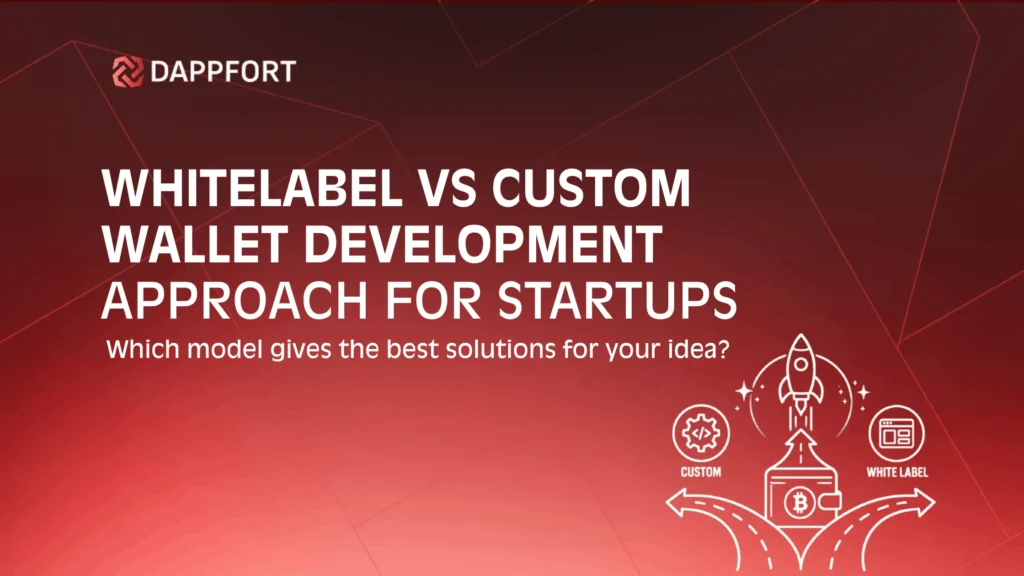
If you are building a crypto wallet, the first decision is not UI or features or even which blockchain to use.
It is this:
Custom Crypto Wallet or White Label Solution?
This choice decides how your product will operate in real business conditions—not just during launch, but when users grow, transactions increase, and security pressure becomes real.
It directly affects:
- How your wallet is secured and who controls the architecture
- How easily you can scale when user demand increases
- Your actual development and maintenance cost over time
- How fast you can go to market
- Whether the product is truly yours to own and control over time
Most startups lean toward white label because, honestly, it is faster and cheaper at the start. And that makes sense — for MVPs and early testing, it does the job. But once you need deeper control, custom security logic, or support for multiple chains, that same convenience starts working against you.
Custom development costs more upfront and takes longer to ship. But what you get in return is a system built around long-term scale, full product ownership, and real control over your infrastructure.
This guide breaks down both options in practical terms so you can decide based on business goals and technical reality—not assumptions or vendor positioning.
What is a White Label Crypto Wallet?
A white label crypto wallet is a ready-made wallet system that you can rebrand and launch as your own product. Instead of building infrastructure from zero, you use an existing wallet framework and configure it for your business needs.
What you typically get:
- Your own branding (logo, colors, UI changes)
- Basic feature configuration (enable/disable functions)
- Pre-supported blockchain networks and tokens
What you don’t control:
- Core architecture and backend logic
- Security design and key management system
- Scalability limits and infrastructure behavior
In business terms:
You are not owning the technology—you are using a pre-built system under your brand. It works well for quick launches and MVPs, but flexibility and deep customization are limited when your product starts scaling or requires advanced security or multi-chain expansion.
Read more about Dappfort White Label Crypto Wallet Development
What is Custom Crypto Wallet Development?
Custom crypto wallet development means building a wallet system from scratch — shaped around your business requirements, your security standards, and your long-term scaling goals.
Instead of fitting your product into an existing system, everything is designed specifically for what you are building.
Core areas built from the ground up:
- System architecture
- Security and key management model
- Blockchain network integrations
- Backend and transaction processing systems
- Scalability and performance design
In business terms:
You are not using a ready-made system—you are building your own wallet infrastructure as a product asset. This approach is used when the goal is long-term ownership, deeper control over security, and the ability to scale or expand features without platform limitations.
Read more about Dappfort Custom Crypto Wallet Development
Not Sure Which Wallet Type Fits Your Business?
Talk to our team and get honest advice on whether white label or custom development suits your current stage.
Key Difference of Choosing Custom vs Whitelabel Development (What Most Founders Miss)
The difference is not features or UI. It is in control over the system architecture and security model.
White label wallets are built for speed. You get a market-ready system, launch quickly in days, and operate within fixed technical boundaries. Custom wallet development is built for control. You define how the system works, how it scales, and how security is implemented.
In practical business terms:
| White label wallet solution: | Custom wallet solution: |
| Faster go-to-market | Full control over security design |
| Lower upfront cost | Scalable architecture for long-term growth |
| Fixed architecture and limited security, scalability | Flexible integration with new blockchains and features |
| Dependent on provider’s roadmap | Complete product ownership |
Why this matters:
The difference becomes clear when the product starts scaling:
- Increasing user base and transaction volume
- Adding multiple blockchain networks
- Upgrading security or compliance requirements
- Building advanced features like DeFi or cross-chain support
At that point, white label systems often hit technical limits. Custom-built wallets don’t, because the architecture was designed around your business goals, not a template.
When White Label Wallets Make The Right Option for Startups?
White label wallets are not a bad option. They are simply built for a different stage of the product lifecycle.
They make sense when:
- You need to validate a product idea quickly with a minimum viable product (MVP)
- You want to test market demand before investing in full-scale development
- You are working with limited budget and need faster time to launch
- Your initial version does not require advanced features like MPC, DeFi integrations, or cross-chain functionality
Business perspective:
White label wallets are best treated as a validation tool — not something you anchor your long-term infrastructure on.
They get you to market quicker, help you collect real user feedback, and keep those early-stage risks manageable. But here’s the thing — they were never really built for deep customization, complex security models, or the kind of scalability your product will eventually demand.
Limitations of White Label Crypto Wallets
White label wallets help with fast launches, but they come with structural limitations that many startups only realize after scaling begins.
1. Limited Wallet Architecture Control
You cannot meaningfully change core wallet logic, transaction flow, or security design. You operate within a fixed system.
2. Vendor Dependency Constraints
Your product roadmap is tied to the provider. If they delay updates or stop supporting features, your product is affected.
3. Scalability Constraints
As user volume grows or you expand to multiple blockchains, performance and integration flexibility can become restricted.
4. Security Transparency Gaps
In many cases, you don’t fully control or audit how keys, signing, and sensitive operations are handled internally.
5. Feature Limitations
Advanced capabilities like MPC wallets, custom DeFi integrations, or complex staking systems are often restricted or not fully customizable for seamless performance.
In business reality:
White label wallets work fine for entry-level launches, but they were never built for long-term product evolution or infrastructure-heavy crypto businesses.
When Custom Crypto Wallet Development Is the Right Choice?
Custom development makes sense when you are building a long-term product — not just throwing something out there to test an idea.
You should choose custom development if:
- Security is a core part of your business model, not just a feature
- You plan to scale across multiple blockchain networks
- You expect high transaction volume and consistent user growth
- You need stronger credibility with investors or institutional partners
- You want full ownership and control of your infrastructure
In business reality:
Custom wallets are built for scale, control, and long-term flexibility. They take longer to build, but they remove dependency on fixed templates and vendor limitations.
If your goal is to build a serious & genuine crypto wallet product, not just launch quickly, custom development is the more sustainable approach.
Ready to Build a Wallet That Scales With Your Business?
We build custom crypto wallet systems designed around your security, scalability, and long-term product goals.
Advantages of Custom Crypto Wallet Development
1. Full Ownership of Architecture
You control the entire system—backend, security layer, and blockchain integrations. No dependency on third-party templates or fixed frameworks.
2. Strong Security Design
Custom builds allow implementation of production-grade security systems such as:
- MPC wallet architecture
- Multi-signature transactions
- Hardware Security Modules (HSMs)
- Advanced encryption standards
3. Built for Scalability
The system is designed to handle:
- High transaction volumes
- Multi-chain expansion
- API-driven ecosystem growth and integrations
4. Product Differentiation
You are not limited by template features. This allows you to build custom wallet capabilities that fit your specific business model and user needs.
5. Investor Confidence
Custom architecture signals technical depth, long-term planning, and stronger execution capability—key factors for investor and institutional trust.
Cost Perspective (Custom Vs White Label Crypto Wallet Development)
White label wallets often look more cost-effective at the start. The upfront investment is lower, and launch is faster.
But the real cost shows up later when the product starts scaling. If you want a deeper breakdown of what this actually looks like in numbers, here is a practical guide on the cost to create a crypto wallet.
Hidden long-term costs of white label:
- Migration from white label to custom architecture
- Vendor lock-in with limited control over system changes
- Feature restrictions during scaling or product expansion
- Security redesign when requirements become more advanced
- Additional cost for workarounds and external integrations
Custom wallet development cost reality:
Custom wallets require higher upfront investment, but the system is designed to avoid rework later.
- No forced migration when scaling
- Full control over architecture and upgrades
- Easier integration of new features and blockchains
- Reduced dependency on third-party providers
Business reality:
In crypto wallet development, the lowest initial cost is not always the lowest total cost. Early architecture decisions directly impact long-term spending, scalability, and technical flexibility.
Security Perspective (Custom vs White Label Wallet Development)
Security is the biggest difference between white label and custom wallet development. In crypto wallets, security is not just a feature—it defines whether the product can safely exist at scale.
White label wallets:
- Security architecture is pre-built and fixed
- Limited visibility into private key management flow
- Updates and patches depend on the vendor
- Custom security changes are often restricted or not possible
Custom wallets:
- Full control over private key architecture and custody design
- Ability to implement MPC, multi-signature, or hybrid security models
- Independent third-party security audits can be conducted
- Security design can evolve with business and regulatory needs
Business reality:
In crypto wallet systems, security is not optional—it is foundational. Once user funds are involved, any limitation in security control becomes a long-term risk, not a short-term tradeoff.
Scalability Perspective (Custom vs White Label Wallet Development)
White label wallets are generally built for MVP-level usage and early-stage traffic. They work well when the goal is to launch quickly and validate demand.
But as the product grows, limitations start to appear in scaling and integration flexibility.
White label systems:
- Designed for low to moderate transaction volumes
- Limited flexibility for deep architectural changes
- Multi-chain expansion often depends on vendor support
- Scaling beyond initial limits can require workarounds or migration
Custom wallet systems:
- Built for institutional-level adoption and large user bases
- Designed for multi-chain and cross-chain expansion from the start
- Supports high-frequency transaction environments
- Scales globally through controlled architecture and infrastructure design
Business reality:
Scalability is not about handling early users—it is about sustaining growth without rebuilding the system. If long-term expansion is the goal, scalability becomes a core architectural decision, not a post-launch upgrade.
How Startups Should Choose Custom vs White Label Development (Simple Framework)?
The decision between white label crypto wallet development and custom wallet development should be based on business stage and long-term intent, not just cost or speed.
Choose White Label if:
- You are validating a product idea or market demand
- You need a fast launch with limited budget
- You are building an MVP or early prototype
- You are testing user interest before scaling investment
Choose Custom Development if:
- You are building a long-term crypto product or platform
- You need full control over your security and system architecture
- You plan to grow across users, chains, or geographies
- You are getting ready for funding, institutional adoption, or enterprise use
- You need advanced blockchain features and deep integrations
Simple way to think about it:
White label = speed and validation.
Custom build = ownership and scale.
The right choice really comes down to one thing — are you testing the market, or building infrastructure for long-term growth.
Final Perspective
The decision between custom and white label crypto wallet development is not about which option is better overall.
It is about what stage your business is in and how much risk you are willing to carry later. White label helps you launch quickly and validate your idea with minimal upfront investment. Custom development is what supports long-term growth — where having control over your architecture, security, and scalability really starts to matter.
In most cases, companies start with white label to test the market. But as they scale, they move toward custom infrastructure — because at some point, full control over security, performance, and system design just becomes non-negotiable.
Conclusion
If you are seriously building a crypto wallet business, your decision should not be based on cost or speed alone.
It should be based on:
- Security ownership
- Scalability requirements
- Long-term architecture control
- Investor readiness
A good crypto wallet development company will not push one model on everybody — they will look at your business stage and recommend the right architecture for where you actually are.
If you are still unsure which path fits your startup, that usually means you have already reached the point where architecture matters more than MVP speed.
How Dappfort Fits In?
At this stage, picking a development partner is less about who gets things done fastest and more about who brings architectural clarity to the table.
Dappfort helps startups design and build crypto wallet systems — keeping security-first architecture, multi-chain scalability, and production-grade infrastructure at the center. Rather than handing over fixed templates, the whole approach is built around your business stage, risk profile, and long-term product goals.
Dappfort is a good fit for teams that need:
- Custom wallet architecture (custodial, non-custodial, MPC)
- Multi-chain and DeFi-ready integration systems
- Security-focused engineering (key management, encryption, audits)
- Scalable backend infrastructure for high transaction volume
This is built for founders who are putting together real financial infrastructure — not just a wallet app.
If you are looking at wallet development options and need clarity on architecture, security design, or scalability planning, Dappfort can help point you in the right technical direction before development even starts.
Let’s Build Your Crypto Wallet the Right Way
From architecture planning to production deployment, Dappfort handles every layer of your wallet development.
FAQ
1. Can I start with a white label wallet and switch to a custom wallet later?
Yes — but it will cost you more than starting custom from day one. Migration means rebuilding almost everything. If scale is the goal, start right.
2. How long does it actually take to build a custom crypto wallet?
Typically 3 to 6 months for a production-ready build. White label takes weeks — but you get speed without control. Custom takes longer but delivers a system that is truly yours.
3. Is a white label crypto wallet secure enough for a live product?
For an MVP, yes. For real user funds at scale, not quite. You don’t control the keys, the patches, or the security design. That’s a risk you shouldn’t hand to a vendor.
4. What is the real cost difference between custom and white label?
White label is cheaper on day one. Custom is cheaper over three years. Hidden migration costs, vendor fees, and security redesigns add up fast with white label.
5. How do I know which option is right for my startup?
Simple — are you testing an idea or building a real product? White label validates. Custom scales. Know which stage you are in and the answer becomes obvious.