Crypto exchanges are growing fast. And with that growth comes one question that never really goes away — how are customer assets actually protected?
Customers ask for it. Regulators ask it. Institutional investors ask it before they sign anything. If your answer isn’t clear, you’ve already lost some of them.
Most exchanges start with custody infrastructure. Many rely on secure cryptocurrency wallet development services to build the foundation for protecting digital assets. And sitting at the heart of that is multi-signature wallet technology.
This guide breaks down how multi-signature infrastructure works, why it matters, and what operators need to think about when building custody that actually holds up.
Why Custody Infrastructure Matters?
Every crypto exchange is responsible for managing one of its most valuable assets: customer trust.
One security incident and that trust is gone. Not just the money. Customers walk. Regulators get involved. Operations slow down. The press doesn’t hold back. And chasing institutional clients becomes a much harder sell.
Custody architecture isn’t a tech problem anymore. It’s a business priority. Get it right, and you scale faster, attract bigger money, and show the market you’re serious. Get it wrong, and you’re one bad day from a crisis you might not come back from.
What Is a Multi-Signature Wallet?
Understanding modern multi-signature wallet development practices helps exchanges build stronger authorization controls and custody frameworks.
A normal wallet runs on one private key. One person controls it. If that key gets taken, everything goes with it.
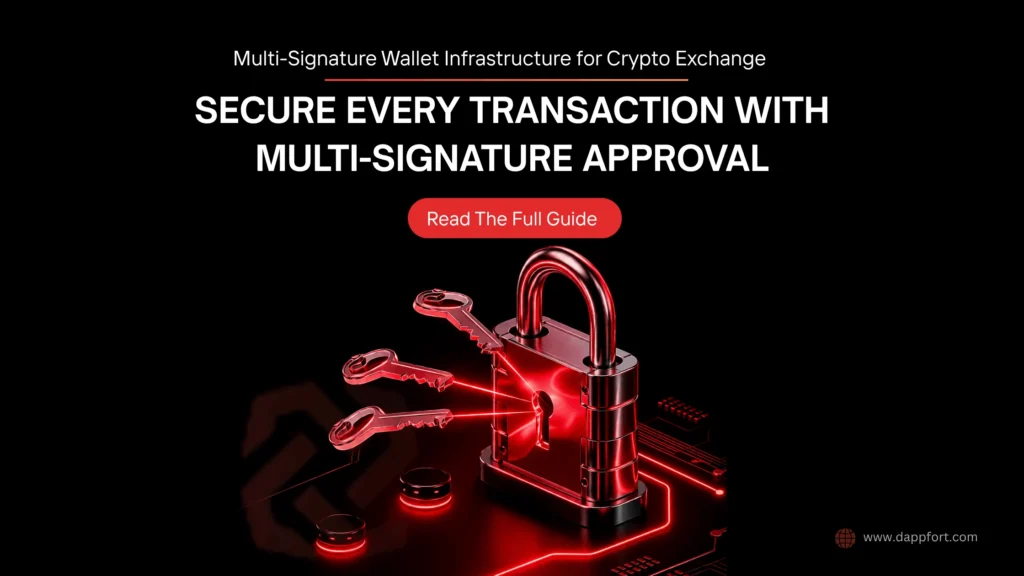
A multi-signature wallet needs more than one person to sign off before anything moves. Several authorized parties each hold part of the approval. Nothing happens until enough of them agree.
Two common setups:
2-of-3 Configuration:
Three keyholders, two needed to approve. One gets compromised? Doesn’t matter — attacker’s still locked out.
3-of-5 Configuration:
Five keyholders, three required. More room to operate without giving up security.
The setup varies based on exchange size and risk tolerance. But the rule stays the same — nobody moves funds solo.
Why Do Exchanges Use Multi-Signature Infrastructure?
It comes down to this: one person controlling everything is a liability. Multi-signature breaks that up.
When authority sits in one account or one person, one bad moment causes massive damage. Spreading it across people and systems makes a catastrophic failure dramatically harder to pull off.
Here’s what exchanges actually get from it:
Reduced Single Points of Failure:
One stolen credential doesn’t open the vault. An attacker needs to hit multiple independent signers at once — a much bigger task.
Better Governance:
Every fund movement needs sign-off from multiple people. That’s not red tape — it’s built-in accountability.
Stronger Internal Controls:
No employee, whatever their title, can move customer funds on their own. That matters more than most people think — until it doesn’t, and then it matters a lot.
Enhanced Accountability:
Every approval gets logged. Every transaction leaves a record. That’s valuable inside the org and essential when regulators or auditors show up.
The Role of Multi-Signature in a Broader Custody Framework
Multi-signature is a critical piece. But it’s not the whole picture.
The best exchanges layer their custody. Here’s what that looks like in practice:
Cold storage holds most assets offline. No connection to the internet means nothing to hack into remotely. Long-term reserves live here.
Hot wallet infrastructure keeps things running day-to-day, especially for exchanges leveraging multichain wallet development services to support assets across multiple blockchain networks.
MPC security controls go a step further by splitting cryptographic authority across systems in ways even harder to crack than standard multi-sig.
Transaction monitoring watches movements as they happen. Anything unusual gets flagged before it becomes a loss.
Governance policies spell out who approves what, under what conditions, and what happens when things go sideways. This is the human layer. Without it, everything else is just tools sitting unused.
Every layer covers gaps in the others. That’s the point.
Common Security Risks Multi-Signature Helps Address
Key Compromise:
Stolen credentials don’t go far. An attacker would need to breach several independent signers at the same time — and that’s a whole different level of difficulty.
Insider Threats:
No single employee holds unchecked power over customer assets. Even senior people can’t move funds by themselves.
Operational Errors:
High transaction volume means mistakes happen. Multi-sig puts a natural checkpoint in place before anything irreversible goes through.
Unauthorized Access:
Multiple independent approvals mean multiple independent walls. Each one needs to be broken down separately.
That said, multi-signature alone isn’t enough. It’s a strong layer that needs the right governance and processes around it to do its job.
Security Best Practices That Actually Make a Difference
Setting up multi-signature is the easy part. Running it well takes discipline.
Split Approval Rights Across Teams:
Keep signing authority spread across security, ops, treasury, and leadership. If one department has a problem, the others hold the line.
Lock Down Signer Devices:
The system is only as secure as each person in it. Hardware security keys, solid authentication, endpoint protection, encrypted comms not optional. Foundational.
Write Down Every Approval Policy:
Who signs off on what. When things get escalated. What the emergency plan looks like. What access reviews look like. If it lives only in someone’s head, it’s not a policy — it’s a risk.
Conduct Regular Security Reviews:
Custody controls should be reviewed periodically to identify gaps and validate effectiveness.
Why Governance Matters as Much as Technology
Most exchanges focus on the tech and underestimate everything around it. That’s the mistake.
Excellent technology still fails when the people and processes are weak. A perfectly configured multi-sig wallet won’t save you if approvals are rubber-stamped, access is never audited, or nobody has a plan when things go wrong.
Good governance is just clarity. Everyone knows what they’re responsible for. Workflows are documented and actually followed. Risk reviews happen regularly — not only after something breaks. Incident plans exist before they’re needed. Audits produce real accountability, not just filing.
Institutional investors look at governance just as hard as they look at tech. Sometimes harder. They know that’s where things quietly fall apart.
Multi-Signature vs MPC: What Exchanges Need to Consider
Once an exchange gets serious about custody, multi-sig and MPC — Multi-Party Computation — always end up in the same conversation.
Both cut down reliance on a single private key. But they work differently.
Multi-signature gives each party a separate key. Every approval means a real signature from each holder. It’s transparent, well-understood, and plays nicely with most blockchains.
MPC splits the key itself into pieces that never exist whole in any one place. Approvals happen cryptographically, not through collected signatures. Harder to crack, more flexible — but also more complex to get right.
Neither is the definitive winner. It depends on transaction volume, technical team, compliance needs, and where the business is going. Some exchanges run both.
What Institutional Clients Look For?
Institutional investors go deep in custody before they trust an exchange with their assets. Here’s what they want to know:
Custody Architecture:
What protects customer funds? Where are they held? Who can touch them?
Authorization Controls:
Who approves transactions? What stops one person from going rogue? What’s the escalation path?
Key Management:
Where are signing credentials kept? What happens when a signer leaves?
Governance:
What policies exist around moving assets? Are they written down? Are they followed?
Security Validation:
Has any of this been independently reviewed? When? What came out of it?
Exchanges that answer these cleanly tend to win the partnership. Ones that stumble tend to watch it go to a competitor who can.
Common Custody Gaps Found During Security Assessments
Many exchanges implement multi-signature wallets but overlook important operational risks.
Examples include:
- Weak signer security
- Excessive approval concentration
- Inadequate monitoring
- Limited audit visibility
- Outdated access controls
- Poor incident response planning
These issues may not be obvious during daily operations but can become significant risks during periods of stress or attack.
Identifying and addressing these weaknesses early helps improve overall security maturity.
Why Independent Security Reviews Matter?
Internal teams know the system well. That’s valuable — and it’s also a blind spot.
Working closely with something every day means you stop noticing its weak points. Familiar problems stop looking like problems. Small gaps get accepted as normal.
Outside reviewers don’t carry those assumptions. They ask the basic questions that stopped getting asked a long time ago. They check whether workflows actually function, not just whether they’re documented. They look at whether access controls have drifted. They run attack scenarios that internal teams often avoid running on themselves.
What they find regularly surprises people — not because the internal team failed, but because closeness hides things.
For any exchange chasing institutional clients, periodic independent reviews aren’t optional anymore. They’re expected.
Is Your Custody Infrastructure Ready for Institutional Expectations?
A lot of exchanges build solid wallet tech and then overlook the governance, key management, and authorization workflows that make it actually work.
The gap between having multi-sig and running a mature custody operation is real. That gap is where most failures happen.
As a Dappfort cryptocurrency exchange development company, helps crypto exchanges close it — evaluating custody architectures, finding security weaknesses, assessing operational risks, and strengthening customer asset protection through specialized blockchain security assessments and consulting.
Conclusion
Multi-signature wallet infrastructure is one of the most effective ways to reduce custody risk in crypto exchanges. That’s not a sales pitch — it’s what the industry has learned the hard way.
But it’s not enough by itself.
The exchanges that genuinely protect their customers pair multi-signature with real governance, operational discipline, continuous monitoring, and honest security reviews. They treat custody as something that needs ongoing attention, not a one-time setup.
As threats get more sophisticated and institutional expectations keep climbing, the exchanges that build mature custody frameworks are the ones that earn serious trust — and hold onto it.
Frequently Asked Questions
What is a multi-signature wallet?
It requires multiple approvals before any cryptocurrency moves. Instead of one private key controlling everything, several authorized parties hold part of the authorization — and a set number must agree before a transaction goes through.
Why do crypto exchanges use multi-signature infrastructure?
Because spreading control across multiple people is safer than concentrating it in one place. Multi-sig cuts insider risk, makes attacks much harder, adds a checkpoint against operational mistakes, and creates the audit trail regulators and institutional clients want to see.
Is multi-signature more secure than a single-key wallet?
Yes, by a wide margin. One key means one point of failure. Multi-sig has several independent ones — all of which would need to fall at the same time for an attacker to get anywhere.
Can multi-signature wallets eliminate all custody risks?
No. Strong layer of protection, but no single technology removes all risk. Multi-sig works best alongside governance controls, real-time monitoring, access management, and regular independent reviews.
How often should custody infrastructure be reviewed?
At least once a year — and whenever the organization, infrastructure, or threat landscape changes in a meaningful way. The best exchanges make it a routine, not a reaction.
Build a Secure Multi-Signature Custody Infrastructure for Your Crypto Exchange
Protect customer assets with enterprise-grade custody architecture, multi-signature authorization controls, cold storage strategies, and advanced wallet security solutions designed for modern crypto exchanges.