Table of Contents
Introduction: Why Startups and Enterprises Are Building Decentralized Exchanges?
Centralized exchanges expose users to custodial risk, difficult fund management, and regulatory shutdowns. These weaknesses have pushed both retail users and institutions toward decentralized trading models.
Building a decentralized exchange allows platforms to offer non-custodial trading, transparent settlement, and programmable trust, while reducing single points of failure.
For many businesses, a DEX is not just a product—it’s a strategic shift toward future-proof financial infrastructure.
As users demand self-custody, transparency, and censorship resistance, startups and enterprises are increasingly exploring how to build a decentralized crypto exchange that is both secure and scalable while meeting the evolving expectations of modern traders.
This guide is written for cryptocurrency exchange & web3 startups those who want a clear, practical understanding of DEX development.
What Is a Decentralized Exchange(DEX) and How Does It Work?
A decentralized exchange is a trading platform where users trade directly from their wallets using smart contracts, without handing custody of funds to a central operator. Trades are executed and settled on the blockchain.
Instead of internal databases and custodial accounts, DEXs rely on smart contracts, liquidity mechanisms, and on-chain settlement to enforce rules and complete transactions transparently.
What is a DEX(Decentralized Exchange)?
A DEX(decentralized exchange) is a non-custodial trading platform powered by smart contracts. Users connect wallets, approve transactions, and trade assets directly on-chain, maintaining full control over their private keys at all times.
How DEX Trade Works in Onchain?
When a user places a trade, the transaction is sent to a smart contract. The contract validates balances, pricing rules, and liquidity availability before executing the trade and updating on-chain state.
Role of smart contracts in Decentralized Exchange
Smart contracts replace centralized matching and settlement systems in decentralized exchange. They enforce pricing logic, manage liquidity pools or order books, and ensure that trades execute exactly as coded without manual intervention.
Wallet-based trading flow
Users connect wallets like MetaMask or WalletConnect, sign transactions locally, and interact directly with smart contracts. This eliminates account creation, custodial risk, and centralized fund control.
Types of Decentralized Exchanges You Can Build
Not all decentralized exchanges work the same way. Choosing the wrong model can lead to poor liquidity, high gas costs, or limited scalability.
AMM-based DEX (Automated Market Maker)
AMM DEXs use liquidity pools instead of traditional order books. Prices are determined algorithmically, making them simple to deploy and highly decentralized, but they can suffer from slippage and impermanent loss.
Order book DEX
Order book DEXs replicate traditional trading models using on-chain or off-chain components. They offer better price discovery but require more complex architecture and often face scalability challenges on Layer 1 blockchains.
Hybrid DEX architecture
Hybrid DEXs combine off-chain order processing with on-chain settlement. This model improves speed and scalability while preserving non-custodial settlement, making it increasingly popular for professional-grade platforms.
Step-by-Step Guide to Creating a Decentralized Exchange(DEX):
Building a decentralized exchange(DEX) involves more than writing smart contracts. It requires aligning user needs, blockchain infrastructure, security practices, and long-term scalability. The steps below break down the process into manageable, execution-ready phases.
Define DEX use case and target users
Start by identifying whether your DEX targets retail traders, institutions, or niche markets. Use cases determine liquidity design, compliance needs, and performance requirements.
Choose blockchain and Layer 2
Select a blockchain based on security, ecosystem maturity, and transaction costs. Layer 2 solutions can significantly improve scalability and user experience by reducing gas fees.
Design DEX architecture
Architect the system into clear layers—frontend, smart contracts, liquidity, settlement, and indexing—to ensure modularity, scalability, and easier upgrades.
Develop smart contracts
Smart contracts handle trading logic, liquidity management, and settlement. Clean, minimal code with clear upgrade paths reduces risk and simplifies future improvements.
Integrate wallets and UI
User experience is critical. Wallet integrations must be seamless, with clear transaction prompts, readable fees, and intuitive trading flows.
Build liquidity mechanisms
Liquidity determines success. This may include pool incentives, governance tokens, or market-maker integrations to ensure tight spreads and low slippage.
Implement security audits
Every smart contract must undergo professional audits. Audits catch vulnerabilities that could otherwise result in catastrophic fund losses.
Launch and monitor
After deployment, continuous monitoring is essential. Track usage, gas efficiency, and abnormal activity to respond quickly to emerging risks.
DEX Development Architecture Explained
A scalable DEX(decentralized exchange) depends on clear separation between components. Modular architecture improves security, simplifies upgrades, and allows teams to optimize performance without breaking core protocol logic as usage and transaction volume grow.
- Frontend layer
Handles wallet connections, trade inputs, and transaction visualization. It should remain stateless and never handle private keys. - Smart contract layer
Implements trading rules, liquidity logic, and settlement. This smart contract layer in DEX {Link out} must be minimal, audited, and upgrade-aware. - Liquidity layer
Manages pools or order books. Poor liquidity design leads to slippage, failed trades, and low adoption. - Settlement layer
Finalizes asset transfers on-chain, ensuring transparency and cryptographic finality. - Indexing and analytics
Off-chain indexers improve UX by providing real-time order books, trade history, and performance metrics without overloading the blockchain.
Security Best Practices for Developing a DEX
Security failures destroy trust instantly.
- Smart contract audits
Independent audits identify vulnerabilities early. Multiple audits are often justified for high-value protocols. - Reentrancy protection
Proper state management and checks-effects-interactions patterns prevent common attack vectors. - Oracle security
Price feeds must be resilient to manipulation. Decentralized or time-weighted oracles reduce risk. - Governance controls
Upgrade and admin permissions should be limited, transparent, and ideally governed by decentralized mechanisms.
DEX Scalability Challenges and How to Solve Them
Scalability determines whether a DEX survives growth.
- Layer 2 rollups
Rollups reduce transaction costs while inheriting Layer 1 security. - Off-chain order matching
Moving performance-heavy logic off-chain improves speed without compromising settlement security. - Batch transactions
Batching trades lowers gas costs and improves throughput. - Hybrid DEX models
Hybrid designs balance decentralization with real-world performance demands.
Cost to Develop a Decentralized Exchange
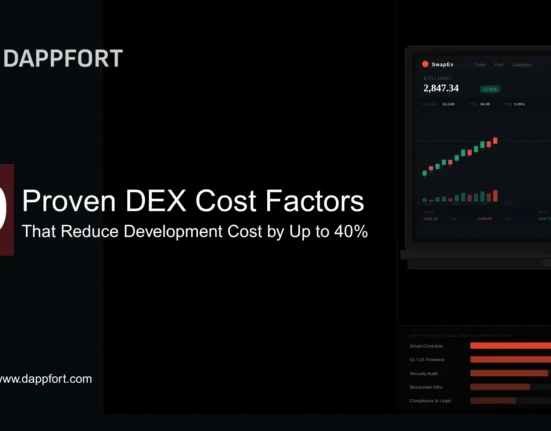
DEX development cost varies widely depending on factors such as blockchain selection, smart contract complexity, liquidity mechanisms, security audits, and the level of customization required for the platform.
- Core development: smart contracts, frontend, indexing
- Security audits: often a significant but necessary expense
- Infrastructure: nodes, analytics, monitoring
- Ongoing maintenance and upgrades
Costs scale with complexity, security requirements, and performance goals.
Should You Build a DEX From Scratch or Use a Development Partner?
Building from scratch offers control but increases risk and time-to-market. Working with experts experienced in crypto exchange platform development can help businesses accelerate deployment, strengthen security, and avoid common infrastructure challenges during the development process.
Final Thoughts
Creating a decentralized exchange is as much a strategic decision as a technical one.
The most successful platforms prioritize security, scalability, and user trust from day one—then evolve through hybrid models as volume grows.
DEXs are no longer experimental.
Built correctly, they are foundational infrastructure for the next generation of financial markets.
Frequently Asked Questions for Building Decentralized Exchange:
How long does it take to build a decentralized exchange?
Typically 4–9 months, depending on complexity, audits, and scalability requirements.
How much does it cost to create a DEX?
Costs range from mid five figures to six figures, driven largely by security audits and architecture choices.
Is building a DEX legal?
Legality depends on jurisdiction. Compliance planning is essential.
What blockchain is best for DEX development?
Ethereum, Arbitrum, Polygon, and similar ecosystems are popular due to tooling and liquidity.
Can a DEX be secure and scalable?
Yes—when designed with layered architecture, audits, and scaling solutions.