Finding a decent Web3 developer is hard. Finding one who can actually build a production grade crypto exchange — one that handles real money, real users, and real security pressure — is genuinely difficult.
The market has flooded with developers who learned Solidity during the 2021 bull run, built a few token contracts, and now list “Web3 developer” on their profiles. That’s not the same as someone who understands order book architecture, knows how to design key management systems that won’t get drained in a breach, and has thought seriously about what regulatory compliance means at the infrastructure level.
When you’re hiring for a crypto exchange specifically, the stakes around that distinction are unusually high. A bad hire on a marketing website costs you time and money. A bad hire on exchange infrastructure can cost your users their funds — and cost you everything.
Here’s what actually separates developers worth hiring from the ones who will create problems you’ll spend months cleaning up.
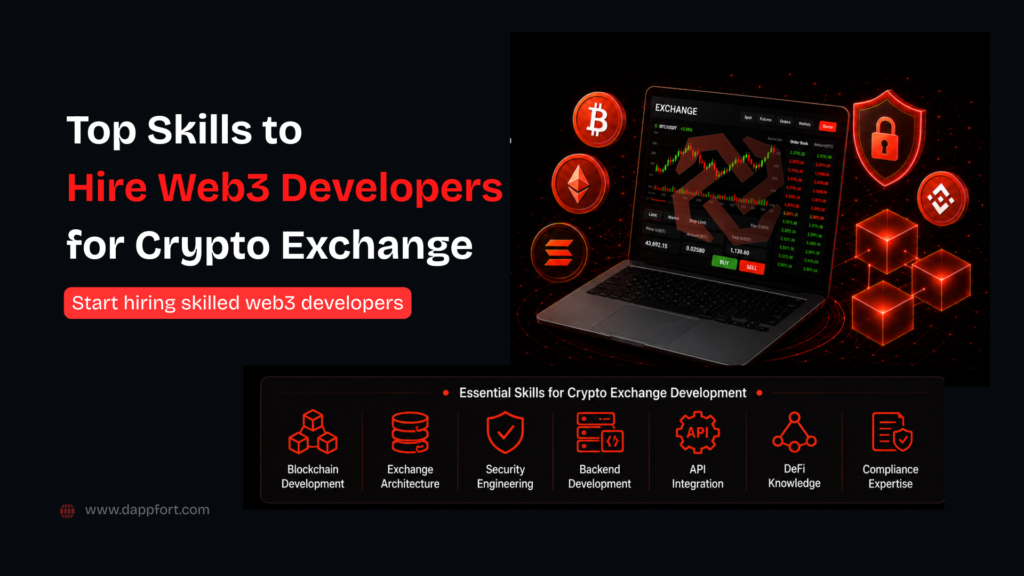
Blockchain and Smart Contract Development
This is the foundation everything else sits on. A developer applying for exchange work who can’t explain the difference between a reentrancy vulnerability and an integer overflow vulnerability in a smart contract is a developer who hasn’t spent enough time in production systems where those things actually matter.
What to look for beyond the obvious:
Solidity fluency matters, but depth matters more than breadth. Can they walk you through an audit finding and explain how they fixed it? Have they worked with upgradeable contract patterns? Do they understand the tradeoffs between proxy architectures? Can they explain why a particular gas optimization works and what it costs in readability?
Rust is increasingly relevant for anyone working on Solana or near-EVM chains. If your exchange has multi-chain ambitions — and most serious ones do — a developer who’s only ever touched Solidity is going to hit a wall.
The honest signal isn’t certifications or course completions. It’s GitHub history. Real smart contract work leaves evidence: commits, issues, pull requests, deployed contract addresses you can actually verify on-chain. Someone who can point you to a mainnet deployment they contributed to and walk you through decisions they made during that project is telling you something meaningful.
Exchange-Specific Architecture Knowledge
Building a token contract is genuinely different from building exchange infrastructure. Experienced teams such as a Dappfort cryptocurrency exchange development company understand the unique challenges of matching engines, liquidity systems, wallet security, and high-volume trading environments.
An exchange needs an order book engine — or a robust AMM architecture if you’re going the DeFi route — that can handle high transaction throughput without the latency that makes trading impractical. It needs a matching engine that processes orders correctly under load. It needs a settlement layer that’s both fast and accurate. It needs withdrawal and deposit flows that are secure against the specific attack patterns that exchanges attract.
These aren’t generic backend problems. A developer who’s spent three years building SaaS applications and recently got into Web3 may be technically capable but will take significant time to develop the domain intuition that exchange architecture requires. That ramp-up time has costs — in timeline, in review overhead, and in the risk of decisions made without enough context.
In interviews, ask about specific architectural decisions: How would you design the order matching engine for a high-frequency trading environment? What’s your approach to handling partial order fills? What do you think about the database design for an order book that needs to be both fast and auditable? The answers reveal whether someone has actually thought about these problems or is reconstructing an answer from general principles on the fly.
Security Engineering — Not Just Awareness
Every developer who’s been in a Web3 development company for more than a year can name the major exploit types. Reentrancy attacks, flash loan exploits, oracle manipulation, front-running — these show up in every security overview article. Naming them isn’t a skill. Designing systems that don’t have them is.
The developers worth hiring can talk about how they’ve integrated security thinking into their development process. Not just “we did an audit before launch” — that’s table stakes. How do they approach threat modeling during design? What does their internal code review process look like for security-sensitive components? Have they ever found a vulnerability in their own code before it shipped? Can they tell you about it?
| Skill Area | Junior Signal | Senior Signal |
| Smart contract security | Names common vulnerabilities | Architects around them from day one |
| Key management | Knows HSMs exist | Has implemented MPC or multisig in production |
| Audit experience | Has read audit reports | Has participated in or responded to audits |
| Incident response | Understands the concept | Has a process; has used it |
| Access control | Implements role-based permissions | Designs least-privilege systems end to end |
The table above is a useful mental model when you’re evaluating candidates. Junior developers with good instincts can grow into strong security engineers. But for exchange infrastructure specifically, the cost of that learning curve happening in production is high enough that you want people who’ve already crossed several of these thresholds.
Backend Systems and Performance Engineering
The blockchain side of exchange development gets most of the attention. The backend systems that support it get less — and they’re where a lot of exchange performance problems originate.
Order books, trading engines, real-time market data feeds, wallet infrastructure, user authentication systems — these are high-performance backend problems that happen to connect to blockchains. Building these systems requires a carefully selected crypto exchange tech stack that can support low-latency trading, scalable infrastructure, real-time data processing, and secure wallet management.
They require developers who understand database design under load, message queue architecture, caching strategies, and horizontal scaling. Someone who’s strong on Solidity but has never had to design a system that handles 10,000 transactions per second is going to find exchange backend work harder than they expected.
Look for experience with: PostgreSQL at scale (not just “used Postgres”), Redis for caching and session management, message queues like Kafka or RabbitMQ for event-driven architectures, and real experience debugging performance issues under load — not just theoretical knowledge of where bottlenecks typically appear.
API Design and Integration Experience
Exchanges live on their APIs. Traders, third-party applications, institutional clients — they all interact with your exchange primarily through API endpoints. An API that’s poorly designed, inconsistently documented, or unreliable under load is a competitive liability.
A developer who’s built and maintained production APIs — not just consumed them — brings a different perspective to API design. They’ve seen what breaks, what causes support overhead, what makes integration painful for downstream developers. That experience shows up in cleaner endpoint design, better error handling, more thoughtful versioning strategies.
WebSocket experience specifically matters for exchange work. Real-time market data, order status updates, live price feeds — these are WebSocket problems. A developer who’s only worked with REST APIs is missing a significant piece of the exchange technology stack.
DeFi and Protocol Knowledge
Not every exchange is a DeFi exchange, but the protocol landscape increasingly affects even centralized exchange development. Cross-chain bridges, liquidity pool integrations, stablecoin infrastructure — these are things that developers building modern exchange features need to understand at a functional level.
More practically, developers with genuine DeFi experience tend to have developed sharper instincts around the specific attack patterns that crypto applications attract. The adversarial environment of DeFi — where every contract is public, every exploit is potentially profitable, and there are no chargeback mechanisms — produces a particular kind of security awareness that’s directly applicable to exchange development.
Regulatory and Compliance Technical Knowledge
This one gets overlooked in technical hiring conversations, but it matters more than most teams realize until it costs them.
Compliance requirements in crypto — KYC, AML, Travel Rule, transaction reporting — have technical implementation implications that developers need to understand. The compliance layer isn’t just a business requirement that gets handed off to a legal team. It touches transaction flows, data architecture, API design, and reporting infrastructure. Developers who’ve implemented compliance systems before know where the edge cases are and what the common mistakes look like.
In markets with MiCA, FinCEN, or FCA oversight, technical compliance gaps can create regulatory exposure that’s existential for a business. The developer who says “compliance is someone else’s problem” is a developer who will create problems for someone else to clean up.
Skills Comparison at a Glance
| Skill | Why It Matters for Exchanges | Red Flag |
| Smart contract dev | Core product functionality | Only knows Solidity basics |
| Security architecture | Irreversible transactions = no recovery | “We’ll audit later” mindset |
| Order book / matching engine | Trading performance | No high-throughput system experience |
| Key management | Custody of user funds | Vague on HSM / MPC tradeoffs |
| Backend at scale | Exchange availability under load | Only worked on low-traffic systems |
| API design | Trader and integration experience | Only consumed APIs, never built them |
| DeFi protocols | Cross-chain and liquidity features | No on-chain protocol experience |
| Compliance technical knowledge | Regulatory survival | Treats compliance as non-technical |
How to Actually Evaluate These Skills
Resumes in Web3 are notoriously unreliable. The space moves fast, titles are inconsistently used, and the gap between “worked on a project” and “made the critical architectural decisions on a project” isn’t always visible from a CV.
A few approaches that work better than standard interviews:
Ask for on-chain evidence. Mainnet deployments are public. If a candidate claims to have built something, ask for the contract address and spend ten minutes looking at what’s there. The commit history, the complexity of the contract, the transaction volume it’s seen — these tell you things a resume can’t.
Give a real problem, not a puzzle. Instead of algorithmic challenges, describe an actual exchange architecture problem — a withdrawal flow that needs to handle both hot and cold wallet routing, or a matching engine that needs to process orders with sub-second latency. Ask how they’d approach it. The quality of the question they ask back tells you as much as their answer.
Have them review code with known issues. Show them a smart contract or a backend component with planted vulnerabilities and see what they find. This is more revealing than asking them to explain security concepts in the abstract.
Where Dappfort Fits
Hiring Web3 developers for exchange infrastructure is genuinely hard and genuinely high-stakes. The talent pool is shallow, the skill requirements are specific, and the cost of a wrong hire shows up in ways that are difficult and expensive to fix.
As a Dappfort Web3 development company, Dappfort has built crypto exchange infrastructure across the full stack — matching engines, smart contract systems, security architecture, compliance layers, and everything connecting them.. When businesses come to us, they’re not getting developers who are learning on the job. They’re getting people who’ve already navigated the decisions that matter and know where the traps are.
Whether you’re building an exchange from scratch, scaling an existing platform, or evaluating whether your current technical foundation is solid enough to grow on, that’s a conversation worth having before it becomes urgent.