The first generation of crypto payment gateways did one thing they let merchants accept Bitcoin. That was the whole value proposition. Receive crypto, convert to fiat, done.
That model worked for a small number of enthusiastic early adopters. It never worked well enough to drive mainstream merchant adoption, and the reasons were obvious to anyone who actually tried to use it. Volatility made pricing difficult. Single-chain support meant customers on different networks were locked out. Slow confirmations created friction at the payment moment. And the user experience assumed a level of crypto familiarity that most customers simply didn’t have.
The next generation of crypto payment gateways is being built on three technologies that directly fix these problems AI, stablecoins, and multi-chain infrastructure. Not as separate additions to an existing model, but as the foundation of a genuinely different approach to how crypto payments work.
The Market Behind This Shift
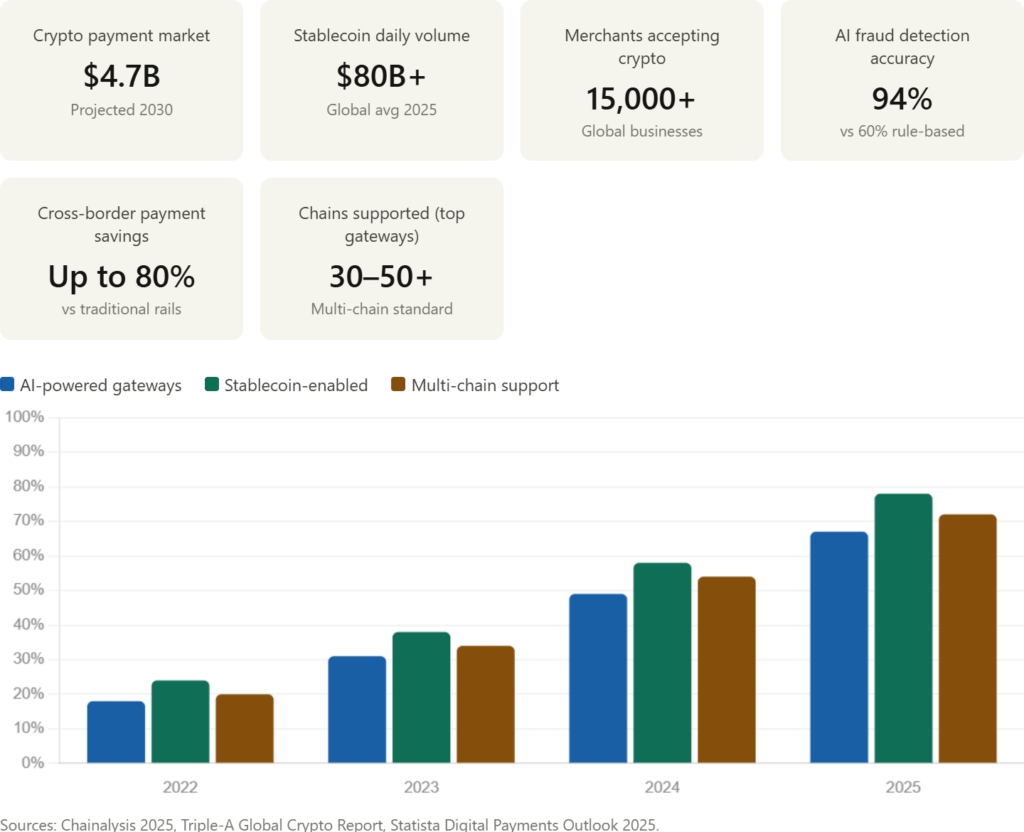
The chart above shows how quickly things have moved. In 2022 less than a quarter of gateways supported stablecoins properly. By 2025 that number is approaching 80%. AI and multi-chain support have followed similar curves. This is not a gradual shift — it is a fast one.
Why the Old Model Stopped Working?
To understand where payment gateways are going it helps to understand clearly why the original approach hit a wall.
The first generation of crypto gateways was basically a conversion tool. A customer pays in Bitcoin, the gateway converts it to dollars, the merchant receives dollars. Simple enough. But that model had problems that only got more obvious as the market grew.
Volatility was the biggest one for merchants. If a customer pays the equivalent of $100 in Bitcoin and the price drops 5% before the merchant settles, the merchant loses money on that transaction. Most merchants do not want to take on that kind of price risk just to accept crypto payments. The solution instant conversion added fees and friction that eroded the cost advantage crypto was supposed to provide.
The single-chain problem was the second major barrier. A gateway that only accepts Ethereum excludes users on Solana, Polygon, BNB Chain, and a dozen other networks where people actually hold their funds. Every unsupported chain is a customer who cannot complete the transaction.
And the user experience, honestly, was not built for mainstream adoption. Wallet addresses, confirmation times, gas fees that changed between when the user initiated and when they confirmed these are things crypto-native users have learned to manage. They are things that cause regular users to abandon the checkout.
The three technologies reshaping this space each address one of these problems directly.
Stablecoins Solving the Volatility Problem for Good
Stablecoins are the piece that makes crypto payments practical for mainstream merchant adoption. The price stability problem disappears when the payment currency is pegged to a fiat value. A merchant accepting USDC receives $100 worth of USDC and that is exactly what it is worth when they settle. No conversion risk. No surprise losses.
The numbers behind stablecoin adoption reflect this. Daily stablecoin transaction volume now exceeds $80 billion globally. USDC and USDT together represent a significant portion of on-chain payment activity. This is not speculative trading volume a growing share of it is genuine commercial use.
For payment gateways specifically, stablecoin support changes the merchant conversation completely. Instead of asking a business to accept an asset that moves 5% on a slow day, you are offering them a faster, cheaper version of the dollar payment they already understand. That is a much easier sell.
USDC settlement has become the standard for serious payment gateway deployments. Merchants in markets with banking friction parts of Latin America, Southeast Asia, Africa are finding stablecoin settlement genuinely more reliable than traditional fiat infrastructure. Faster settlement, lower fees, and access that does not depend on having a strong banking relationship.
Stablecoin yield integration is the next layer. Gateways that let merchants earn yield on idle stablecoin balances rather than just holding them are turning a payment tool into something closer to a treasury management tool. That is a different value proposition entirely and one that larger merchants find genuinely interesting.
The regulatory environment around stablecoins is also clarifying faster than most people expected. Federal stablecoin legislation in the US, MiCA in Europe these frameworks are giving businesses clearer ground rules for building on stablecoin infrastructure, which accelerates adoption.
Multi-Chain Infrastructure Meeting Users Where They Are
The multi-chain reality of crypto in 2025 is not going away. Users hold assets across Ethereum, Solana, Polygon, BNB Chain, Avalanche, Base, Arbitrum, and other networks. A payment gateway that only accepts one or two of these is leaving a significant portion of potential customers unable to pay.
But multi-chain support is not just about adding more accepted currencies to a list. It is about building infrastructure that handles the complexity of multiple blockchain networks different confirmation times, different fee structures, different transaction finality guarantees while presenting the user with a simple and consistent payment experience.
Cross-chain routing is where this gets technically interesting. A user on Solana who wants to pay a merchant that settles in USDC on Ethereum should not have to manually bridge assets. A well-built multi-chain gateway handles that routing automatically finding the best path, estimating fees accurately, and completing the transaction without the user needing to understand what happened underneath.
Layer 2 integration has changed the economics of multi-chain payments significantly. Transaction fees on Ethereum mainnet that made small payments impractical become very manageable on Arbitrum, Optimism, or Base. Payment gateways that route appropriately to Layer 2 networks give merchants better fee economics and users faster confirmations.
Unified settlement across chains is the merchant-facing benefit that makes multi-chain support practically useful. Merchants do not want to manage multiple wallets on multiple chains. They want to accept payments from wherever their customers are and settle in a single currency to a single address. Building this cleanly requires solid architecture it is not a feature you can add to a basic gateway as an afterthought.
AI Making Gateways Smarter at Every Layer
AI is the technology that ties the other two together and makes the whole system significantly more capable. It affects three distinct areas inside a payment gateway fraud detection, compliance automation, and transaction optimization.
Fraud detection is where the improvement over older systems is most dramatic. Rule-based fraud systems work on fixed thresholds and patterns. They catch the attacks they were designed for and miss the ones they were not. Sophisticated fraud adapts quickly to known rules the attackers run the same system in reverse to understand what triggers a flag and design around it.
ML-based fraud detection does not have fixed rules to reverse-engineer. It builds a model of normal payment behaviour for each merchant and each user segment, then flags anything that deviates significantly from that baseline. The accuracy difference is real AI systems consistently outperform rule-based alternatives in production environments, with fewer false positives creating less friction for legitimate customers.
Compliance automation is an area where AI saves significant operational cost. KYC verification document checking, liveness detection, identity matching can now happen in seconds rather than hours. Transaction monitoring that learns from actual payment patterns in your user base generates far fewer false alerts than generic rule sets. Sanctions screening that runs in real time on every transaction rather than in batch processes is only practical with AI assistance.
Smart transaction routing uses AI to optimise the path each payment takes through the system choosing the right blockchain network based on current fees and confirmation times, selecting the best liquidity source for currency conversion, and timing settlements to reduce cost. These optimisations add up to meaningful fee savings at scale that benefit both merchants and end users.
Dynamic fee estimation is a specific AI application that directly affects user experience. Gas fees on blockchain networks fluctuate significantly. A payment gateway that quotes an inaccurate fee and then presents a different number at confirmation creates exactly the kind of friction that causes users to abandon. AI systems that model fee behaviour accurately and quote with appropriate confidence ranges solve a real UX problem.
What This Means for Businesses Building Payment Infrastructure?
The technology combination described above AI, stablecoins, multi-chain is not just improving existing gateway products. It is enabling use cases that were not viable before.
Cross-border B2B payments are one. A business paying suppliers in five different countries, each with different banking infrastructure and currency requirements, can now route everything through stablecoin rails with AI-optimised settlement. The cost and time savings compared to traditional wire transfers are significant.
Subscription billing in crypto becomes practical when stablecoins remove the volatility problem. Recurring payments in USDC with automated billing logic handled by smart contracts is a clean solution for subscription businesses that want to serve crypto users without building a separate billing system.
Marketplace payouts to sellers or creators across different countries and different blockchain preferences become manageable with multi-chain infrastructure. Pay out to wherever each recipient wants to receive the gateway handles the routing.
Embedded payments in Web3 applications benefit from all three technologies simultaneously. An AI-powered gateway that accepts any stablecoin across any supported chain, with fraud detection that does not add friction for legitimate users, is the infrastructure that makes in-app crypto payments as smooth as card payments in traditional apps.
The Infrastructure Decision Behind All of This
The businesses that build payment infrastructure on top of these three technologies well will look back at 2025 and 2026 as the window where the right architectural decisions made a significant long-term difference.
Getting the architecture right means making specific decisions about how AI integrates into the transaction flow, how multi-chain routing handles edge cases, how stablecoin settlement connects to accounting and compliance systems. These are not easy decisions, and they are much easier to make correctly at the start than to retrofit into a system built on simpler assumptions.
Build Your Payment Gateway With Dappfort
Dappfort builds crypto payment gateway development that brings AI, stablecoin support, and multi-chain capability together in production systems — not as separate features bolted onto a basic gateway, but as a coherent architecture designed to work together.
The team has built across DeFi infrastructure, exchange systems, and payment rails — which means understanding both the technical depth these systems require and the business context they operate in.
If you are building a crypto payment gateway or evaluating what your current infrastructure needs to support the next generation of payment use cases, that conversation is worth having now.
Ready to Build the Next Generation of Crypto Payment Infrastructure?
Dappfort helps you architect AI-powered, stablecoin-first, multi-chain payment gateways — built for production, not prototypes. Let’s design the right infrastructure for your business before the window closes.