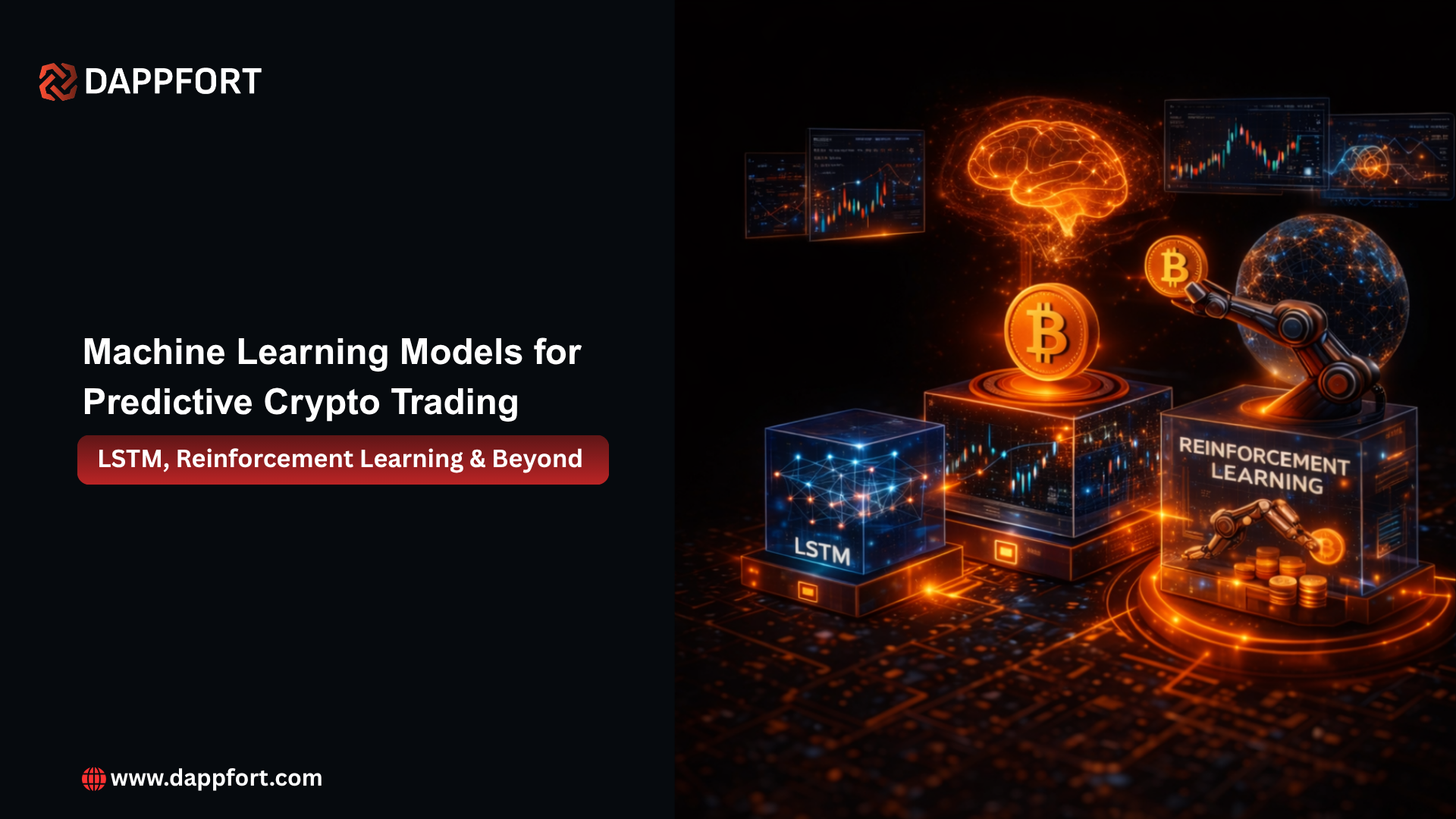
Artificial intelligence is reshaping the global cryptocurrency market, and no area is evolving faster than AI-powered quantitative trading. As digital assets become more volatile and data-heavy, traders are adopting advanced AI systems that detect patterns, predict price action, and execute trades in milliseconds.
This new era belongs to traders and companies who leverage advanced machine learning, statistical modeling, and real-time data automation—and businesses like Dappfort that build these high-performance AI trading engines.
Whether you’re a beginner exploring crypto automation or an enterprise looking to deploy your own AI quant trading bot, this guide breaks down everything you need to know— from how AI quant trading works to how you can build a powerful, customizable bot for your trading needs.
If you’re exploring automation for your trading strategies or looking to build your own AI-driven trading bot, this is your roadmap.
What Is AI Quantitative Trading?
AI quantitative trading blends artificial intelligence, predictive algorithms, and data-driven decision-making to automate trades with zero emotional bias. Unlike traditional trading, which relies on manual analysis, AI quantitative trading uses:
- Machine learning models
- Big data analytics
- Statistical pattern recognition
- High-frequency execution engines
These systems detect hidden trends, forecast movements, and execute trades in milliseconds—far faster than any human trader can respond.
For highly volatile cryptocurrencies, this precision is invaluable. AI systems process market sentiment, social signals, order books, and historical patterns simultaneously, allowing traders to capitalize on opportunities at lightning speed.
Why AI Quantitative Trading Is Dominating Crypto Markets?
Crypto markets never sleep. Prices shift in seconds. Retail traders face emotional stress. AI changes all of this.
1. Lightning-Fast Execution
AI bots react within milliseconds—critical for volatile markets where price windows close instantly.
2. Unmatched Accuracy
Every decision follows predefined strategies and statistical validation, eliminating human error.
3. Unlimited Scalability
AI can monitor hundreds of pairs across multiple exchanges—a capability impossible for manual traders.
4. Emotion-Free Trading
No fear. No greed. No panic selling. Just data. Logic. And mathematical discipline.
Together, these capabilities create a consistent, high-performance trading layer ideal for both retail users and institutions.
Core Features of AI Quantitative Trading Systems
AI-based trading models usually include:
- Algorithmic rule engines
- High-frequency execution modules
- Predictive analytics
- Sentiment analysis models
- Automated risk management
- Real-time market data monitoring
These features help traders outperform traditional manual methods.
How AI Quantitative Trading Works in Cryptocurrency
AI trading systems rely on:
1. Machine Learning Models
Trained on historical market data to predict price patterns and anomalies.
2. Real-Time Market Data Processing
AI continuously scans order books, sentiment feeds, and price movements.
3. Automated Execution
Trades are executed automatically when predefined criteria are met.
4. Continuous Optimization
The system learns from past decisions to refine future strategies.
Key Benefits of Using AI for Crypto Trading
1. Speed
AI executes trades far faster than humans—critical for high-volatility assets.
2. Precision
Algorithms ensure every trade aligns with strategy, timing, and risk controls.
3. Scalability
Monitor 50+ pairs across multiple exchanges simultaneously.
4. Consistency
AI never gets tired, emotional, or distracted.
Developing an AI Quantitative Trading Bot: Step-by-Step
Building a reliable AI trading system requires strategic planning and advanced technical execution. Here is the complete workflow:
1. Define Your Trading Objective
Before any coding begins, clarify your goals:
- Which crypto pairs should the bot trade?
- Should it follow arbitrage, market making, trend prediction, or sentiment analysis?
- What’s your risk tolerance?
- Do you need HFT, cross-exchange arbitrage, or long-term predictive modeling?
A clear roadmap ensures the bot is engineered for measurable performance.
2. Select a Qualified AI Trading Bot Development Partner
Not every software house understands AI quantitative trading. You need:
- Expertise in algorithmic trading & ML
- Ability to tailor strategies
- Long-term technical support
This is where companies like Dappfort crypto bot development company stand out—offering end-to-end custom development using the latest AI frameworks and quant methodologies.
3. Build the Technical Architecture
This stage includes:
- Choosing programming languages (Python, C++, Java)
- Setting up market data pipelines
- Creating algorithm modules
- Designing risk management rules
- Establishing secure API connections
The architecture must support real-time trading without delays or downtime.
4. Integrate Machine Learning & AI Models
AI models can include:
- Price prediction tools
- Sentiment classifiers
- Reinforcement learning agents
- Statistical arbitrage engines
These models help the bot adapt and evolve with changing market conditions.
5. Backtesting & Simulation
Before deployment, every strategy undergoes:
- Historical backtesting
- Live paper trading
- Market volatility simulation
- Stress testing under extreme scenarios
This ensures optimal performance before going live.
6. Deploy the Trading Bot into Live Markets
Deployment includes:
- Connecting to exchanges via secure APIs
- Activating execution modules
- Monitoring dashboards for P/L, win rate, and trade frequency
- Automated fallback mechanisms
- Error-handling & stop mechanisms
This is where the bot transitions from theory to real-world trading.
7. Ongoing Optimization & Updates
AI models require continuous improvement:
- Retrain models with fresh data
- Add new trading pairs
- Improve execution speed
- Adjust strategies based on market cycles
- Scale infrastructure as volume grows
Regular updates ensure long-term profitability.
How to Start Trading Crypto Using AI
If you’re ready to begin using AI in your crypto trading journey:
- Choose a platform that supports AI automation
- Build or purchase a custom AI trading bot
- Train it using historical data
- Backtest strategies
- Launch in a controlled live environment
- Monitor performance and refine
This structured approach increases your chances of generating consistent returns.
Top AI Trading Bots in the Market Today
To understand the industry benchmark, here are popular AI trading tools:
Pionex
Grid trading + arbitrage automation.
Cryptohopper
Advanced customizable strategies.
3Commas
Portfolio balancing + smart trading features.
Bitsgap
Simple interface + arbitrage tools.
These platforms showcase what modern AI trading ecosystems can offer.
AI Quantitative Trading Apps: The Mobile Revolution
AI-powered mobile apps allow traders to automate, track, and adjust strategies from anywhere.
Popular choices:
- eToro
- Coinrule
- TradeSanta
The rise of AI trading apps highlights a major trend: trading on the go with real-time optimization.
The Role of AI Development Services in Crypto Trading
Professional AI development ensures trading bots are:
- Secure
- Scalable
- High-performing
- Strategy-driven
- Future-ready
Key services include:
- Custom crypto bot development
- AI integration
- Risk management system development
- Dashboard creation
- Model optimization and upgrades
These services help traders launch dependable AI trading systems tailored to their needs.
Future Trends in AI Quantitative Trading
Expect rapid growth in:
- LLM-powered sentiment prediction
- Autonomous trading ecosystems
- Deep-learning price forecasting
- AI-enhanced arbitrage models
- Real-time volatility mapping
- Cross-exchange liquidity engines
Staying ahead of these trends offers a competitive edge.
Challenges & Opportunities
While AI trading offers exceptional potential, challenges remain:
- Security risks
- Model inaccuracies
- Exchange API limits
- Regulatory compliance
Each challenge creates room for innovation—especially for traders and companies developing next-gen trading bots.
Ready to Build Your Own AI Quantitative Trading Bot?
If you’re planning to automate your trading strategy or launch a full-scale crypto trading platform, now is the right time to leverage AI.
You can develop a bot that includes:
- Predictive analytics
- Arbitrage engines
- High-frequency modules
- Multi-exchange integrations
- Custom strategy automation
- Real-time monitoring dashboards
A properly built AI trading system can transform your performance and scalability.
🔚 Wrapping Up
AI is changing the future of cryptocurrency trading, so it’s important for traders and developers to adopt these new technologies. By adding AI to quantitative trading bots, businesses can improve their trading strategies, boost performance, and get better results in a competitive market.
If If you want to create a top-notch quantitative crypto trading bot, our crypto trading bot development company is ready to help. Together, we can build a strong trading solution that fits your needs and helps you succeed in the ever-changing world of cryptocurrency trading.
FAQs to know before developing AI Quantum Crypto Trading Bot:
Q. What does AI-driven quantitative trading mean in crypto?
AI-driven quantitative trading in the crypto space simply means letting a machine handle the heavy analysis. Instead of manually scanning charts, AI models evaluate massive streams of price movements, order books, news sentiment, and historical patterns. Based on that data, the system identifies trade setups and executes them automatically, aiming to reduce human error and boost precision.
Q. How exactly do AI crypto trading bots operate?
These bots act like automated assistants plugged into the market 24/7. They continuously read market signals, compare them with predefined trading rules, and react instantly when conditions match. By combining algorithms with machine learning, the bot can refine decisions over time and handle trades far faster than any human trader could.
Q. Can AI-based trading bots actually generate steady profits?
They can, but there’s no guarantee. A bot’s consistency depends on how well its strategy is built and how unpredictable the market becomes. While AI helps with speed and analysis, it doesn’t eliminate risk. Volatile conditions, poor strategy logic, or unexpected market news can disrupt performance — so users should treat bots as tools, not magic money machines.
Q. Which AI crypto trading bots are considered reliable today?
A number of platforms have earned solid reputations for offering smarter automation, flexible strategies, and beginner-friendly dashboards. Traders generally look for bots with proven backtesting, transparent performance data, customizable algorithms, and robust risk controls. The “best” choice really depends on the user’s trading style and experience level.
Q. How do I get started using AI for crypto trading?
Most people begin by connecting an AI trading bot to their exchange account through secure API keys. Once connected, the bot can monitor the market, interpret trends, and automate trades based on the chosen strategy. Many traders experiment with paper trading first to understand how the bot behaves before committing real funds.
Q. What advantages does AI bring to crypto trading?
AI helps traders handle more information than they ever could manually. It removes emotional decision-making, processes real-time data faster, catches opportunities instantly, and executes complex strategies with precision. For users, this often translates into more disciplined trading and improved efficiency.
Q. What risks should I be aware of when using AI crypto trading bots?
AI tools aren’t foolproof. Bugs, poor strategy design, unpredictable volatility, and over-reliance on old data can all lead to losses. If a bot misreads the market or its algorithm isn’t updated to match current conditions, the outcome can be costly. It’s important to monitor performance, keep risk limits in place, and avoid assuming the bot will always make the right call.